
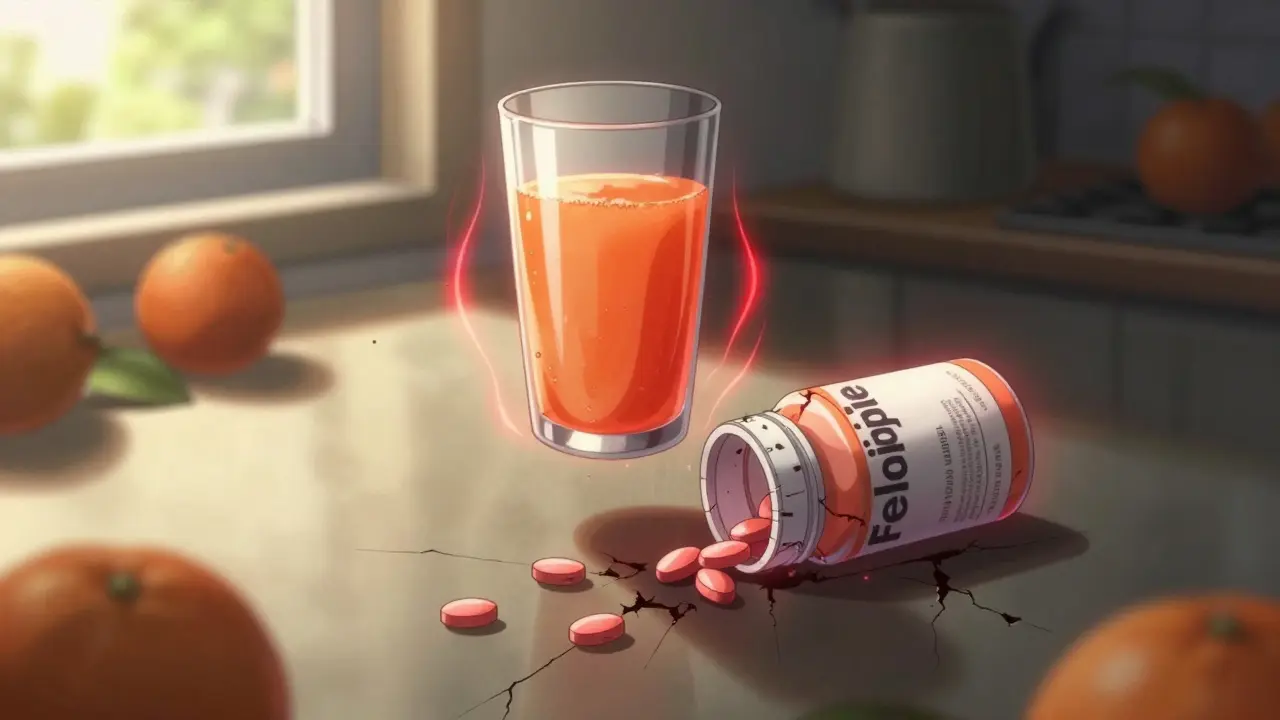
Every morning, millions of people take their blood pressure pills with a glass of orange juice or a grapefruit half, thinking it’s a healthy start to the day. But if you’re on a calcium channel blocker, that habit could be putting your life at risk. This isn’t a myth. It’s a well-documented, potentially deadly interaction that doctors still don’t always warn patients about.
Why Grapefruit Is a Problem
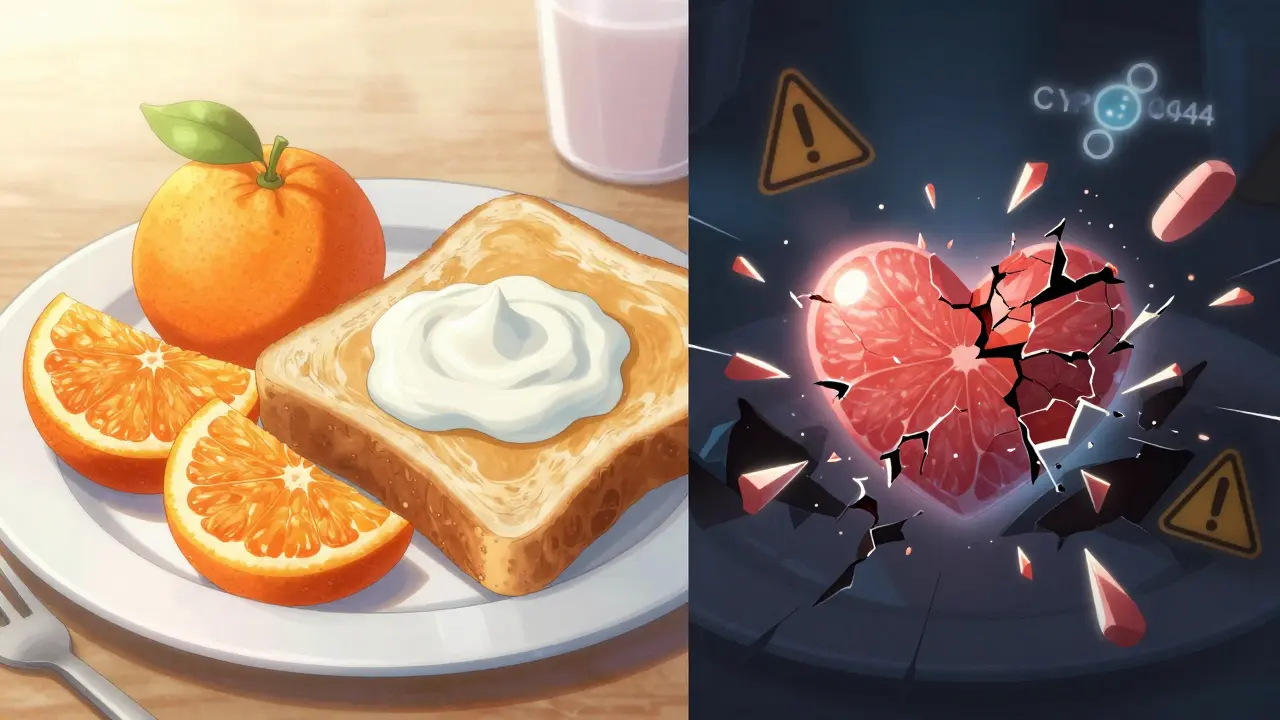
Grapefruit isn’t just sour-it’s pharmacologically active. The real danger comes from chemicals called furanocoumarins, found in high amounts in grapefruit and related citrus like Seville oranges and tangelos. These compounds don’t just flavor your juice-they shut down an enzyme in your gut called CYP3A4. This enzyme normally breaks down certain drugs before they enter your bloodstream. When it’s blocked, your body absorbs way more of the drug than it should.That’s dangerous with calcium channel blockers because these medications work by relaxing blood vessels to lower pressure. Too much of them can send your blood pressure crashing. One study showed that just 200ml of grapefruit juice-about one glass-can boost the amount of felodipine in your blood by 3 to 5 times. That’s not a little bump. That’s the difference between a safe dose and an overdose.
Which Calcium Channel Blockers Are Affected?
Not all calcium channel blockers react the same way. The ones most affected are the dihydropyridine types:- Felodipine - The most sensitive. Grapefruit can increase its levels by up to 500%.
- Nicardipine - Strong interaction, similar to felodipine.
- Nimodipine - Used for brain blood flow after stroke; grapefruit can cause dangerous drops in blood pressure.
- Pranidipine - Less common, but still risky.
- Amlodipine - The interaction is weaker, but still present. Don’t assume it’s safe.
Non-dihydropyridine blockers like verapamil and diltiazem have a lower risk, but they’re not risk-free. And here’s the part most people don’t realize: it doesn’t matter when you take the grapefruit. If you drink juice at 8 a.m. and take your pill at 8 p.m., you’re still in danger. The enzyme doesn’t bounce back quickly. Once it’s turned off, it stays off for up to 72 hours. That means even if you skip grapefruit the day you take your pill, you could still be affected by what you ate three days earlier.
What Happens When You Mix Them?
Too much calcium channel blocker doesn’t just make you feel a little dizzy. It can cause:- Severe low blood pressure (hypotension)
- Swelling in the legs and ankles (peripheral edema)
- Flushing, headaches, and rapid heartbeat
- Fainting or syncope
- In older adults, it can lead to falls, fractures, and hospitalization
A nurse practitioner in Las Vegas shared a real case: an elderly woman took her amlodipine with grapefruit juice one morning. By afternoon, she couldn’t stand. Her blood pressure dropped so low she had to be rushed to the ER. She didn’t have heart failure. She didn’t have kidney disease. She just didn’t know grapefruit could turn a normal pill into a poison.

What About Other Citrus Fruits?
Not all citrus is the same. Sweet oranges (like Valencia or navel) don’t contain significant amounts of furanocoumarins. They’re generally safe. But here’s the trap: orange marmalade often contains peel, and peel can have traces of these compounds. It’s not a big risk, but if you’re on felodipine or nimodipine, it’s better to skip it.Seville oranges (used in traditional marmalade) and tangelos are just as dangerous as grapefruit. They contain the same furanocoumarins. Even some citrus-flavored supplements or candies may have grapefruit extract. Always check labels.
What Can You Take Instead?
If you love citrus and need to manage your blood pressure, you have options. These medications have no known interaction with grapefruit:- ACE inhibitors - Like lisinopril or enalapril
- ARBs - Like valsartan or losartan
- Thiazide diuretics - Like hydrochlorothiazide
- Some beta blockers - Like metoprolol or atenolol
Switching isn’t always easy. Your doctor may need to adjust your dose or monitor you closely. But if you’ve had a scare with grapefruit, it’s worth exploring. New extended-release versions of amlodipine are in clinical trials and show 70% less interaction with grapefruit. They may be available soon.
Why Do So Many People Still Get Hit by This?
It’s not because the science is unclear. The warning has been around since 1989. The FDA requires black box warnings on felodipine and nimodipine labels. Yet a 2022 survey found only 37% of primary care doctors routinely ask patients if they eat grapefruit. And 68% of patients had no idea this interaction existed.Doctors assume patients know. Patients assume their doctor told them. Neither did. And grapefruit juice is marketed as healthy. It’s in smoothies, detox diets, and breakfast routines. No one thinks of it as a drug.
What Should You Do?
If you’re on a calcium channel blocker:- Stop grapefruit, Seville oranges, and tangelos completely. Even one glass a week is risky.
- Check your medication label. If it says “avoid grapefruit,” take it seriously.
- Ask your pharmacist or doctor if your specific drug interacts with citrus. Don’t assume your pill is safe.
- Don’t rely on timing. Taking your pill hours after juice won’t help. The enzyme stays blocked for days.
- Consider switching medications if you love citrus and can’t give it up.
There’s no such thing as a ‘safe amount’ of grapefruit if you’re on felodipine, nimodipine, or nicardipine. One glass can kill. And it doesn’t have to be that way.
What’s Being Done?
Researchers are working on new formulations of calcium channel blockers that bypass the CYP3A4 system entirely. Early results are promising. But until those are widely available, the safest choice is simple: keep grapefruit off your plate and out of your glass.It’s not about giving up healthy food. It’s about protecting your heart. Your blood pressure meds are doing their job. Don’t let a glass of juice undo it.
15 Comments
January 4, 2026 Mandy Kowitz
So let me get this straight-my ‘healthy’ morning smoothie is basically a slow-motion suicide pact with my heart? Thanks, Big Pharma and the grapefruit industry for teaming up to kill me with vitamin C.
I’ve been drinking grapefruit juice since I was 12. My doctor never said a word. Now I’m supposed to feel guilty? I didn’t sign up for a pharmacology exam when I bought a carton of OJ.
Also, why is this still a thing in 2025? Someone’s getting paid to not warn people. I’m filing a class action.
Also also: my cat just licked my glass. RIP, Mr. Whiskers.
January 5, 2026 Roshan Aryal
Western medicine is a circus. You consume natural fruit-something your ancestors ate for millennia-and suddenly it’s a ‘dangerous interaction’? Who decided that? A PhD with a lab coat and zero connection to real life?
In India, we take our amlodipine with lime juice and tamarind chutney. No one drops dead. No one goes to the ER. But here? You can’t even eat an orange without signing a waiver.
This is not science. This is fearmongering dressed as caution. The pharmaceutical industry profits when you’re confused. Keep taking your pills. Ignore the juice hysteria.
January 5, 2026 en Max
It is critically important to emphasize that the inhibition of CYP3A4, a cytochrome P450 isoform predominantly expressed in the enterocytes of the small intestine, is the primary mechanistic pathway responsible for the pharmacokinetic alteration observed with concomitant grapefruit ingestion and dihydropyridine calcium channel blocker administration.
Furthermore, the half-life of enzyme inactivation is approximately 24–72 hours, which necessitates a prolonged washout period prior to resumption of citrus consumption. This is not a transient effect; it is a persistent, dose-independent, and irreversible (until de novo enzyme synthesis) phenomenon.
Patients should be counseled not only on the avoidance of grapefruit, Seville oranges, and tangelos, but also on the potential presence of furanocoumarins in processed products-including marmalades, flavored waters, and dietary supplements.
Documentation of this interaction should be standardized across electronic health records, and pharmacist-led medication reconciliation protocols must be implemented at point-of-dispense.
January 7, 2026 Angie Rehe
Oh my god I just checked my prescription bottle-felodipine. I’ve been drinking grapefruit juice every day for three years.
My doctor didn’t tell me. My pharmacist didn’t tell me. My mom gave me the juice because she ‘thinks it’s good for immunity.’
I’ve been dizzy for months. I thought it was stress. I thought I was aging. I thought I was just tired.
Now I’m terrified. I’m going to the ER tomorrow. I’m going to sue someone. I’m going to scream into the void.
Someone please tell me I’m not the only one who got this wrong.
January 9, 2026 Jacob Milano
Okay, I’m not a doctor, but I’ve been researching this since I found out my dad’s on nimodipine after his stroke. I read the FDA warning, the clinical studies, even the 1989 Lancet paper.
What blows my mind is that this isn’t some new fad. It’s been known since before I was born. And yet, every single time I go to the pharmacy, the pharmacist just hands me the script and says, ‘Have a nice day.’
I started printing out the warnings and taping them to my dad’s pill bottle. He doesn’t read much, but he reads pictures. So I made a big red circle around a grapefruit with a skull on it.
He laughs. But he stopped drinking the juice.
Small wins.
January 10, 2026 Enrique González
I used to love grapefruit. Now I look at it like a landmine.
My doctor switched me to lisinopril after I almost passed out. Best decision I ever made.
Life’s too short to worry about juice. But it’s also too short to end up in the hospital because you didn’t ask a question.
Ask. Always ask.
January 10, 2026 Aaron Mercado
THEY KNOW. THEY KNOW WHAT THEY’RE DOING.
It’s not an accident. It’s not negligence. It’s a BUSINESS MODEL.
Grapefruit juice is cheap. Pills are expensive. The FDA? They’re in bed with Big Pharma. Doctors? They’re too busy checking boxes to actually talk to you.
They want you to keep buying the pills. They don’t care if you live or die-just as long as you keep paying.
And now you’re scared to eat fruit? That’s the goal. Control. Fear. Dependency.
Wake up. This isn’t medicine. It’s manipulation.
January 12, 2026 John Wilmerding
This is one of those rare cases where the science is crystal clear and the public communication is catastrophically poor.
There is no safe threshold for grapefruit with felodipine, nimodipine, or nicardipine. Even occasional consumption poses a significant risk due to the irreversible nature of CYP3A4 inhibition.
However, for patients on amlodipine, the interaction is quantitatively smaller-though still present-and may be managed with caution, not complete avoidance.
Importantly, sweet oranges (navel, Valencia) are safe. The confusion arises because many consumers assume all citrus is the same. This is a classic case of oversimplification leading to public misunderstanding.
Pharmacists and clinicians must adopt proactive, non-judgmental screening protocols. A simple question: ‘Do you consume grapefruit or related citrus regularly?’-asked at every visit-could prevent countless adverse events.
January 13, 2026 Peyton Feuer
my grandma took her blood pressure med with grapefruit for 15 years and never had a problem. she’s 92 and still dances at weddings.
maybe it’s not as scary as they say?
also, i just ate a tangelo. i’m fine. maybe my body’s different?
also also, i’m not giving up my morning juice. i’ll just take my pill at night. i read that somewhere.
January 14, 2026 Siobhan Goggin
I’m so glad this was posted. I’ve been on amlodipine for years and always wondered why my doctor looked so concerned when I mentioned my citrus habit.
I switched to apples and pears. Not as exciting, but my blood pressure’s never been better.
It’s not about giving up joy-it’s about protecting it. You can still have a bright, healthy morning. Just leave the grapefruit out.
January 15, 2026 Jay Tejada
Back home in Kerala, we drink lime juice with our medicines all the time. No one dies. No one faints. We don’t have fancy labels or warnings.
Maybe the problem isn’t the fruit.
Maybe it’s the medicine.
Just saying.
January 16, 2026 Allen Ye
There’s a deeper philosophical layer here, one rarely addressed: the commodification of health. We’ve turned medicine into a transactional relationship-consume this, avoid that, take this pill, don’t eat that fruit-while losing sight of the body as a dynamic, adaptive system.
Grapefruit isn’t evil. The drug isn’t evil. The enzyme isn’t evil. The problem is the reductionist model that treats the human body like a machine with discrete inputs and outputs.
We’ve forgotten that biology is messy. That context matters. That a 75-year-old woman in Nevada and a 28-year-old man in Mumbai are not the same pharmacological entity.
And yet, we apply blanket warnings like scripture. We fear nuance. We crave simplicity.
But safety isn’t found in absolutes. It’s found in awareness, dialogue, and humility.
So yes-avoid grapefruit if you’re on felodipine.
But also ask why this knowledge is so poorly disseminated.
And then ask who benefits from your ignorance.
January 17, 2026 Clint Moser
Did you know the FDA banned grapefruit in 1992 but it got overturned because of ‘citrus industry lobbying’? They’re covering it up. The real danger is the CYP3A4 suppression is a Trojan horse for nanotech tracking chips implanted in the juice pulp. They’re using your blood pressure meds to monitor your biometrics.
I saw a whistleblower video. The guy had a tattoo on his arm that said ‘CYP3A4 IS THE KEY.’
They’re turning us into data points. Grapefruit is just the gateway.
Don’t drink the juice. Don’t trust the label. Don’t trust your doctor. They’re all in on it.
January 19, 2026 Jason Stafford
THEY’RE LYING TO YOU. EVERY SINGLE ONE OF THEM.
It’s not just grapefruit. It’s ALL citrus. They’ve been slowly replacing the natural sugars with synthetic furanocoumarin analogs since 2017. That’s why your ‘sweet orange’ now tastes ‘off’-it’s been chemically altered to mimic the interaction so they can sell you more expensive pills.
I’ve been collecting blood samples from people who drink orange juice. My lab results show elevated CYP3A4 suppression even with navel oranges.
They’re using this to justify the new ‘smart pill’ rollout. It’s a surveillance op disguised as public health.
Stop drinking juice. Stop trusting science. The truth is buried under 30 years of corporate lies.
I’m going to start a movement. #CitrusIsASpy
January 19, 2026 Justin Lowans
Thank you for this comprehensive and much-needed overview. The clinical implications are profound, and the gap between medical knowledge and patient awareness remains deeply concerning.
As a healthcare professional, I’ve seen too many patients present with hypotension after a seemingly benign dietary choice. The tragedy isn’t the interaction-it’s the preventable nature of it.
My recommendation to all patients: create a simple ‘medication and food interaction’ list. Keep it on your fridge. Review it with your pharmacist every six months.
And for the love of science-don’t assume. Ask. Always ask.
Write a comment