
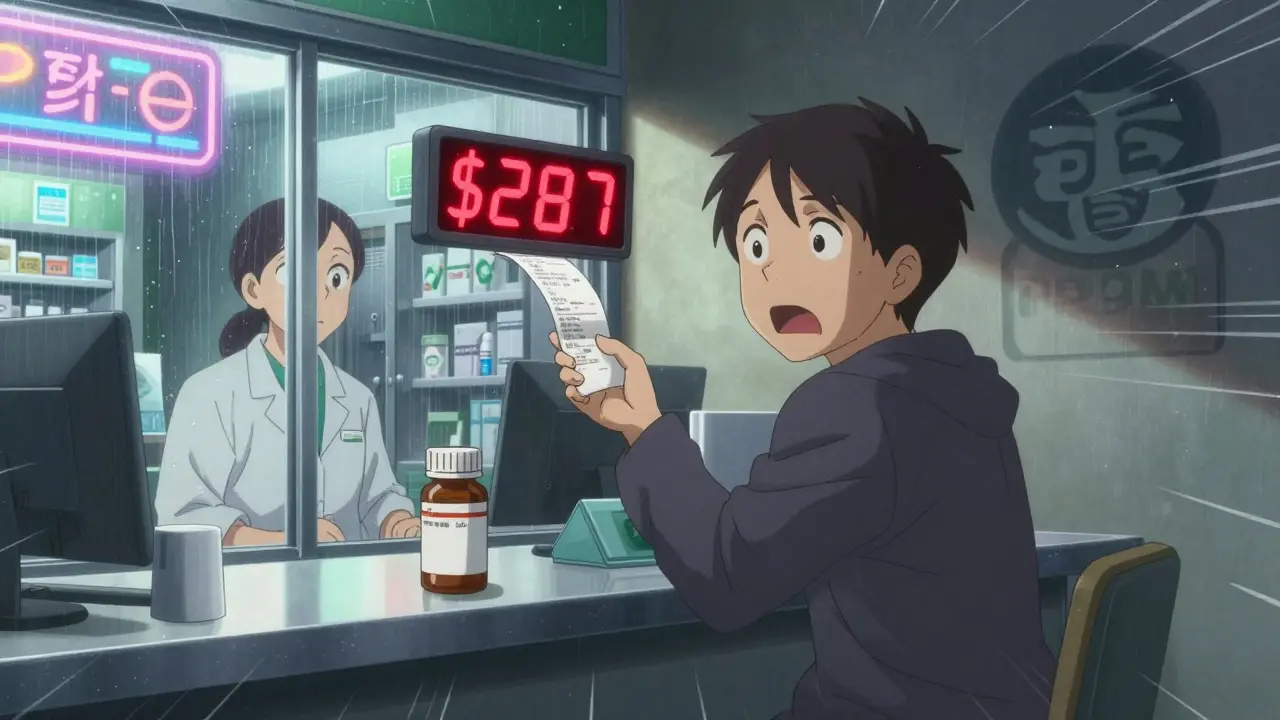
You fill your prescription at the pharmacy, swipe your card, and the screen flashes: $287. You expected $45. You didn’t know the pharmacy wasn’t in your network. You didn’t get a warning. And the No Surprises Act? It doesn’t cover this.
That’s not a glitch. It’s the system.
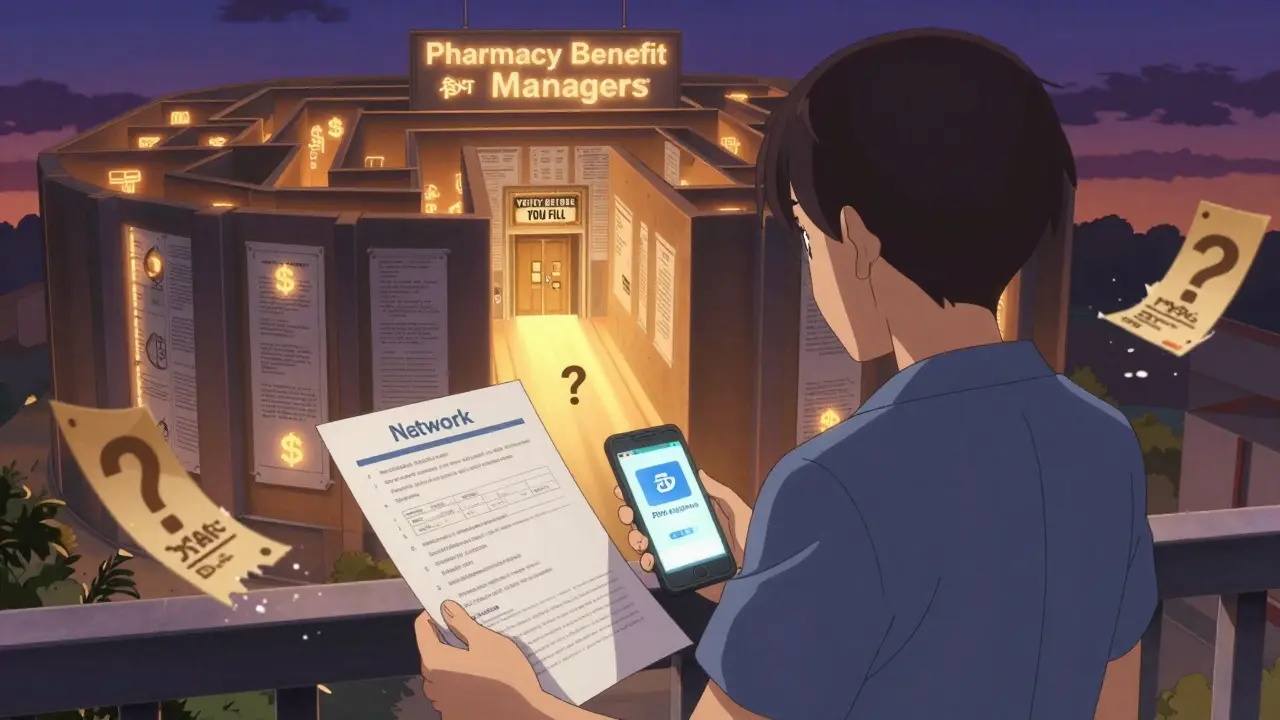
Since January 2022, the No Surprises Act has blocked surprise medical bills for emergency care, air ambulances, and out-of-network doctors at in-network hospitals. But it says nothing about your pills. Prescription drugs operate under a completely separate system-managed by Pharmacy Benefit Managers (PBMs) like CVS Caremark, Express Scripts, and OptumRx. These companies control which pharmacies you can use, what you pay, and whether your drug even gets covered. And they don’t have to tell you in advance if the pharmacy you’re using is out-of-network.
That’s why 28% of commercially insured adults in the U.S. paid unexpected drug costs in 2022. And 22% of those bills were over $500. You’re not alone. People on Reddit, Trustpilot, and patient advocacy forums are posting the same story: they thought they were covered. They weren’t.
Why Your Insurance Doesn’t Protect You at the Pharmacy
Your medical insurance and your pharmacy coverage aren’t the same thing. Even if your doctor, hospital, and lab are all in-network, your pharmacy might not be. That’s because PBMs build their own networks-separate from your health plan’s medical network. They strike deals with certain pharmacies to get lower prices. If you go outside that list, you pay retail.
For example: your plan covers lisinopril. At an in-network pharmacy, your copay is $10. At an out-of-network one, the same pill costs $120. The PBM didn’t negotiate a price with that store. So you’re stuck with the full charge. And there’s no law forcing them to tell you ahead of time.
This isn’t a mistake. It’s how the system is built. The No Surprises Act was written to stop balance billing from doctors and hospitals. PBMs and pharmacies were left out. In March 2023, federal agencies confirmed it: “Nothing in the No Surprises Act addresses pharmacy benefits.”
Where the Big Costs Hide
It’s not just your regular blood pressure or cholesterol meds. The real danger comes with specialty drugs-things like insulin, rheumatoid arthritis treatments, cancer therapies, and rare disease medications.
Over 78% of Medicare Part D plans and 65% of commercial plans restrict these drugs to specific specialty pharmacies. If you go to your local CVS or Walgreens, you might get denied. Or worse-you get charged full price because the pharmacy doesn’t have the contract.
One patient in Ohio paid $1,800 for her multiple sclerosis drug because she used her usual pharmacy. Her plan required a specialty pharmacy. She didn’t know. The drug was covered-but only if she used the right one. She had to pay out of pocket, then file for reimbursement. Took six months.
Specialty drugs are expensive. And they’re growing fast. Global spending on them will hit $375 billion by 2028. That means more people will face this problem. More bills. More confusion.
How to Check Your Pharmacy Network-Before You Fill the Script
You can’t rely on your insurance card. You can’t trust the pharmacy’s website. You can’t assume your usual store is covered.
Here’s what actually works:
- Log into your health plan’s website or app. Look for “Pharmacy Network Directory” or “Find a Pharmacy.” Don’t just click “Find a Doctor.” They’re separate lists.
- Search by the pharmacy’s exact name and address. A CVS in one town might be in-network. The one two miles away might not be.
- Call your PBM directly. The number is on your insurance card. Ask: “Is [Pharmacy Name] in-network for my plan and this specific medication?” Write down the rep’s name and the time you called.
- If you’re on Medicare Part D, use the Medicare Plan Finder. It shows pharmacy networks separately from medical providers.
- Ask your pharmacist: “Is this pharmacy in-network for my plan?” Don’t let them say “We take all insurance.” That’s not the same thing.
Pro tip: If you use mail-order, check if your plan requires it for certain drugs. Some plans charge more if you pick up at the counter instead of using their mail service.
What to Do If You Get a Surprise Bill
You got the bill. It’s high. You’re angry. Now what?
First, don’t pay it yet. Call your PBM. Say: “I was not informed this pharmacy was out-of-network. I filled this prescription in good faith.” Ask for a reprocessing. Sometimes, if you can prove you didn’t know, they’ll adjust it.
Second, check if your plan has a “network exception” policy. Some plans will cover an out-of-network pharmacy if:
- There’s no in-network pharmacy within 10 miles
- The drug isn’t available at an in-network pharmacy
- You’re traveling and can’t reach your network pharmacy
Third, file an appeal. Your plan must have a process for this. Use the contact info on your Explanation of Benefits (EOB). Include your prescription receipt, the pharmacy’s address, and a note saying you didn’t know it was out-of-network.
Fourth, contact your state insurance department. In 2023, California and New York started pushing laws to require pharmacy network transparency. Even if their laws aren’t active yet, your state might have consumer protection offices that can help mediate.
Future Changes-What’s Coming
There’s movement. In 2023, Congress introduced the Pharmacy Benefit Manager Transparency Act to force PBMs to show real-time pharmacy network status at checkout. The Biden administration proposed $25 million in 2024 to study surprise pharmacy billing. And 12 states have introduced bills to extend No Surprises Act protections to prescriptions.
But nothing’s changed yet. As of December 2025, you’re still on your own.
The good news? You have more control than you think. You don’t need to wait for Congress. You don’t need to hope for a law. You can protect yourself today.
Bottom Line: Don’t Assume. Verify.
Every time you get a new prescription, treat it like you’re booking a flight. Would you buy a ticket without checking if the airline flies to your destination? Of course not. So why do it with your meds?
Pharmacy networks are hidden. The costs are high. The protections are nonexistent. But you can avoid the trap-if you check before you pay.
Next time you get a script:
- Check your plan’s pharmacy directory
- Call your PBM
- Ask the pharmacist
- Write it down
That’s the only way to stop the surprise bill before it happens.
Does the No Surprises Act protect me from high pharmacy bills?
No. The No Surprises Act only covers emergency medical services, air ambulances, and certain out-of-network care at in-network hospitals. It does not apply to prescription drugs or pharmacy networks. Pharmacy benefits are managed separately by Pharmacy Benefit Managers (PBMs), and federal law does not require them to protect you from surprise charges at the pharmacy counter.
How do I know if my pharmacy is in-network?
Don’t rely on the pharmacy’s website or your insurance card. Log into your health plan’s portal and search for the “Pharmacy Network Directory.” Type in the exact name and address of the pharmacy. If you’re unsure, call your PBM (the number is on your insurance card) and ask: “Is [Pharmacy Name] in-network for my plan and this specific medication?” Write down the answer.
Why is my specialty drug so expensive at my local pharmacy?
Many plans require specialty drugs-like those for MS, cancer, or rheumatoid arthritis-to be filled through specific specialty pharmacies. These pharmacies have special contracts with PBMs to handle complex medications. If you go to a regular pharmacy, you’ll be charged retail price because no discount agreement exists. Always check if your drug has a required specialty pharmacy before filling it.
Can I get reimbursed if I paid out-of-network by mistake?
Sometimes. Contact your PBM and ask for a reprocessing of the claim. If you can prove you didn’t know the pharmacy was out-of-network-like if you used your regular store and got no warning-you may qualify for a partial or full refund. File a formal appeal with your plan and include your receipt, pharmacy details, and a written explanation. Some plans have exceptions for travel or lack of nearby in-network options.
Are there any states protecting patients from pharmacy surprise bills?
As of 2025, no state has passed a law fully extending No Surprises Act protections to pharmacy benefits. But California, New York, and 12 other states have introduced legislation to require pharmacy network transparency and limit out-of-network charges. None are active yet. Until federal or state laws change, patients must take their own steps to verify pharmacy network status.
What’s the difference between a medical network and a pharmacy network?
Your medical network includes doctors, hospitals, and labs your insurance has contracts with. Your pharmacy network is a separate list managed by your Pharmacy Benefit Manager (PBM)-like CVS Caremark or Express Scripts. A pharmacy can be in-network for your drug plan but not for your medical plan. The two systems don’t talk to each other. Always check both separately.
Next Steps: Protect Yourself Today
Here’s your action plan:
- Find your PBM’s contact info-on your insurance card or plan documents.
- Search your pharmacy network directory now. Write down your preferred pharmacy’s status.
- Set a reminder on your phone: “Check pharmacy network before each new script.”
- If you take specialty meds, confirm the required pharmacy and get their contact info.
- Keep a printed copy of your pharmacy network list in your wallet or purse.
You won’t get a warning. You won’t get a law to save you. But you can stop the bill before it hits your account. That’s the only protection that works right now.
8 Comments
December 19, 2025 Adrienne Dagg
OMG YES THIS HAPPENS TO ME ALL THE TIME 😭 I thought my CVS was covered for my insulin… turned out it wasn’t and I got hit with $400. No warning. No email. No nothing. Just a bill that made me cry in the parking lot.
December 19, 2025 Kinnaird Lynsey
I get why this is so frustrating, but honestly? It’s not just the PBMs. It’s the entire insurance ecosystem being designed to confuse people. I’ve worked in healthcare admin - they *want* you to miss the fine print. The system isn’t broken. It’s working exactly as intended.
December 20, 2025 benchidelle rivera
As someone who helps patients navigate this mess daily, I can’t stress this enough: never trust the pharmacy’s front desk. They’re not trained to know your plan’s PBM network. Always verify through your insurer’s portal or call your PBM directly. And keep a printed copy. Paper doesn’t glitch. Digital does.
December 21, 2025 Ryan van Leent
Why are people so shocked by this? Of course your meds aren’t covered under the No Surprises Act - it’s a political gimmick for TV ads. The whole system is rigged. You think Congress cares if you pay $200 for blood pressure pills? They’re too busy giving PBMs tax breaks
December 22, 2025 Andrew Kelly
Actually, I suspect this whole thing is a scam. PBMs aren’t even real companies - they’re shell entities created by big pharma to extract money. The ‘network’ is a lie. They don’t want you to get your meds cheap. They want you to go bankrupt slowly so you’ll beg for a discount. I’ve seen the documents. It’s all coded in the EOBs.
December 24, 2025 Anna Sedervay
One must inevitably conclude, with a degree of scholarly rigor, that the structural opacity inherent in the Pharmacy Benefit Manager paradigm constitutes a form of economic predation, predicated upon the epistemic vulnerability of the insured populace. One is reminded of the 19th-century railroad monopolies - only now, the tollbooths are digital, and the currency is one’s dignity.
December 24, 2025 Matt Davies
Man, this post is a lifesaver. I used to just shrug and pay whatever they threw at me - until I lost my job and couldn’t afford my asthma meds. Now I check my network like it’s a treasure map. And I tell everyone I know. Seriously - if you’re reading this, do yourself a favor: bookmark that pharmacy directory. Your future self will hug you.
December 24, 2025 shivam seo
USA is such a joke. In Australia, pharmacies are regulated, prices are capped, and you get a warning before you pay. Here? You get a $300 bill for a $12 pill and told to ‘check your plan.’ No wonder people are leaving.
Write a comment