
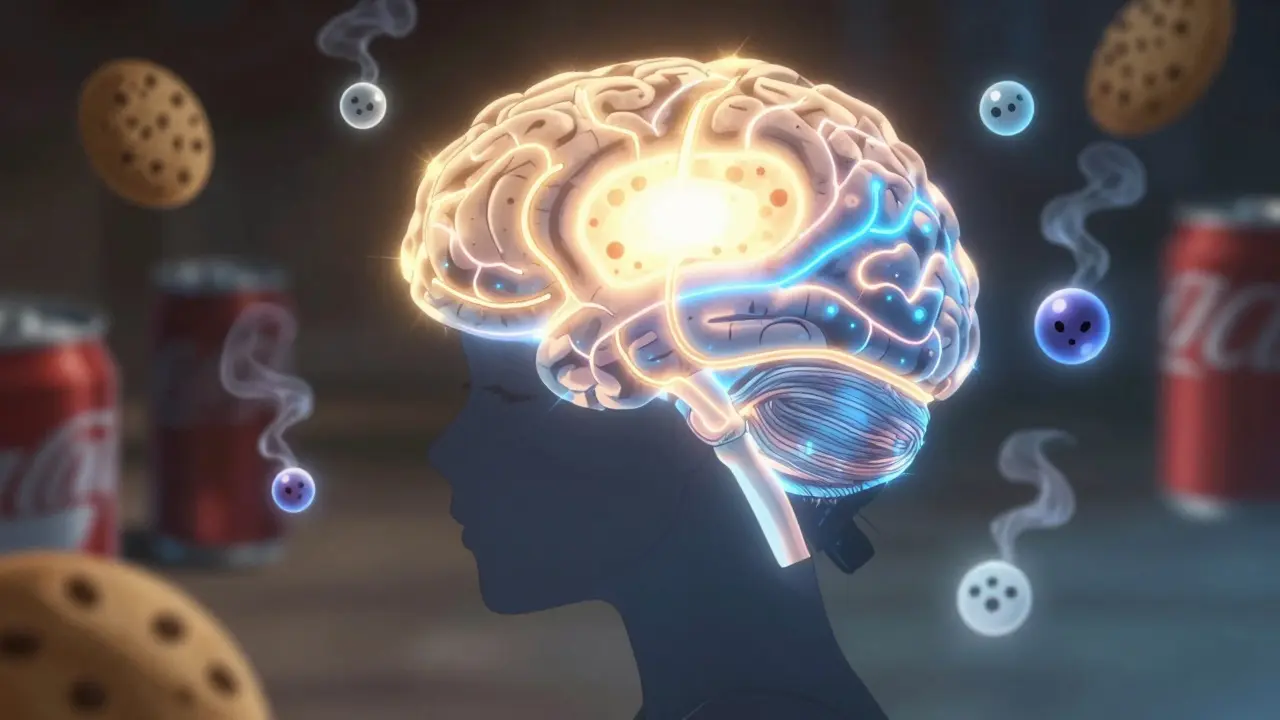
Let’s be honest-most of us have tried swapping sugar for artificial sweeteners hoping to cut calories and lose weight. But if you’ve ever had a diet soda and then suddenly found yourself craving a whole bag of cookies, you’re not alone. The science behind why this happens is messy, contradictory, and deeply personal. Some people swear by stevia. Others swear at it. So what’s really going on when you choose sugar-free?
What Happens When Your Brain Gets Sweetness Without Calories
Your brain expects energy when it tastes something sweet. That’s how evolution wired us. Sugar delivers both sweetness and calories. Artificial sweeteners deliver the sweetness-but nothing else. No glucose. No energy. Just flavor. A 2023 study from the University of Southern California found that sucralose doesn’t trigger the release of GLP-1, a key hormone that tells your brain you’re full. Without that signal, your brain keeps looking for food. Participants in the study reported 17% higher hunger levels after drinking a sucralose-sweetened beverage compared to one with real sugar. And it wasn’t just a feeling-it showed up on brain scans. The hypothalamus, which controls hunger, lit up differently in people who consumed sucralose, especially women. Female participants had 40% greater brain activity changes than men. That’s not a small detail. It means gender matters when it comes to how sweeteners affect you.The Reward System Gets Confused
Think of your brain’s reward system like a thermostat. It’s used to balancing sweetness with energy. When you drink a diet soda, your brain says, “Sweet! Energy coming!” But then-nothing. No sugar spike. No energy boost. Over time, your brain recalibrates. It starts to think, “If it’s sweet but doesn’t give me energy, then I need more of it.” This isn’t theory. In a 2016 study at the University of Sydney, fruit flies fed sucralose for five days ended up eating 30% more calories when given real sugar afterward. The same pattern showed up in human studies. People who regularly drank diet soda were more likely to crave intensely sweet foods. The more artificial sweeteners you consume, the more your taste buds demand higher levels of sweetness to feel satisfied. That’s why many people who switch to diet drinks end up reaching for candy, pastries, or sugary snacks-not because they’re weak, but because their brain has been rewired.But Some Studies Say Sweeteners Help
It’s not all bad news. A 2022 randomized trial from the University of Leeds, published in The Lancet eBioMedicine, found that replacing sugar with artificial sweeteners led to lower insulin and blood sugar levels. Participants had 15% lower post-meal glucose spikes and 18% lower insulin responses. That’s a big win for people managing diabetes or insulin resistance. The same study showed no increase in hunger or calorie intake over two hours after consumption. In fact, participants ate fewer calories overall when sweeteners replaced sugar in their diet. And here’s something important: a 2021 meta-analysis of 15 clinical trials concluded that using non-nutritive sweeteners reduced daily calorie intake by an average of 112 kcal. That’s about the energy in a small banana. Over a year, that adds up to nearly 41,000 fewer calories-enough to lose about 12 pounds without changing anything else. So why the contradiction? The answer is time. Short-term studies (under 4 weeks) often show sweeteners helping. Long-term studies (over 3 months) start showing problems-especially with sucralose and aspartame. Your body adapts. Your cravings change. Your brain gets tricked.
Not All Sweeteners Are the Same
You can’t treat all artificial sweeteners like they’re the same. They’re chemically different. They’re metabolized differently. And they affect your body differently.- Sucralose (Splenda): 600 times sweeter than sugar. Doesn’t trigger satiety hormones. Linked to increased hunger in long-term users, especially women. Found in diet sodas, sugar-free gum, and “zero sugar” snacks.
- Aspartame (Equal, NutraSweet): 200 times sweeter. Broken down into phenylalanine, aspartic acid, and methanol. Linked to increased appetite in some men. Often blamed for cravings in diet sodas.
- Acesulfame Potassium (Ace-K): Often blended with sucralose. Used in 78% of diet beverages. May affect gut bacteria and insulin sensitivity over time.
- Stevia (Truvia, PureVia): Derived from a plant. 200-300 times sweeter. Less likely to trigger cravings. In Amazon reviews, only 15% of negative feedback mentions increased hunger-compared to 28% for Splenda.
- Monk Fruit: 150 times sweeter. Minimal research, but early data suggests it doesn’t spike insulin or trigger hunger. Preferred by dietitians for beginners.
One big reason stevia and monk fruit feel better to users? They’re less intense. High-intensity sweeteners like sucralose overwhelm your taste buds. Low-intensity ones give you sweetness without the shock to your system.
Who’s Most at Risk?
Not everyone reacts the same. Research shows three groups are more likely to experience increased cravings:- Women: Brain scans show stronger neural responses to sucralose. Hormonal differences may make them more sensitive to the disconnect between sweetness and energy.
- People with obesity: Their bodies already have altered hunger signaling. Sweeteners may worsen the imbalance.
- Long-term users: If you’ve been drinking diet soda daily for over six months, your brain has likely adjusted. That’s when cravings start creeping back.
On Reddit’s r/loseit, 68% of 1,247 users said sweeteners helped reduce cravings. But 32% said they made things worse-mostly those who drank diet soda daily for over a year. The American Diabetes Association’s 2023 survey found that 41% of people with type 2 diabetes who used aspartame reported increased appetite. That’s almost half.

What Actually Works in Real Life
If you’re trying to manage weight and cravings, here’s what the data and dietitians agree on:- Start with low-intensity sweeteners. Monk fruit or stevia are better first choices than sucralose or aspartame. They’re less likely to trigger reward system confusion.
- Pair sweeteners with protein. A 2021 study showed that adding protein (like Greek yogurt or cottage cheese) to a sweetened snack reduced hunger responses by 22%. Protein tells your brain you’re full. Sweeteners don’t.
- Give yourself a 2-3 week reset. If you’ve been using artificial sweeteners daily, your taste buds are oversensitized. Cut them out for three weeks. You’ll notice food tastes sweeter naturally. Cravings drop.
- Avoid diet sodas as your main drink. They’re designed to be addictive. Blends of sucralose + Ace-K are engineered to make you want more. Water, sparkling water, or herbal tea are better.
- Don’t use sweeteners to justify eating more. “I had a diet soda, so I can have this cookie” is a trap. That mindset undermines weight management more than sugar ever could.
The Bottom Line
Artificial sweeteners aren’t magic. They’re not evil. But they’re not harmless, either. For some people, they’re a useful tool to cut sugar and lose weight. For others, they’re the reason cravings won’t go away.The biggest mistake? Thinking one size fits all. Your biology, your habits, your gender, your history with sugar-all of it matters. If you’re using sweeteners and still feeling hungry, it’s not your fault. It’s your brain trying to make sense of a signal it doesn’t understand.
Try this: Swap your daily diet soda for sparkling water with a splash of lemon. Use stevia in your coffee instead of Splenda. Give yourself two weeks without any artificial sweeteners. Then notice how your cravings change. You might be surprised.
Weight management isn’t about picking the “right” sweetener. It’s about understanding how your body responds-and adjusting before your cravings adjust you.
Do artificial sweeteners make you gain weight?
Not directly. But they can indirectly lead to weight gain by increasing cravings, especially with long-term use of high-intensity sweeteners like sucralose and aspartame. Studies show that while sweeteners reduce calorie intake short-term, some people compensate by eating more later-particularly if their brain’s reward system has been rewired by repeated exposure to sweetness without calories.
Which artificial sweetener is least likely to cause cravings?
Stevia and monk fruit are currently the best options based on user reports and early research. They’re less intense than sucralose or aspartame, and studies show fewer links to increased appetite. A 2023 Amazon survey found only 15% of negative reviews for stevia-based products mentioned cravings, compared to 28% for sucralose products. Many dietitians recommend starting with monk fruit because it’s closer to natural sweetness and doesn’t overwhelm the palate.
Why do I crave sugar more after using diet soda?
Your brain expects energy when it tastes sweetness. Diet soda gives you sweetness without calories. Over time, your brain recalibrates and starts to think, “I need more sweetness to feel satisfied.” This is called the “sweetness-energy disconnect.” Studies in fruit flies and humans show this leads to increased calorie intake later. It’s not weakness-it’s biology.
Are artificial sweeteners safe for people with diabetes?
Yes, for most people with diabetes, artificial sweeteners are a helpful tool to avoid blood sugar spikes. A 2021 study found sucralose caused only 12.7 mmol/L*min in glucose response compared to 89.4 for sugar. The American Diabetes Association supports their use for blood sugar control. But 41% of users still report increased appetite, so pairing sweeteners with protein or fiber can help manage hunger.
How long does it take to reset sugar cravings after quitting artificial sweeteners?
Most people notice a drop in cravings after 2-3 weeks without artificial sweeteners. A 2023 survey of dietitians found that 78% of clients who stopped using sweeteners for four to six weeks returned to preferring naturally sweet foods like fruit. The key is consistency-no hidden sweeteners in sauces, protein bars, or “healthy” snacks during the reset period.
14 Comments
December 26, 2025 Liz MENDOZA
I used to drink diet soda every day and thought I was being so healthy. Then I started craving sweets nonstop. I switched to sparkling water with lemon and stevia in my coffee-and after two weeks, my cravings just... faded. I didn’t even miss it. It’s not about willpower. It’s about rewiring your brain. You’re not broken. Your body’s just confused.
December 27, 2025 Kylie Robson
Let’s be precise here: the GLP-1 suppression effect of sucralose is mediated via T1R2/T1R3 receptor desensitization in enteroendocrine L-cells, which reduces postprandial insulinotropic signaling. This is not merely ‘brain confusion’-it’s a neuroendocrine mismatch that triggers compensatory hyperphagia via NPY/AgRP upregulation in the arcuate nucleus. The 2023 USC fMRI data shows heightened hypothalamic activation in females due to estrogen-modulated ghrelin receptor density. This is biologically deterministic, not anecdotal.
December 27, 2025 Will Neitzer
While I appreciate the depth of this analysis, I must respectfully point out that conflating correlation with causation in the context of artificial sweeteners and weight gain is a common fallacy. The Leeds study clearly demonstrated a net caloric reduction. To suggest that sweeteners ‘rewire’ the brain ignores the plasticity of reward pathways and the fact that behavioral context (e.g., using diet soda as a justification for dessert) is the true driver of increased intake. The science is nuanced, not dystopian.
December 28, 2025 Janice Holmes
OMG I KNEW IT. I’ve been drinking diet soda for 8 years and I’ve gained 40 pounds and I swear it’s because my brain is screaming for sugar like a toddler in a candy store. I tried monk fruit once and it tasted like sad grass. Then I had a banana and cried. Like, actual tears. This isn’t about calories. It’s about betrayal. My brain feels LIED TO.
December 28, 2025 Olivia Goolsby
Have you considered that Big Pharma and the artificial sweetener industry are in cahoots with the FDA to keep us addicted? The same companies that made aspartame also made Agent Orange. They don’t care if you crave sugar-they care if you keep buying their products. And guess what? They’re funding all the ‘sweeteners are safe’ studies. The real reason they don’t want you to know? Sweeteners mess with your gut microbiome so badly that your body starts producing its own sugar cravings-like a biological trap. They’ve been doing this since the 80s. Wake up.
December 30, 2025 Alex Lopez
Interesting post. 😅 But let’s be real-most people who blame sweeteners for cravings are the same ones who drink a diet soda and then eat three cookies ‘because it’s zero sugar.’ The sweetener isn’t the villain. The mindset is. Also, if you’re using aspartame and getting headaches? That’s a different problem. But craving sugar? That’s just habit. Try drinking water for a week. You’ll be shocked how much less you crave.
December 31, 2025 Gerald Tardif
Man, I used to think stevia was just ‘plant sugar.’ Then I tried monk fruit-holy hell, it’s like nature whispered sweetly into my coffee. No aftertaste. No brain chaos. I stopped reaching for candy. I started tasting real fruit again. It’s not magic. It’s just… gentler. Like your body finally got a chance to breathe. Try it. Just for two weeks. You don’t need to quit everything. Just swap one thing. Watch what happens.
December 31, 2025 Monika Naumann
In India, we have used jaggery and honey for centuries. These are natural. Artificial sweeteners are a Western chemical experiment. Your body was not designed to process synthetic molecules that mimic sweetness without nourishment. This is not science. This is cultural imperialism disguised as nutrition. Why do you trust American corporations over your own ancestral wisdom?
December 31, 2025 Elizabeth Ganak
my mom used to say ‘if it’s too sweet, it’s not real’ and she was right. i switched to plain tea with a tiny bit of honey and now i can taste the difference in apples. it’s wild. no more midnight cookie runs. just peace.
January 2, 2026 Nicola George
Wow. So you’re telling me my 10 diet sodas a day are making me eat more cake? I’m shocked. 🤡 I mean, I literally thought I was being a health warrior. Turns out I was just training my brain to be a sugar addict with a side of guilt. Thanks, science. Now I’m gonna drink water and cry quietly in the shower.
January 3, 2026 Satyakki Bhattacharjee
Everything in nature has a balance. Sugar is natural. Sweeteners are not. Nature does not lie. Your body knows. When you eat sugar, you feel full. When you drink sweet water, your soul knows something is wrong. This is not about science. This is about truth.
January 4, 2026 Kishor Raibole
It is interesting to observe that the modern paradigm of caloric reduction has led to a paradoxical increase in metabolic dysregulation. The substitution of nutritive sweeteners with non-nutritive alternatives constitutes a form of metabolic deception, wherein the organism is conditioned to expect energy expenditure in response to gustatory stimuli, yet is denied the requisite biochemical feedback. This phenomenon, while statistically significant in controlled trials, is often misattributed to individual willpower-a fallacy perpetuated by the diet-industrial complex.
January 6, 2026 John Barron
Okay but have you seen the ingredient list on ‘sugar-free’ gum? It’s like a chemistry lab exploded. Sucralose + Ace-K + aspartame + acesulfame potassium + artificial flavors + titanium dioxide. And you think your gut isn’t screaming? 🤯 I used to think I was being healthy. Now I just drink water. And I’m not even mad. I’m just… done.
January 7, 2026 Anna Weitz
It’s not the sweeteners. It’s the fact that we’ve turned eating into a math problem. You’re not supposed to track every calorie. You’re supposed to eat food that makes you feel good. If you’re craving sugar after a diet soda, maybe you’re just hungry for real life. Try eating an orange. Not a ‘zero sugar’ orange. An actual orange. Let your body feel what real sweetness tastes like. Not a chemical copy. Real. Just once.
Write a comment