

Clozapine Dosage & Smoking Interaction Estimator
Estimated Impact
Enter patient details to see how smoking changes may affect clozapine levels.
Imagine spending months fine-tuning a medication dose to finally stabilize a patient's symptoms, only for everything to crash because the patient started smoking cigarettes. This isn't a rare fluke; it is a classic, high-stakes pharmacokinetic battle. For people taking Clozapine is an atypical antipsychotic used primarily for treatment-resistant schizophrenia , tobacco smoke isn't just a health hazard-it's a metabolic trigger that can strip the drug from the bloodstream faster than the body can replace it.
The Biological Switch: How Smoking Changes Metabolism
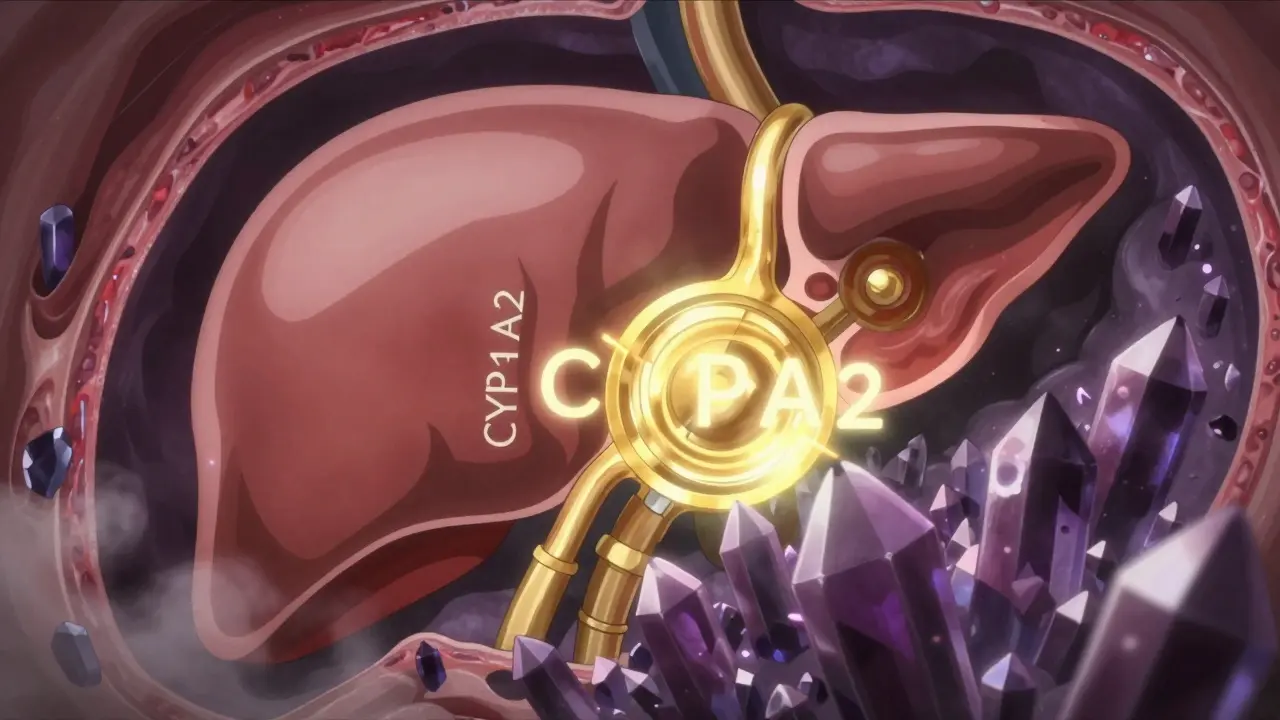
The core of the problem lies in the liver, specifically with an enzyme called CYP1A2 is a cytochrome P450 enzyme responsible for metabolizing a variety of drugs and toxins in the liver . Under normal conditions, CYP1A2 handles the heavy lifting of breaking down clozapine into metabolites like norclozapine and clozapine-N-oxide. However, tobacco smoke contains polycyclic aromatic hydrocarbons. These chemicals act as ligands for the aryl hydrocarbon receptor (AhR). When these chemicals bind to the receptor, they travel to the cell nucleus and essentially "turn on" the gene responsible for producing CYP1A2.
This process, known as induction, means the liver starts producing significantly more enzymes. For a heavy smoker, the maximum rate of metabolism (Vmax) can increase by 2 to 3 times. Because CYP1A2 is responsible for about 60% to 70% of clozapine's total clearance, the result is a dramatic drop in the amount of drug available in the plasma. On average, smoking reduces clozapine concentrations by 30%, but in some patients, that drop can hit 50%. This often pushes a patient from a therapeutic range (typically 350-500 ng/mL) down to subtherapeutic levels, causing symptoms of schizophrenia to return despite no change in the prescribed dose.
Clozapine vs. Other Antipsychotics
You might wonder why this doesn't happen with every antipsychotic. The answer is the specific metabolic pathway each drug uses. While some medications are processed by multiple enzymes, clozapine is uniquely vulnerable because of its heavy reliance on the CYP1A2 pathway and its narrow therapeutic window. If a drug has a wide therapeutic index, a 30% drop might not be noticeable. With clozapine, a 30% drop is the difference between stability and a relapse.
| Medication | Primary Metabolic Enzyme | Sensitivity to Tobacco | Typical Interaction Effect |
|---|---|---|---|
| Clozapine | CYP1A2 (Major) | Very High | 30-50% reduction in plasma levels |
| Olanzapine | CYP1A2 (Moderate) | Moderate | 20-30% reduction in plasma levels |
| Risperidone | CYP2D6 | Low/Minimal | Negligible effect from smoking |
| Quetiapine | CYP3A4 | Low | Minimal effect from smoking |
The Danger of Quitting Cold Turkey
While smoking lowers drug levels, quitting smoking does the exact opposite. When a patient stops smoking, the induction effect wears off. The "extra" CYP1A2 enzymes disappear, and the liver's ability to clear the drug slows down. If the dose isn't lowered to match this new, slower metabolism, clozapine can accumulate to toxic levels.
This is where the situation becomes dangerous. Toxicity can lead to severe sedation, tachycardia, and even life-threatening events like seizures or myocarditis. There are documented cases where patients who quit smoking while staying on a "smoker's dose" (e.g., 400mg) ended up with plasma levels exceeding 800 ng/mL, resulting in emergency hospitalization. The induction effect usually lasts for 1 to 2 weeks after the last cigarette, meaning the risk window is narrow but critical.
Genetic Wildcards: The CYP1A2 *1F Variant
Not every smoker reacts the same way. Genetics play a huge role in how a person responds to tobacco. Specifically, the CYP1A2 *1F genotype is a genetic variation of the CYP1A2 enzyme that alters its inducibility can change the game. Patients with the *1F/*1F genotype often have normal enzyme activity at baseline, but they are hyper-responsive to tobacco smoke. For these individuals, the drop in clozapine levels is often more severe than in those with the wild-type genotype, making their dosage requirements even more unpredictable.

Practical Management and Dose Adjustment
To handle this, clinicians rely on Therapeutic Drug Monitoring (TDM) is the clinical practice of measuring drug concentrations in the blood to optimize dosage and ensure safety . Since you can't just guess the dose, blood tests are the only way to know if a patient is in the target range.
When managing a patient's smoking status, the following general rules of thumb are often applied:
- Starting Smoking: When a non-smoker starts smoking, doses may need to be increased by 40-60%. For example, a dose of 300mg might need to move toward 450-500mg. Levels should be re-checked within a week.
- Quitting Smoking: When a smoker quits, the dose should be preemptively reduced by 30-50%. A 500mg dose might be lowered to 250-350mg. Monitoring should be frequent for at least two weeks.
- Switching to Vaping: It was once thought that e-cigarettes avoid this interaction. However, recent data suggests that vaping can still induce CYP1A2, although the effect is roughly 15-20% less pronounced than traditional combustible cigarettes.
The Bigger Picture: Hospitalizations and Costs
This isn't just a pharmacological curiosity; it's a massive public health challenge. Between 60% and 70% of patients taking clozapine smoke, compared to only 14% of the general population. When this interaction is ignored, the result is a revolving door of hospitalizations. One study found that unmanaged drug-environment interactions lead to a 22% increase in hospitalization rates, with each avoidable stay costing roughly $14,500.
Fortunately, technology is helping. Many electronic health record systems now include automated alerts that warn doctors when a patient's smoking status changes. These alerts have been shown to reduce adverse events by about 37%. Additionally, new sustained-release formulations of clozapine are being tested to see if they can smooth out these plasma fluctuations, potentially making the drug safer for smokers.
Does nicotine itself cause the induction of CYP1A2?
No, nicotine is not the culprit. The induction is caused by polycyclic aromatic hydrocarbons found in the smoke of combusted tobacco. This is why nicotine patches or gum typically do not cause the same dramatic drop in clozapine levels as smoking cigarettes.
How quickly does the drug level drop after a patient starts smoking?
The induction of the CYP1A2 enzyme generally develops within 48 to 72 hours of regular smoking initiation, meaning plasma levels can start to dip very quickly.
What are the signs of clozapine toxicity after quitting smoking?
Signs include severe sedation, extreme drowsiness, tachycardia (fast heart rate), hypotension, and in severe cases, seizures. These occur because the drug is no longer being cleared by the induced enzymes.
Can pharmacogenetic testing prevent these issues?
Testing for the CYP1A2 *1F variant can help identify patients who are more sensitive to induction, allowing doctors to be more aggressive with monitoring and dose adjustments.
Is the effect of vaping the same as smoking cigarettes?
It is similar but usually less intense. Research suggests e-cigarettes can still induce CYP1A2, but the reduction in plasma levels is often 15-20% less than what is seen with traditional combustible cigarettes.
12 Comments
April 15, 2026 Billy Wood
Insane stuff!! Really shows why monitoring is key!!!
April 16, 2026 Mary Johnson
Funny how they call it "treatment-resistant" when they're actually just manipulating the chemistry with these hidden additives in cigarettes. It's all a giant game to keep people cycling through hospitals and pumping money into the system. They don't want you to know how easily the liver can be tweaked, just keep paying for the TDM tests and the fancy new sustained-release drugs they're pushing now.
April 17, 2026 mimi clouet
Actually, it's super interesting because the AhR pathway is involved in so many other things too! 🧬 Most people forget that these polycyclic aromatic hydrocarbons are literally everywhere in urban smog, not just cigarettes, though the concentration in smoke is way higher 🚬✨ Just a little extra bit of knowledge for everyone! 😊
April 18, 2026 Clint Humphreys
It's quite fascinating if you look at the broader systemic implications, because the medical establishment loves to frame this as a purely biological fluke when in reality it's a perfect example of how external environmental toxins are integrated into our pharmacological control mechanisms. I've read some obscure papers suggesting that the push for these specific TDM protocols is actually a way to standardize patient behavior through biological surveillance, and while I'm sure the doctors mean well, it's a slippery slope when we start talking about "genetic wildcards" to justify more invasive monitoring and expensive testing for a population that is already marginalized by their diagnosis.
April 18, 2026 john chiong
absolutely mental that a few cigs can just wipe out a whole dose of meds like it's nothing the system is a joke
April 19, 2026 Becca Suttmiller
The part about quitting cold turkey is really the most concerning aspect here. It's a reminder that wellness is often a double-edged sword when you're on high-potency medication.
April 20, 2026 Olivia Lo
The ontological tension here is profound, as we see the somatic manifestation of a biochemical induction process creating a precarious equilibrium. By analyzing the pharmacokinetic variability through the lens of CYP1A2 polymorphism, we are essentially witnessing the intersection of genetic determinism and environmental stochasticity. This phenomenological shift in plasma concentration necessitates a robust clinical framework to avoid the catastrophic failure of the therapeutic window. It's not merely a matter of dosing, but a question of how we conceptualize the body as a permeable vessel subject to the exogenous influence of hydrocarbons. The resulting metabolic acceleration effectively renders the prescribed dose an illusion, stripping the patient of stability in a way that is almost poetic in its cruelty. We must consider the ethical implications of such volatility in a population already struggling with cognitive fragmentation. The reliance on TDM is a pragmatic necessity, yet it highlights the fragility of our current psychiatric interventions. When the Vmax increases twofold, the subjective experience of the patient is fundamentally altered, yet the clinical chart remains static. This discrepancy underscores the need for a more nuanced, personalized approach to medicine that accounts for the visceral reality of the patient's habits. Ultimately, the interaction between clozapine and tobacco is a testament to the intricate, often invisible, choreography of enzyme induction. It forces us to acknowledge that the boundary between the drug and the environment is non-existent. To ignore the smoking status is to ignore the very engine that drives the drug's efficacy.
April 21, 2026 Tabatha Pugh
I already knew about the *1F variant. It's basic pharmacogenetics. Most clinicians who don't check for this are just lazy or under-trained.
April 21, 2026 Anurag Moitra
The explanation provided regarding the aryl hydrocarbon receptor is quite precise and helpful for understanding the mechanism of action
April 22, 2026 Sam Dyer
Only in this country do we have docs who forget that people smoke! 🙄 Common sense is dead, but hey, as long as the big pharma companies make a killing on the "new and improved" sustained-release garbage, who cares if the patients are dizzy as hell? absolute clown show! 🤡
April 24, 2026 melissa mac
It's so important that we support patients through the process of quitting smoking so they don't hit those toxicity levels. Let's make sure we're emphasizing a gradual transition and close monitoring.
April 25, 2026 Mark Dueben
I agree with the need for better support. It's a lot for a patient to handle while also managing their mental health.
Write a comment