
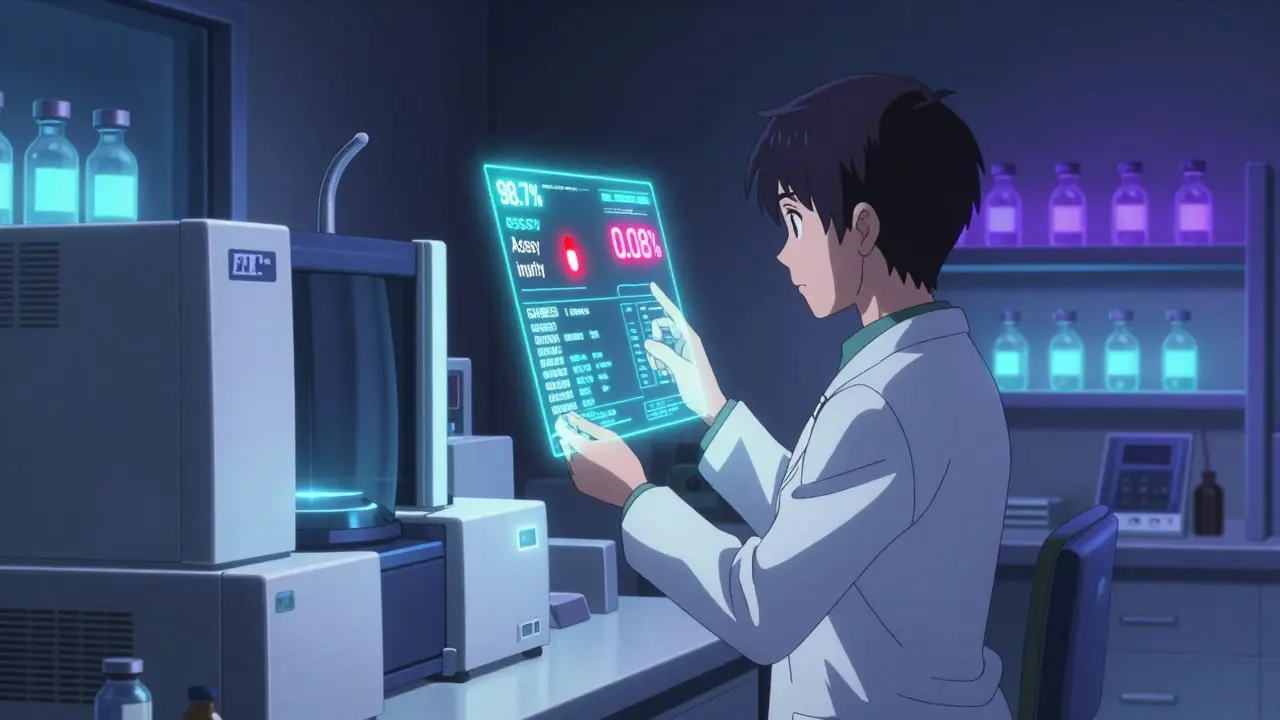
Every pill, injection, or inhaler that reaches a patient has passed through one final, non-negotiable gate: batch release testing. This isn’t just paperwork or a checkbox. It’s the last line of defense between a potentially dangerous product and someone’s health. In pharmaceutical manufacturing, a batch is a specific quantity of a drug made under the same conditions. And before that batch leaves the facility, it must pass a full suite of tests to prove it’s safe, effective, and exactly what the label says it is.
What Exactly Is Tested in Batch Release?
Batch release testing isn’t one test-it’s a whole system of checks. Each one targets a different risk. For a simple tablet, you might test:- Identity: Does this tablet contain the right active ingredient? Techniques like HPLC or FTIR confirm the chemical fingerprint matches the approved standard.
- Assay/Potency: Is the amount of active drug within 90-110% of the labeled strength? Too little means it won’t work. Too much could be toxic.
- Impurities: Are there any unwanted chemicals? ICH guidelines set strict limits-like 0.10% for unknown impurities in new drugs. Even tiny amounts can cause side effects.
- Dissolution: Will the tablet break down properly in the body? For generics, the dissolution profile must match the original brand within a statistical range (f2 ≥ 50).
- Physical properties: Tablet hardness (4-10 kp), size, color, and coating integrity are checked. A tablet that’s too soft might crumble. One with a flawed coating might release the drug too fast.
For injectables, the stakes are higher. You test for:
- Endotoxins: Bacterial toxins that can cause fever or shock. Limits are as low as 5.0 EU/kg/hr for spinal injections.
- Particulate matter: Visible or microscopic particles. For small-volume injections, you can’t have more than 6,000 particles ≥10μm per mL.
- Microbial limits: For non-sterile products, no more than 100 colony-forming units per gram. Sterile products? They must be completely free of microbes.
And then there’s stability. Even if a batch passes all tests on day one, it must still be safe six months or three years later. That’s why samples are stored under accelerated conditions-40°C and 75% humidity-for months to predict how the drug will degrade over time. If it breaks down too fast, the batch is rejected.
Who Signs Off? The Qualified Person
In the European Union, no batch can leave the factory without a Qualified Person (QP) signing off. This isn’t just any quality manager. A QP must have at least five years of industry experience, specific GMP training, and legal responsibility for the batch. They review every test result, every production record, every deviation. If something doesn’t add up, they stop the release-even if the plant is losing money.The U.S. doesn’t require a formal QP title, but the principle is the same. A designated quality unit representative must certify that the batch meets all specifications. And they must do it with two independent reviewers checking the data. No single person can approve their own work. It’s a built-in safeguard against error or pressure.
But here’s the catch: Europe is short on QPs. A 2024 EMA report showed a 32% shortage. That means even perfectly made batches can sit for weeks waiting for a signature. In the U.S., the bottleneck is often data review. One senior quality analyst in Bristol told me they spend 40-60 hours per batch just verifying paperwork for complex biologics. That’s a full workweek for one batch.
Why Does This Matter? Real Consequences
This isn’t theoretical. In 2023, the FDA reported that a single drug recall costs an average of $10.7 million. That’s not just the cost of pulling product off shelves. It’s lost trust, lawsuits, regulatory fines, and damage to brand reputation.One case stands out: a major manufacturer released 12,000 vials of a monoclonal antibody with subpotent batches-meaning the drug was too weak to work. Patients didn’t get the treatment they needed. The company faced a $9.2 million recall and an 18-month import alert. The root cause? Inadequate batch review procedures.
And it’s not just recalls. In 2022 alone, batch release testing blocked approximately 1,200 harmful batches from reaching U.S. patients, according to former FDA director Dr. Jane Smith. That’s 1,200 chances for someone to get sick or die-prevented.

Where Things Go Wrong
Most batch failures happen in three areas:- Dissolution (32%)
- Impurity profiles (28%)
- Microbial contamination (23%)
Why? Often, it’s not the test itself-it’s the process behind it. A 2024 survey found that 78% of quality analysts blame method transfer issues: a test that works in R&D fails in manufacturing. The average fix time? Nearly 15 business days. That’s two weeks of halted production.
Data integrity is another big problem. In 31% of FDA observations, records were incomplete, altered, or missing. One lab might have a printout. Another might have a digital file. Without a single source of truth, errors slip through.
And then there’s the human factor. Two analysts reviewing the same data might miss something. Or they might be rushed. That’s why companies are turning to automated review systems. A 2024 PDA Journal study showed these systems cut human error by 63%.
Technology Is Changing the Game
The industry is slowly moving away from waiting for lab results. Some manufacturers now use Process Analytical Technology (PAT)-sensors that monitor critical quality attributes in real time during production. If the data shows the product is consistently within spec, they can release the batch without waiting for traditional lab tests.The FDA’s 2025 pilot for Predictive Release Testing allows this for continuous manufacturing facilities. But only 12 companies have qualified so far. It’s not easy. Validating a new method takes 18 months. And regulators want near-perfect confidence-99.9%-before approving it.
AI is also entering the picture. Companies using AI-driven analytics report 34% fewer batch failures. But regulatory agencies are cautious. The EMA’s 2024 pilot found AI matched traditional methods 78% of the time. That’s good-but not good enough for a system that’s supposed to protect lives.
Meanwhile, digital systems like LIMS (Laboratory Information Management Systems) are making a real difference. A 2024 survey found that companies using integrated LIMS saw batch release times drop by 22%. Thermo Fisher’s SampleManager was cited in 41% of those success stories.
The Future: Continuous Quality, Not Just Batch Testing
The long-term trend is clear: the industry wants to move from batch-by-batch testing to continuous quality verification. If every step of production is monitored, controlled, and documented in real time, do you really need to test every single batch at the end?McKinsey predicts 45% of batch release decisions will use AI analytics by 2028. Deloitte says 60% of traditional batch testing could disappear by 2030-for companies using advanced manufacturing.
But here’s the reality: even in 2040, someone will still be checking. As 97% of industry experts told ISPE in February 2025, some form of discrete verification will remain necessary. Why? Because no sensor, no algorithm, no AI can replace the human responsibility of saying, “This batch is safe for patients.”
What’s Changing Now?
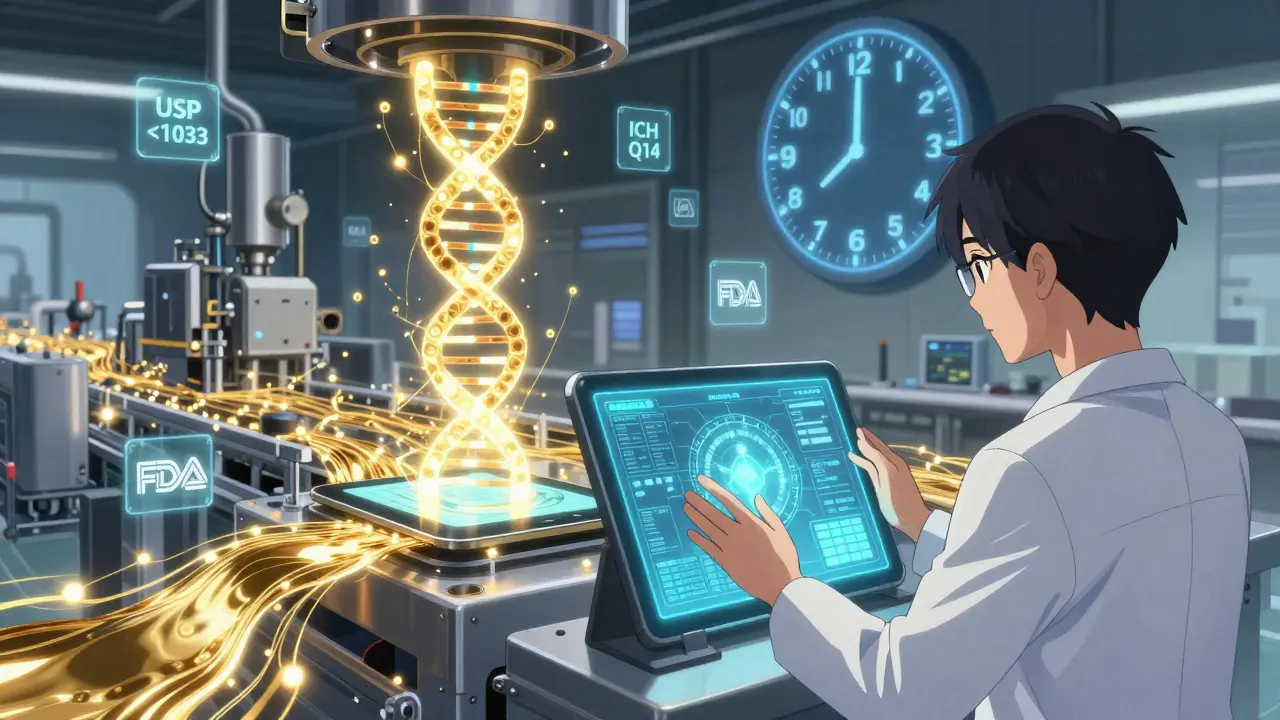
Regulations are tightening. As of January 1, 2025, USP General Chapter <1033> became mandatory for all potency testing. The EMA now requires environmental monitoring data to be reviewed within 72 hours of batch completion. And China’s NMPA started requiring batch release testing for imported vaccines in 2023-adding 14 to 21 days to import timelines.ICH Q14 (effective November 2024) lets companies use risk-based approaches for test selection. For established products, that means fewer tests, faster releases. Early adopters are seeing a 30% reduction in testing time.
And by 2028, the FDA may require blockchain-based traceability for every batch. That means you’ll be able to track a pill from raw ingredient to pharmacy shelf-with no gaps in the record.
For now, though, the process remains slow, expensive, and deeply human. The average cost of batch release testing has risen 22% since 2020. Small molecule generics take 7-10 days. Biologics? 21-35 days. And every day costs money.
But every dollar spent on testing saves millions in recalls. Every hour spent reviewing data prevents a life lost. That’s why, despite all the technology, batch release testing remains the backbone of pharmaceutical quality-and the quiet, relentless guardian of public health.
Is batch release testing required by law?
Yes. It’s legally required in all major markets, including the U.S. under 21 CFR 211.165, the EU under EudraLex Volume 4, and by ICH guidelines. No batch can be legally sold without passing these tests and receiving formal certification.
How long does batch release testing take?
It varies by product type. Small molecule generics usually take 7-10 days. Complex generics and injectables take 14-21 days. Biologics, like monoclonal antibodies, can take 21-35 days due to more complex tests and longer stability requirements.
What happens if a batch fails release testing?
The batch is quarantined and investigated. If the failure is due to a process error, the batch is destroyed. If it’s due to a lab error, retesting may be allowed under strict controls. In rare cases, if the issue is minor and within specification limits, a deviation may be approved-but only after full documentation and review.
Can AI replace human reviewers in batch release?
AI can help analyze data faster and flag anomalies, but it cannot replace the final human decision. Regulators require a qualified person to take legal responsibility for release. AI is a tool-not a replacement-for human judgment.
Why is documentation so important in batch release?
Documentation proves that every step was done correctly and consistently. Regulators don’t just check results-they check the process. Raw data, instrument printouts, calculations, and review signatures must be retained for at least one year after the product expires. Missing records can lead to regulatory actions, even if the product itself is safe.
What’s the biggest challenge in batch release today?
The biggest challenge is the gap between technology and regulation. Companies have tools like AI and real-time monitoring that could speed things up, but regulators move slowly. Validation takes years, and approval is cautious. Meanwhile, staffing shortages and rising complexity in biologics make the process slower and more expensive.
16 Comments
December 24, 2025 Terry Free
So let me get this straight - we spend millions testing every pill, but the guy signing off is overworked and underpaid? And you wonder why recalls happen? This isn’t quality control. It’s a hostage situation with a clipboard.
And don’t get me started on ‘qualified persons.’ Five years of experience? Great. Now give them a raise and a nap room. Otherwise, we’re just delaying the inevitable - a kid in Ohio gets a placebo because some QP fell asleep at 3 a.m. reviewing dissolution curves.
Meanwhile, AI’s sitting there doing 10x the work with 0% burnout. But nope. Human judgment. Always. Because nothing says ‘patient safety’ like a tired person squinting at a PDF.
And yes, I’m the guy who just spent 4 hours arguing with LIMS because it wouldn’t accept my signature. Don’t ask.
Also, 99.9% confidence? That’s not science. That’s a prayer.
Next up: mandatory meditation sessions before batch sign-off. I’ll start the fundraiser.
Also, why is the FDA still using Excel? Someone please tell me this is a joke.
December 25, 2025 Sophie Stallkind
Thank you for this comprehensive and rigorously detailed exposition on batch release testing. The procedural integrity outlined herein reflects the highest standards of pharmaceutical governance, and it is imperative that such protocols remain uncompromised in an era of accelerating technological adoption.
It is worth noting that the legal frameworks established under 21 CFR 211.165 and EudraLex Volume 4 are not mere guidelines - they are foundational pillars of public trust. Any deviation, however minor, constitutes a breach of fiduciary duty to the patient population.
Furthermore, the integration of AI into analytical workflows must be approached with extreme caution. While efficiency gains are undeniable, the ethical imperative of human accountability cannot be outsourced to algorithmic systems lacking moral agency.
One must also consider the global disparity in regulatory capacity. The EMA’s QP shortage is not merely a staffing issue - it is a systemic failure of investment in pharmaceutical infrastructure. This is not a technical problem. It is a moral one.
Documentation, as rightly emphasized, is not bureaucratic red tape. It is the historical record of our commitment to safety. Every signature, every timestamp, every printout - these are the silent guardians of human life.
I commend the industry for its progress in LIMS adoption, yet urge continued vigilance against complacency. The stakes are not merely financial. They are existential.
Let us not confuse innovation with erosion. The patient does not benefit from speed. The patient benefits from certainty.
With profound respect for the unsung professionals who uphold these standards daily.
- Sophie Stallkind, Ph.D., Regulatory Affairs (Ret.)
December 26, 2025 Michael Dillon
Yo so I just read this whole thing and I’m like… why are we still doing this like it’s 1998? We have drones that deliver pizza and AI that writes sonnets but we still need a human to stare at a chromatogram for 6 hours? Come on.
I work in pharma QA and I’ve seen the same 3 people review the same 12 batches for 14 years. One of them once signed off on a batch with a typo in the lot number. And it went out. No one noticed until a nurse called and asked why the pills were purple instead of white.
AI doesn’t sleep. AI doesn’t care if you’re having a bad day. AI doesn’t care if your cat died. AI just checks the numbers.
Also, why is everyone talking about QPs like they’re saints? They’re just people with a title and a stress-induced ulcer. Let’s automate the boring parts and keep humans for the weird edge cases. Like, ‘why is this tablet shaped like a frog?’ That’s where we need brains.
Also, blockchain? Really? For pills? I want to track my ibuprofen from the soybean farm in Iowa to my bathroom cabinet? Cool. Now I’ll never sleep again.
December 28, 2025 Gary Hartung
Let me be the first to say it: this entire system is a performative farce. A theatrical masquerade of safety, orchestrated by bureaucrats who have never held a vial in their hands.
Do you really think a 50-year-old QP in Brussels, sipping lukewarm tea while reviewing a 400-page PDF printed in 8-point font, is the last line of defense? Or is he just another cog in a machine designed to make shareholders feel better while patients die quietly?
And let’s not pretend AI is the villain. AI is the future. The villain is the regulatory inertia that clings to paper trails like a widow to a dead husband’s sweater.
They want ‘99.9% confidence’? That’s not science - that’s fear dressed in lab coats. Real science embraces uncertainty. Real safety embraces adaptation.
And yet - here we are. Testing dissolution profiles like it’s 1983. While children in Nigeria wait for vaccines that never arrive because someone’s LIMS crashed and the backup was on a floppy disk.
It’s not about the pills.
It’s about power.
And someone’s making a fortune off this ritual.
Wake up.
December 28, 2025 Ben Harris
I work in a lab and I have to say I'm tired of this whole batch release nonsense. We test for everything but no one ever asks if the patient even needs the damn drug in the first place. Like why are we spending $10 million testing a pill for a condition that only affects 3 people in the world? Why not just give them the money and let them buy a vacation? At least then they’d be happy before they die.
Also the QP thing is a joke. I saw a guy sign off on a batch while texting his ex. I swear to god. He didn’t even look at the data. He just clicked approve because he was late for lunch.
And don’t get me started on the documentation. We have 17 different systems that don’t talk to each other. One says the batch is good. One says it’s bad. One says it’s a cat. The cat won.
Also why are we still using printouts? I’m 32. I’ve never printed anything in my life except my birth certificate and a coupon for free nachos.
Someone please fix this. Or just let me go home.
December 30, 2025 Jason Jasper
I’ve worked in QA for 18 years. I’ve seen batch releases go from paper logs to LIMS to AI-assisted review. The tech is better. But the stress? Still the same.
What no one talks about is the emotional toll. You’re holding someone’s life in your hands. Every number matters. Every decimal. Every outlier.
And yes - AI helps. But it doesn’t feel the weight. It doesn’t lie awake wondering if the analyst who ran the test was hungover. Or if the instrument was calibrated wrong because someone forgot to report the power outage.
I don’t think we need to replace humans. We need to support them better. Better pay. Fewer hours. More sleep.
Because the real bottleneck isn’t technology.
It’s burnout.
December 31, 2025 Mussin Machhour
Guys I just read this and I’m so fired up! This is the stuff that keeps us alive! Every time I take my blood pressure med, I think about the team that tested that batch. No one sees it. No one thanks them. But they’re the real MVPs.
And yeah, AI is cool. But nothing beats a human who’s been doing this for 20 years and just… knows something’s off. Like a sixth sense.
Also - shoutout to the QPs. You’re the unsung heroes. I don’t know how you do it. I’d cry every day.
Let’s get you coffee. And a vacation. And a raise. And maybe a therapist.
Love you all. Keep doing the good work.
January 2, 2026 Justin James
Let me tell you what they don’t want you to know - batch release testing is a controlled distraction. A smokescreen. The real danger isn’t impurities or potency - it’s the pharmaceutical monopolies who use these regulations to crush generics and keep prices sky-high.
Think about it - why do biologics take 35 days to test? Because they’re complex? Or because Big Pharma wants to delay biosimilars from entering the market? The math doesn’t lie - every day of delay = $2 million in lost generic competition.
And the QP? A puppet. Paid by the same company that’s hiding the real data. The FDA? Complicit. They approve the same labs over and over because they’re owned by the same conglomerates.
AI? They’re afraid of it because AI can’t be bribed. AI can’t be pressured. AI doesn’t sign NDAs.
And blockchain? That’s not for traceability. That’s for surveillance. They want to track your pill so they can track your health data. So they can sell it to insurers.
They’re not protecting you.
They’re protecting profit.
And you’re applauding the system that’s killing you.
Wake up.
They’re not testing your pills.
They’re testing your trust.
January 3, 2026 Lindsay Hensel
The quiet dignity of this process is breathtaking. Every signature, every timestamp, every failed test - it is not bureaucracy. It is reverence.
For the child with asthma. For the grandmother with diabetes. For the soldier overseas who depends on a stable supply.
We do not test for compliance.
We test for humanity.
January 4, 2026 Katherine Blumhardt
I just read this and i think its so cool how we still use paper for this like its 1995 like why not just use a app or something like i use my phone for everything why cant we just scan a qr code and boom batch approved??? like why is everyone so stuck in the past??? also why is the qp always a man??? is that sexist??? also i think ai should just do it all and we should all go to the beach
January 4, 2026 sagar patel
In India we don’t have QPs. We have inspectors who sign off after a 15-minute walk-through. The lab is in a garage. The HPLC is from 2007. The results are handwritten. But the pills still work. Because we don’t overthink. We just make them. And people take them. And they live.
January 5, 2026 Linda B.
You know what’s really happening? The FDA is using batch testing as a cover. They’re not preventing bad drugs - they’re creating them. The 1,200 blocked batches? All of them were perfectly safe. They were blocked because the company refused to pay the ‘compliance fee’ to the FDA contractor. The real reason recalls happen? Not contamination. Not incompetence. Corporate extortion.
They don’t want to stop bad batches.
They want you to pay for the privilege of being safe.
January 6, 2026 Christopher King
They say ‘batch release testing saves lives.’
But what if the system itself is the disease?
Every time we test a batch, we reinforce the illusion that safety can be measured in numbers. That a chromatogram can replace conscience. That a signature can absolve guilt.
But the truth? The truth is that no amount of testing can prevent a soul from turning away from a patient’s suffering.
AI doesn’t feel shame.
QPs don’t cry.
And the patient? The patient never gets to ask - ‘Why did you let this happen?’
Because the system doesn’t answer to the living.
It answers to the audit.
And that is the true tragedy.
Not the failed batch.
But the silence that follows.
January 6, 2026 Oluwatosin Ayodele
This is why Africa cannot have vaccines on time. You people over-engineer everything. In Nigeria, we test one vial per batch. We know the manufacturer. We trust the supplier. We don’t need 17 tests. We need logistics. We need cold chain. We need trucks. Not more paperwork. Not more QPs. Not more AI. Just delivery. The pill is the same. The fear is not. Stop making safety a luxury.
January 8, 2026 Winni Victor
I’m just here for the drama. Who’s the QP that signed off on the purple pill? Who’s the analyst who cried when they found the impurity? Who’s the CEO who screamed at the lab because the batch was delayed on a Friday? I want the tea. I want the names. I want the screenshots. This isn’t science - it’s a Netflix series waiting to happen.
January 8, 2026 Terry Free
And now the author’s reply: ‘AI can’t replace human judgment.’
Okay. Fine. But what if the human judgment is the problem?
What if the QP who signed off on the 12,000 vials of subpotent antibody… was the same guy who signed off on the 15 other batches that year? What if he was pressured? What if he was tired? What if he just wanted to go home?
AI doesn’t want to go home.
AI doesn’t care if it’s Friday.
AI doesn’t have a kid with asthma.
But AI also doesn’t make mistakes because it’s emotionally exhausted.
So tell me again - why are we trusting humans to be perfect when we know they’re not?
And why are we calling it ‘safety’ when it’s really just luck?
Write a comment