
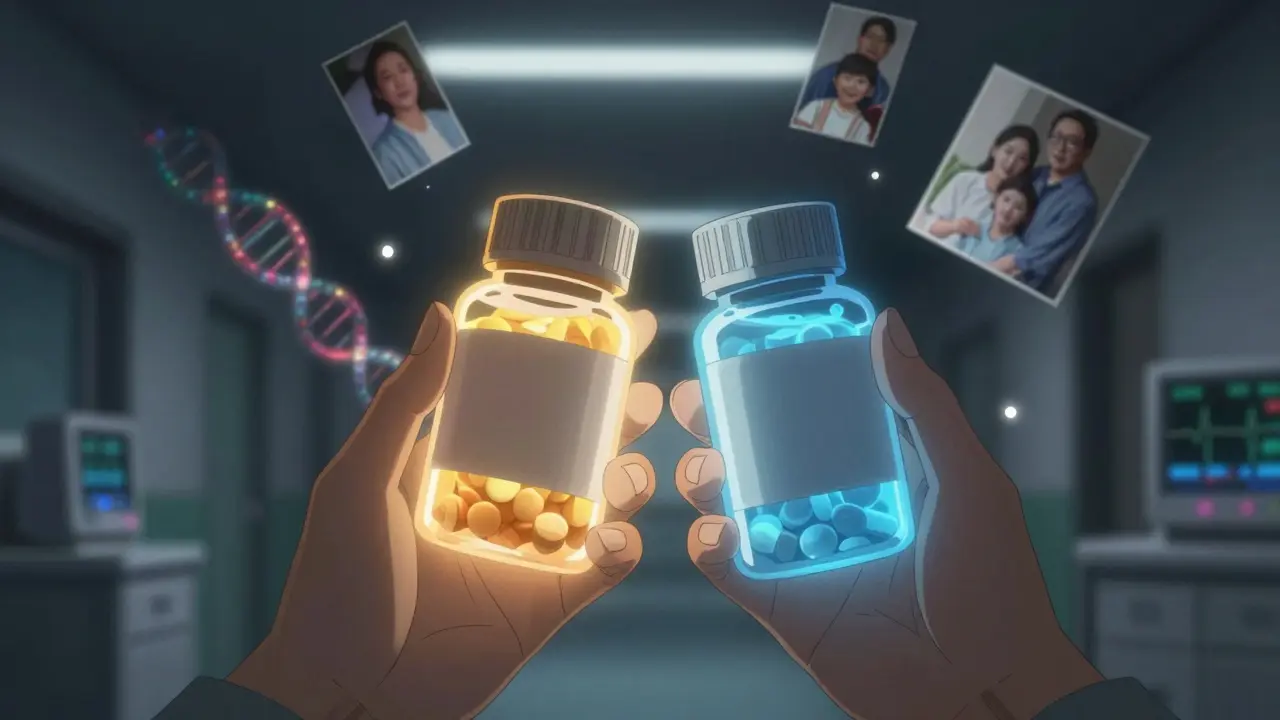
When you switch to a generic drug, you expect the same effect as the brand-name version. But what if your body reacts differently-not because the pill is weaker, but because of your genes? This isn’t science fiction. It’s happening right now, and your family history might hold the key to why.
Why Two People on the Same Generic Drug Have Different Results
Take two people with high blood pressure. Both get the same generic version of metoprolol. One feels fine. The other gets dizzy, tired, and ends up in the ER. Same pill. Same dose. Different outcomes. Why? The answer lies in how their bodies break down the drug. Around 25% of all medications, including common ones like antidepressants, beta-blockers, and painkillers, are processed by a group of liver enzymes called cytochrome P450. The most important of these is CYP2D6. This enzyme doesn’t work the same way in everyone. Some people have a version that breaks down drugs too fast. Others have one that barely works at all. And these differences? They’re inherited. If your parent had a bad reaction to a medication-like severe nausea from codeine or no relief from antidepressants-you might have the same genetic setup. That’s not coincidence. It’s genetics.What Your Genes Say About Your Medications
Your DNA contains specific genes that control how drugs are absorbed, processed, and eliminated. These are called pharmacogenes. The most studied ones include:- CYP2D6: Affects 25% of all drugs. Poor metabolizers can build up toxic levels of drugs like paroxetine or tramadol. Ultra-rapid metabolizers may get no pain relief from codeine because it turns into morphine too quickly.
- CYP2C9 and VKORC1: These determine how you respond to warfarin, a blood thinner. Some people need half the standard dose. Others need more. Getting it wrong can mean a stroke or a bleed.
- TPMT: Crucial for drugs like azathioprine, used in autoimmune diseases and cancer. If you have low TPMT activity, even a normal dose can destroy your bone marrow.
- DPYD: Affects 5-fluorouracil, a chemo drug. People with certain variants risk life-threatening toxicity. Testing before treatment can cut that risk by over 90%.
Family History Isn’t Just About Disease-It’s About Drugs
Most people know their family history of diabetes or heart disease. But how many know if their mom had a bad reaction to a common painkiller? Or if their dad’s antidepressant didn’t work for years until they switched? That’s pharmacogenetic history. And it matters. A 2023 Mayo Clinic study tracked 10,000 patients who got preemptive genetic testing. Over 40% had at least one high-risk gene-drug interaction. Of those, 67% had their meds changed-and adverse events dropped by 34%. That’s not a small win. That’s life-changing. One patient in that study had a DPYD variant. Her oncologist cut her chemo dose by 33% after seeing the results. She finished treatment without the vomiting, mouth sores, or infections that usually come with it. Another patient took a $350 GeneSight test and found out she was a CYP2D6 poor metabolizer. Her psychiatrist ignored the report. She ended up in the hospital with serotonin syndrome from sertraline. The difference? One doctor listened. One didn’t.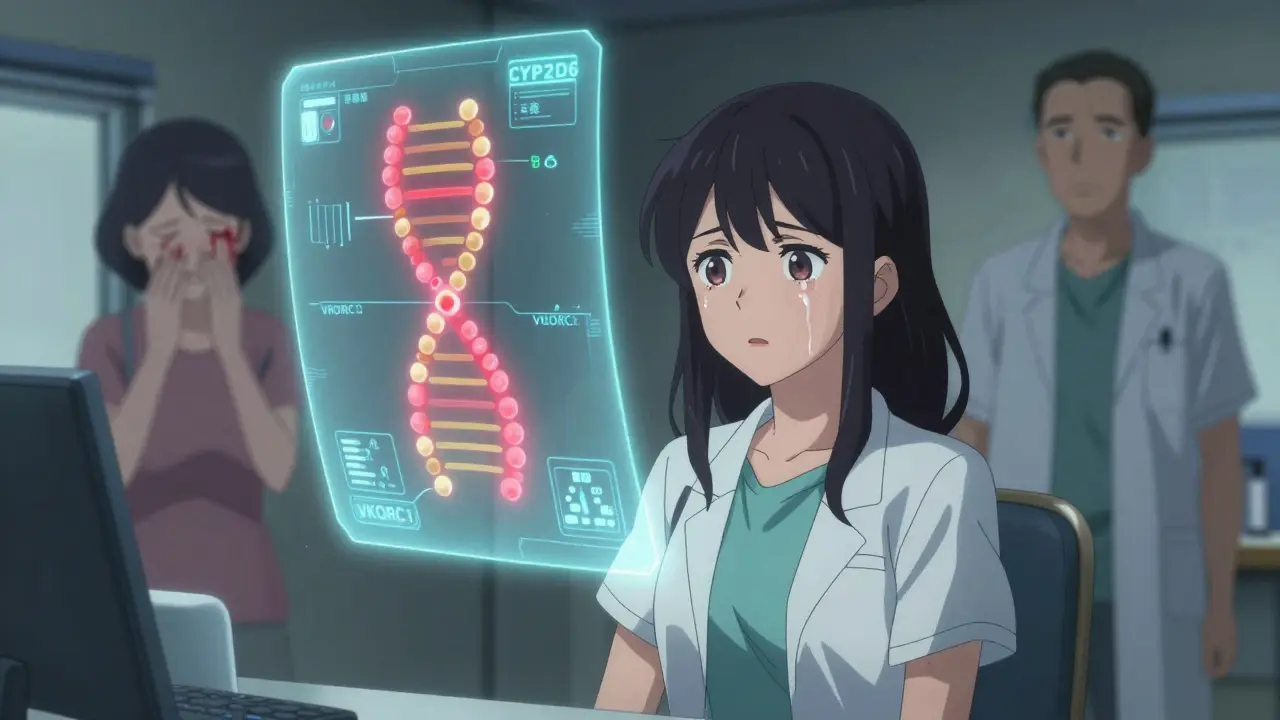
Why Generics Aren’t Always the Same for You
Generic drugs are required to have the same active ingredient as the brand. That’s the law. But they don’t have to match the exact inactive ingredients-fillers, coatings, binders. For most people, that doesn’t matter. But if your body is genetically wired to be extra sensitive to how a drug is released or absorbed, those small differences can make a difference. One person might switch from brand-name Zoloft to generic sertraline and feel fine. Another might feel worse-because the generic version dissolves slower in their stomach, and their slow-metabolizing CYP2D6 enzyme can’t handle the delayed release. This isn’t about generics being inferior. It’s about one-size-fits-all medicine failing people with unique biology.What’s Being Done-And What’s Not
The FDA now lists over 300 drugs with pharmacogenetic information on their labels. Warfarin’s label includes genetic dosing guidance. The Clinical Pharmacogenetics Implementation Consortium (CPIC) has published 24 guidelines for doctors on how to use genetic data to pick the right drug and dose. Some hospitals have made big moves. Mayo Clinic’s RIGHT program tested 83 gene-drug pairs in 167,000 patients. Over 12% had actionable results. Vanderbilt’s PREDICT program does the same. But outside academic centers? Not so much. A 2023 survey found only 32% of community hospitals offer any pharmacogenetic testing. Most primary care doctors don’t know how to read the results. One study showed only 32% of clinicians felt confident interpreting HLA-B*15:02 results linked to carbamazepine reactions-even though that variant can cause deadly skin rashes. And cost? Tests range from $249 to $499. Medicare covers some, but not all. Insurance doesn’t always pay. So unless you’re in a high-risk group-like someone about to start chemotherapy or a blood thinner-getting tested is still a personal choice.
What You Can Do Right Now
You don’t need a lab test to start using your family history. Here’s how:- Ask your family: Did anyone have a bad reaction to a medication? Unusual side effects? No effect from a drug that worked for others? Write it down.
- Bring it to your doctor: Don’t just say, “I think I’m sensitive.” Say, “My mom had severe bleeding on warfarin. My uncle’s antidepressant didn’t work for years. I want to make sure I’m not at risk.”
- Ask about alternatives: If you’re prescribed a drug known to be affected by genetics-like clopidogrel, codeine, or statins-ask if there’s a safer option based on your history.
- Consider testing if you’re on multiple meds: If you take three or more prescriptions, especially for mental health, pain, or heart conditions, pharmacogenetic testing could prevent a hospital visit.
The Future Is Personal
By 2025, 92% of academic medical centers plan to expand pharmacogenomic programs. The NIH spent $127 million on this research in 2023 alone. The All of Us program is returning genetic results to 1 million Americans. We’re moving away from guessing what works. We’re moving toward knowing. Generic drugs are cheaper. That’s good. But they’re not always the same for everyone. Your genes make you unique. Your family’s history with medications? That’s your personal pharmacogenetic map. Don’t assume a pill will work the same for you as it did for your sister. Don’t assume your doctor knows your family’s drug history. Ask. Share. Push for better. Your body doesn’t respond to pills the same way it responds to advice. It responds to your DNA. And that’s something you can-and should-understand.Can my family history predict how I’ll react to generic drugs?
Yes. If close relatives had bad reactions to medications-like severe side effects, no improvement, or dangerous interactions-it’s likely you share similar genetic variants. For example, if your parent had bleeding on warfarin or didn’t respond to antidepressants, you may carry the same CYP2C9, CYP2D6, or SLC6A4 variants. Family history is a strong early indicator of pharmacogenetic risk.
Do generic drugs work differently because of genetics?
The active ingredient in generics is identical to brand-name drugs. But your body’s ability to process that ingredient depends on your genes. If you’re a slow metabolizer, even a small change in how the generic is formulated-like coating or filler-can alter absorption. This doesn’t mean generics are inferior. It means your biology might need a tailored approach.
Is pharmacogenetic testing worth the cost?
For people taking multiple medications-especially antidepressants, blood thinners, painkillers, or chemotherapy-it often is. A Mayo Clinic study showed 67% of patients with high-risk results had their meds changed, reducing adverse events by 34%. For one person, that could mean avoiding hospitalization, organ damage, or death. Tests cost $249-$499. Many insurers cover them if ordered by a doctor for specific drugs.
Which drugs are most affected by genetics?
The top drugs include warfarin (CYP2C9, VKORC1), clopidogrel (CYP2C19), codeine and tramadol (CYP2D6), statins like pravastatin (HMGCR), antidepressants like SSRIs (CYP2D6, SLC6A4), and chemotherapy drugs like 5-fluorouracil (DPYD) and thiopurines (TPMT). These have strong, well-documented gene-drug links.
Can I get tested before switching to a generic?
Yes. If you’re planning to switch, ask your doctor about pharmacogenetic testing. Many labs offer panels that test for 10-20 key genes related to drug metabolism. Results can help determine whether a generic is safe for you-or if you need a different drug altogether. Testing before switching is smarter than waiting for a bad reaction.
15 Comments
January 7, 2026 Kiran Plaha
My dad had a bad reaction to codeine after surgery. We didn’t know why until I read this. Turns out he’s a CYP2D6 ultra-rapid metabolizer. Now I’m getting tested before my next prescription. Family history matters more than we think.
January 8, 2026 Matt Beck
Wow. 🤯 So our bodies are basically little biochemical factories with custom settings?? Like… if your genes are set to ‘turbo mode’ and you take codeine… BOOM 💥 morphine overload. And if you’re on ‘low gear’? Just… nothing. No relief. 😔 This isn’t medicine-it’s genetic roulette. And we’re still playing with the same old rules??
January 9, 2026 Ryan Barr
Genetics > placebo. End of story.
January 10, 2026 Cam Jane
Okay, I’m going to be real with you-this is the most important thing I’ve read all year. I’ve been on three different antidepressants over the last five years. Each one either made me feel like a zombie or did absolutely nothing. My mom had the same thing with her anxiety meds. We never connected the dots until now. If you’re on more than two prescriptions, especially for mental health or pain? Get tested. It’s not expensive compared to ER visits or lost months of your life. Your doctor might not bring it up, but that doesn’t mean you shouldn’t ask. Seriously. Do it. Your future self will thank you.
January 12, 2026 Dana Termini
This is exactly why I stopped trusting one-size-fits-all prescriptions. I had a cousin who bled out on warfarin. My grandma couldn’t tolerate statins. I didn’t realize those were genetic until I read this. Now I keep a little notebook of family drug reactions. I showed it to my cardiologist last month. He actually took notes. It felt good to be heard.
January 13, 2026 Wesley Pereira
so like… the pharma bros just don’t care? generics are cheaper so they don’t need to test for 100% compatibility? lmao. i mean, if your body can’t handle the filler in a generic pill because of your cyp2d6 variant, that’s not your fault. it’s the system’s. and yet we still act like patients are ‘non-compliant’ when things go wrong. 🤡
January 13, 2026 Isaac Jules
People are still dying because doctors won’t listen to genetics. This isn’t ‘alternative medicine.’ This is biochemistry. If your doctor doesn’t know what CYP2D6 is, they shouldn’t be prescribing SSRIs. Period. Stop trusting your GP like he’s a wizard with a magic pill book. He’s not. He’s winging it. And you’re the lab rat.
January 14, 2026 Amy Le
Why are we even letting corporations control our medicine? In America, we pay more for drugs than anyone else, then get told to ‘just take the generic.’ Meanwhile, in India or Germany, they test your genes before prescribing. We’re not progressive-we’re backward. And we’re proud of it? 🇺🇸
January 15, 2026 Pavan Vora
My aunt in Delhi had a bad reaction to paracetamol-skin rash, fever, hospital. We thought it was ‘allergy.’ Now I know: it was DPYD deficiency. My cousin has it too. We didn’t know it was genetic. This article made me cry. We need to tell more people in India about this. Not everyone can afford tests, but we can start asking questions. Please share this with your family.
January 16, 2026 Stuart Shield
It’s wild, isn’t it? We’ve got DNA that’s been passed down for millennia, whispering secrets about how we metabolize drugs-and we’re still treating medicine like it’s a one-size-fits-all hoodie. I mean, we don’t give the same shoe size to everyone, right? Why do we do it with pills? Your genes are your ancestors’ legacy. They’re not just about disease-they’re about survival. And now? They’re trying to tell us how to live.
January 16, 2026 Indra Triawan
I just feel like… everyone’s so obsessed with ‘personalized medicine’ but no one talks about how it’s only for the rich. My cousin got tested. Paid $400. Insurance denied it. Now she’s on a med that’s making her suicidal. Meanwhile, the doctor says ‘try a different generic.’ Like it’s that simple. We’re not talking about preferences. We’re talking about life and death. And it’s all… so quiet.
January 17, 2026 Susan Arlene
my grandma took lisinopril for 10 years. never had an issue. then she switched to generic and got dizzy all day. we thought she was just old. turns out the coating changed how it dissolved. her body needed the brand. she’s been on it since. no one ever asked why. just assumed she was ‘sensitive.’
January 19, 2026 Joann Absi
WHY ISN’T THIS ON THE NEWS?? 😭 I just found out my mom’s depression wasn’t ‘in her head’-it was her CYP2D6! She was on Zoloft for 8 years and it did NOTHING. Then they switched her to a different SSRI based on her genes? She’s smiling again. I’m screaming at my doctor right now to test me. This is the most important thing since the birth control pill. 🙏
January 20, 2026 Mukesh Pareek
Let me cut through the noise: if you’re taking more than 3 meds, you’re playing Russian roulette with your liver. CYP2D6, CYP2C9, TPMT-these aren’t buzzwords, they’re clinical red flags. Most clinicians don’t even know the CPIC guidelines. You’re not a patient. You’re a data point in a broken system. Get tested. Or don’t. But don’t blame the drug when your body shuts down.
January 20, 2026 Ashley S
So now we’re blaming the system for bad doctors? I’m tired of people acting like medicine is a conspiracy. If you don’t like your meds, stop taking them. Or find a better doctor. Stop making everything about genetics. Not everyone’s genes are ‘special.’ Some people just need to take their pills and stop complaining.
Write a comment