
Vitamin E Warfarin Risk Calculator
Assess Your Vitamin E Risk
This tool calculates bleeding risk when taking vitamin E supplements with warfarin. Based on clinical evidence, doses above 400 IU daily significantly increase bleeding risk.
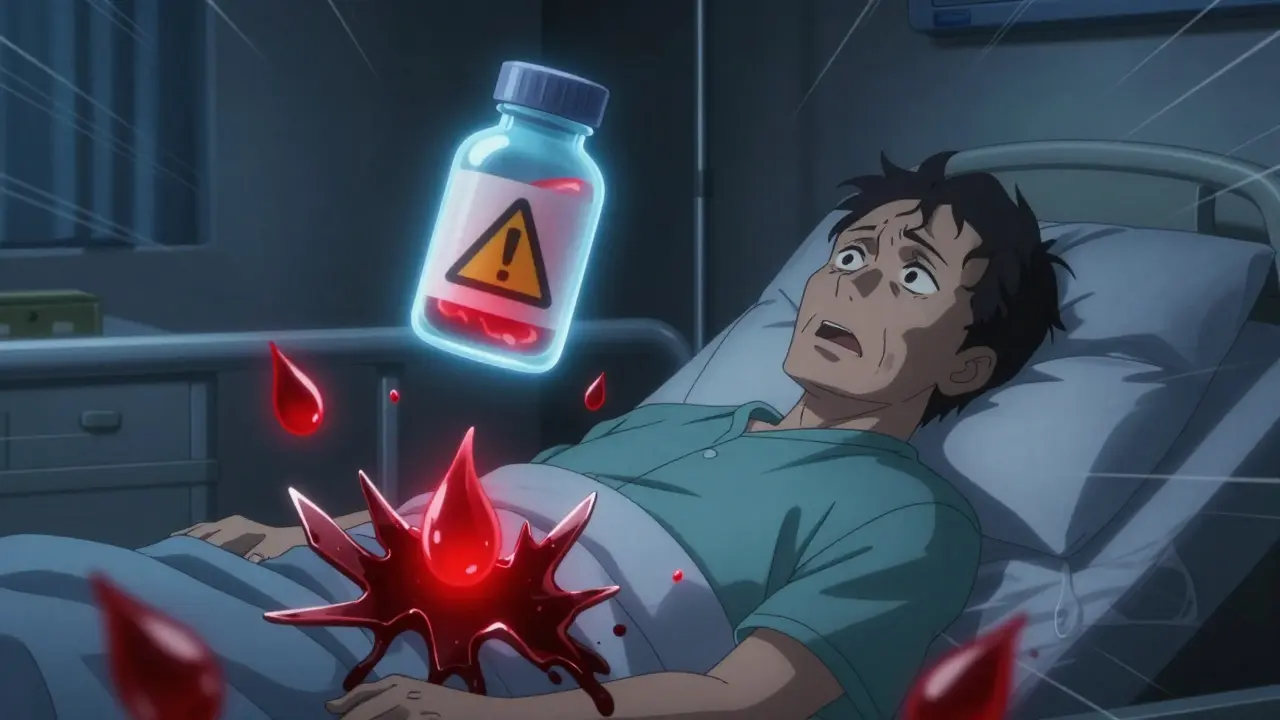
When you're on warfarin, even small changes in your daily routine can throw off your blood clotting balance. That includes something as simple as popping a vitamin E supplement. Many people assume natural means safe, but when it comes to warfarin, that’s not always true. A growing body of evidence shows that vitamin E-especially at doses above 400 IU daily-can boost warfarin’s effects and raise your risk of dangerous bleeding. This isn’t just a theory. It’s a real, documented risk that has sent patients to the ER with internal bleeding, brain hemorrhages, and uncontrolled bruising.
How Vitamin E Interferes with Warfarin
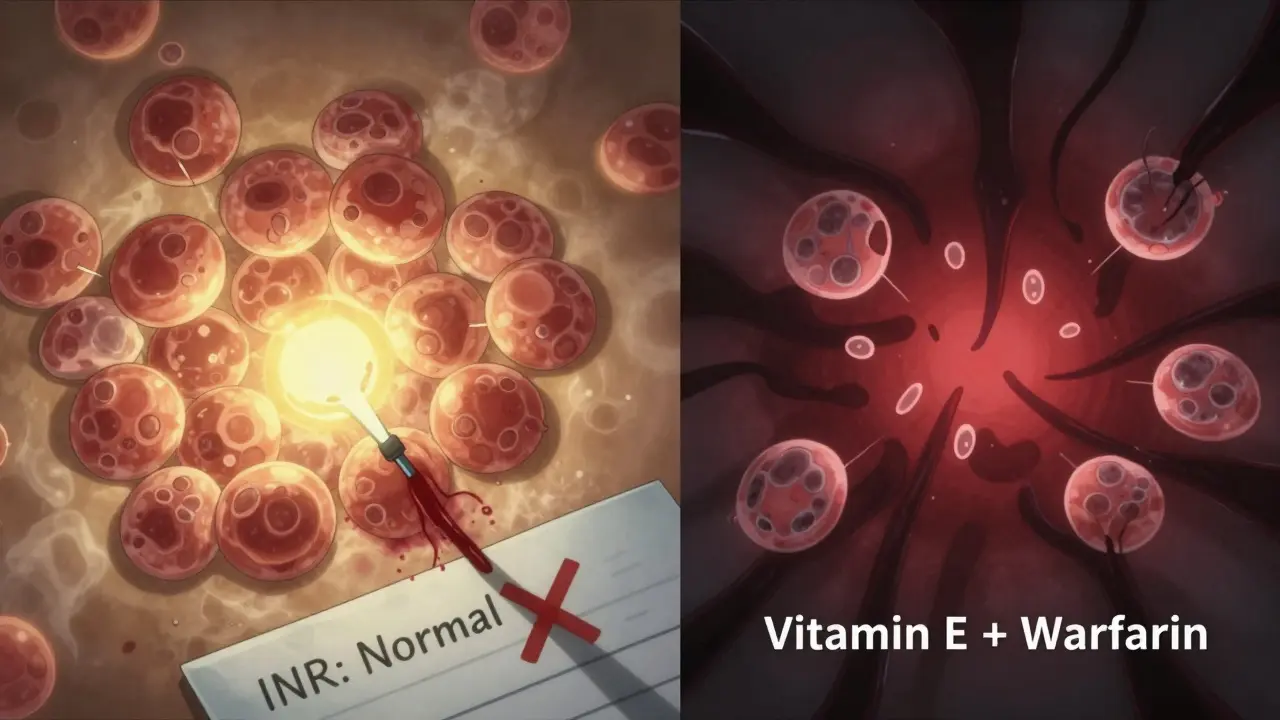
Warfarin works by blocking vitamin K, which your body needs to make clotting proteins. Without enough of those proteins, your blood takes longer to clot-good for preventing strokes and clots, but dangerous if you cut yourself or suffer an injury. Vitamin E doesn’t work the same way, but it adds to the problem. It doesn’t touch vitamin K directly. Instead, it messes with platelets, the tiny blood cells that help form clots at injury sites. Think of it like adding another brake to a car already slowing down. You don’t need to hit the gas to crash-you just need both brakes engaged.Studies show that vitamin E reduces platelet aggregation. That means your platelets stick together less easily, making it harder for your body to seal a cut. When you combine this with warfarin’s effect on clotting factors, the result isn’t just additive-it’s multiplicative. One 2013 study tracking over 1,000 atrial fibrillation patients found that those with higher vitamin E blood levels had nearly double the risk of major bleeding. The risk didn’t jump at 500 IU-it climbed steadily from 400 IU upward.
The Dosage Threshold That Matters
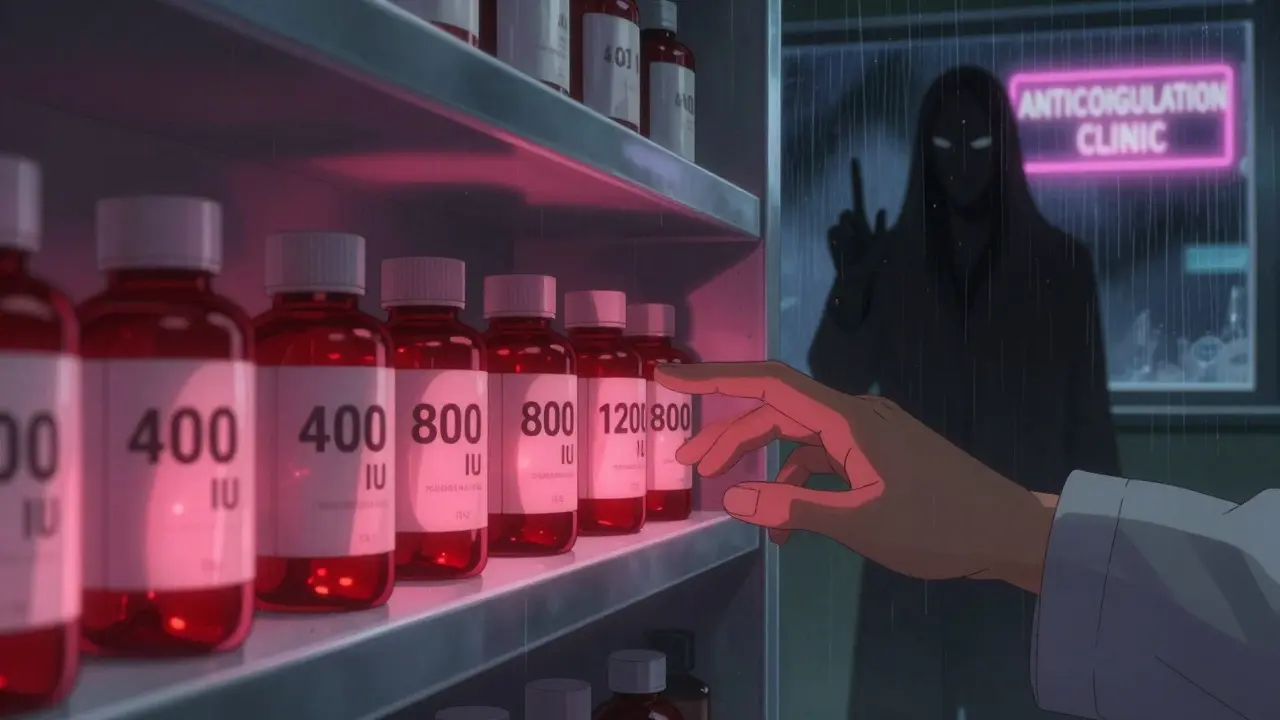
Not all vitamin E is created equal. The difference between safe and risky isn’t about whether you take it-it’s about how much. Most multivitamins contain 30-40 IU of vitamin E. That’s unlikely to cause issues. But many people take standalone supplements labeled as “high-potency” or “antioxidant support,” which often contain 400, 800, or even 1,200 IU per capsule. That’s where the danger kicks in.Multiple clinical guidelines now agree: 400 IU is the line in the sand. Below that, the risk is low. Above it, bleeding events rise sharply. A 2022 NIH update pointed out that while some early studies found no effect, those were short-term and used small groups. Real-world data from anticoagulation clinics tell a different story. In a survey of 250 clinics across the U.S., 78% routinely warn patients not to take vitamin E above 400 IU. Sixty-three percent explicitly forbid doses over that amount.
Even more troubling? The effects can be delayed. One case report described a patient who took 800 IU of vitamin E daily for four weeks with no change in INR-then suddenly started bleeding uncontrollably. The body doesn’t react immediately. It builds up. By the time symptoms appear, the damage may already be underway.
Who’s Most at Risk?
Not everyone on warfarin will react the same way. Genetics play a role. People with certain variations in the CYP2C9 or VKORC1 genes metabolize warfarin more slowly, making them more sensitive to any additional anticoagulant effect. Older adults, those with liver disease, or those already on other blood thinners (like aspirin or clopidogrel) are also at higher risk.But you don’t need a genetic test to know if you’re at risk. If you’ve had a recent drop in hemoglobin, unexplained bruising, nosebleeds that won’t stop, or dark stools, you should suspect a supplement interaction-even if your INR was “normal” last week. Vitamin E doesn’t always show up on routine INR tests. It affects platelets, not clotting factors directly. That’s why the 2013 study looked at vitamin E levels in the blood, not just INR numbers. They found serum levels above 4.49 μmol/mmol cholesterol were linked to any bleeding; above 5.56 μmol/mmol, the risk of major bleeding skyrocketed.
What the Guidelines Say
The American College of Chest Physicians (2012) gave this interaction a Grade 2C rating-meaning moderate evidence, weak recommendation. Translation: we’re not 100% sure, but we’re pretty sure it’s risky. The University of California San Diego Anticoagulation Service goes further: they outright recommend avoiding vitamin E in patients on warfarin. The European Society of Cardiology’s 2023 update even suggests measuring vitamin E levels in patients with unexplained bleeding.Meanwhile, the Coumadin (warfarin) package insert warns about herbal and botanical products-but doesn’t name vitamin E specifically. That’s partly because supplements aren’t regulated like drugs. The FDA can’t force manufacturers to test for interactions. So, if your bottle says “400 IU vitamin E,” there’s no guarantee the label is accurate. One 2021 independent lab test found 22% of vitamin E supplements contained 15-40% more than stated on the label.
What You Should Do
If you’re on warfarin:- Don’t start vitamin E without talking to your anticoagulation provider.
- If you’re already taking it-especially at 400 IU or higher-tell your doctor immediately. Don’t stop suddenly, but don’t keep taking it blindly either.
- Ask for a serum vitamin E test if you’ve had unexplained bleeding or INR spikes.
- Check every supplement label. Vitamin E is often hidden in multivitamins, fish oil blends, and heart health formulas.
- Consider alternatives. If you’re taking vitamin E for antioxidant support, talk to your doctor about safer options. Many of the benefits can be gained from food-nuts, seeds, spinach, and vegetable oils provide enough without the risk.
There’s no such thing as a “safe” dose if you’re on warfarin. There’s only a dose that’s less risky. And even then, it’s not zero.
Why This Isn’t Just a “Case Report”
You might have heard the 1996 study that claimed vitamin E was safe. It’s often cited in online forums. But that study had only 21 patients, lasted just 10 days, and measured INR only. It didn’t look at bleeding events, platelet function, or long-term serum levels. That’s like saying a car is safe because it started up once. Modern research uses bigger samples, longer timeframes, and real-world outcomes. The 2013 study had over 1,000 patients. It found 19 major bleeds-including brain hemorrhages-linked directly to vitamin E levels. That’s not noise. That’s a signal.And it’s getting louder. As supplement use grows-77% of Americans take at least one-clinicians are seeing more cases. The American Heart Association’s 2009 statement warned that high-dose vitamin E may increase hemorrhagic stroke risk. That’s not a hypothetical. It’s a documented outcome.
What About Other Supplements?
Vitamin E isn’t alone. Garlic, ginger, ginkgo, fish oil, turmeric, and even green tea can all increase bleeding risk with warfarin. But vitamin E is unique because:- It’s one of the most popular single-ingredient supplements
- It’s often taken without medical knowledge
- Its effects are delayed and cumulative
- It’s not routinely monitored
Many patients don’t even think of it as a “drug interaction.” They think, “It’s just a vitamin.” But vitamin E at high doses acts like a mild blood thinner. And when paired with warfarin, it’s like doubling down on a medication that already keeps your blood from clotting.
Bottom Line
If you’re on warfarin, vitamin E isn’t harmless. At doses above 400 IU daily, it’s a hidden risk factor for bleeding-especially in older adults, those with genetic sensitivity, or anyone with a history of falls or minor injuries. The evidence isn’t perfect, but it’s consistent enough that every major anticoagulation clinic in the U.S. and Europe now advises against it. Your INR might look fine. Your blood might not show signs. But inside your body, the balance is shifting. And when it tips, it can tip fast.Don’t guess. Don’t assume. Talk to your provider. And if you’re taking vitamin E-especially in high doses-stop. Or better yet, get tested. Your next INR might save your life.
Can I take vitamin E if I’m on warfarin?
It’s not recommended. While low doses (under 100 IU) may be safe for some, the risk increases sharply above 400 IU daily. Most anticoagulation clinics advise avoiding vitamin E supplements entirely if you’re on warfarin. If you’re already taking it, talk to your provider before stopping or continuing.
How does vitamin E increase bleeding risk with warfarin?
Vitamin E reduces platelet aggregation, making it harder for blood to clot at injury sites. Warfarin reduces clotting factor production. Together, they create a double effect: slower clotting and weaker platelet response. This combination raises the risk of uncontrolled bleeding, even if your INR is within range.
Is there a safe dose of vitamin E while on warfarin?
There’s no officially safe dose. Studies show no significant risk below 100-200 IU, but because effects are delayed and individual responses vary, most experts recommend avoiding all supplementation. Even small amounts can accumulate over time, especially in older adults or those with liver issues.
Why do some studies say vitamin E is safe?
Early studies, like the 1996 trial, were short-term and focused only on INR changes. They didn’t measure actual bleeding events, platelet function, or long-term serum levels. Modern research uses larger populations and real-world outcomes-and consistently finds higher bleeding rates in patients taking high-dose vitamin E. The old studies are outdated and incomplete.
Should I get my vitamin E levels checked?
Yes-if you’ve had unexplained bleeding, frequent INR spikes, or are taking high-dose supplements. Serum vitamin E levels above 4.49 μmol/mmol cholesterol are linked to increased bleeding risk. Some clinics now test for this in patients with unexplained hemorrhages. Ask your provider if it’s appropriate for you.
9 Comments
March 10, 2026 Randall Walker
So let me get this straight-you’re telling me my ‘natural’ antioxidant is basically a silent assassin when I’m on warfarin? Thanks for the heads-up, I was just about to double my dose for ‘anti-aging.’
March 11, 2026 Mike Winter
I appreciate the thorough breakdown, but I’m still uneasy about the blanket avoidance. There’s a difference between ‘risk’ and ‘certainty.’ The body isn’t a lab, and individual biochemistry varies wildly. I’ve been taking 400 IU for three years on warfarin-no bleeds, no INR spikes. Maybe the warning is more about liability than biology?
March 13, 2026 Chris Bird
This is why people die. They think vitamins are harmless. Vitamin E? It’s a blood thinner. Warfarin? Blood thinner. Put them together? You get a puddle. Simple.
March 14, 2026 David L. Thomas
The pharmacodynamic synergy here is fascinating-platelet inhibition + vitamin K antagonism creates a non-linear anticoagulant cascade. Most clinicians still rely on INR alone, but we’re missing the platelet component entirely. We need point-of-care platelet function assays in anticoagulation clinics. The data’s there; the infrastructure isn’t.
March 15, 2026 Bridgette Pulliam
I’ve been on warfarin for 8 years. I took vitamin E because my friend said it helped her skin. Then I started bruising like I was in a boxing match. My doctor said, ‘Stop it.’ I did. No more purple arms. I’m not mad-I’m just glad I listened. If you’re on warfarin, don’t play roulette with supplements.
March 15, 2026 Shourya Tanay
The CYP2C9 polymorphism data is particularly compelling. If you’re a poor metabolizer, even 200 IU may tip you over the edge. The fact that this isn’t routinely screened for is a systemic failure. We’re treating a dynamic, polypharmacological state with a static INR metric. It’s like using a speedometer to diagnose engine failure.
March 17, 2026 LiV Beau
I’m so glad someone finally broke this down! 🙌 I’ve been telling everyone I know on blood thinners to skip the supplements. I used to take 800 IU for ‘heart health’-now I get my vitamin E from almonds and spinach. 🌿 And yes, my INR is stable. No more panic visits to the clinic. 💙
March 19, 2026 Adam Kleinberg
This is all corporate pharma fear-mongering. Vitamin E is natural. Warfarin is synthetic. The FDA doesn’t regulate supplements because they don’t want you to know the truth-big pharma profits from bleeding events. They want you dependent on INR checks and expensive blood tests. Wake up.
March 19, 2026 Denise Jordan
I read this whole thing. Honestly? I think it’s overblown. People have been taking vitamin E for decades. If it was that dangerous, wouldn’t we see more headlines? I’m keeping mine.
Write a comment