
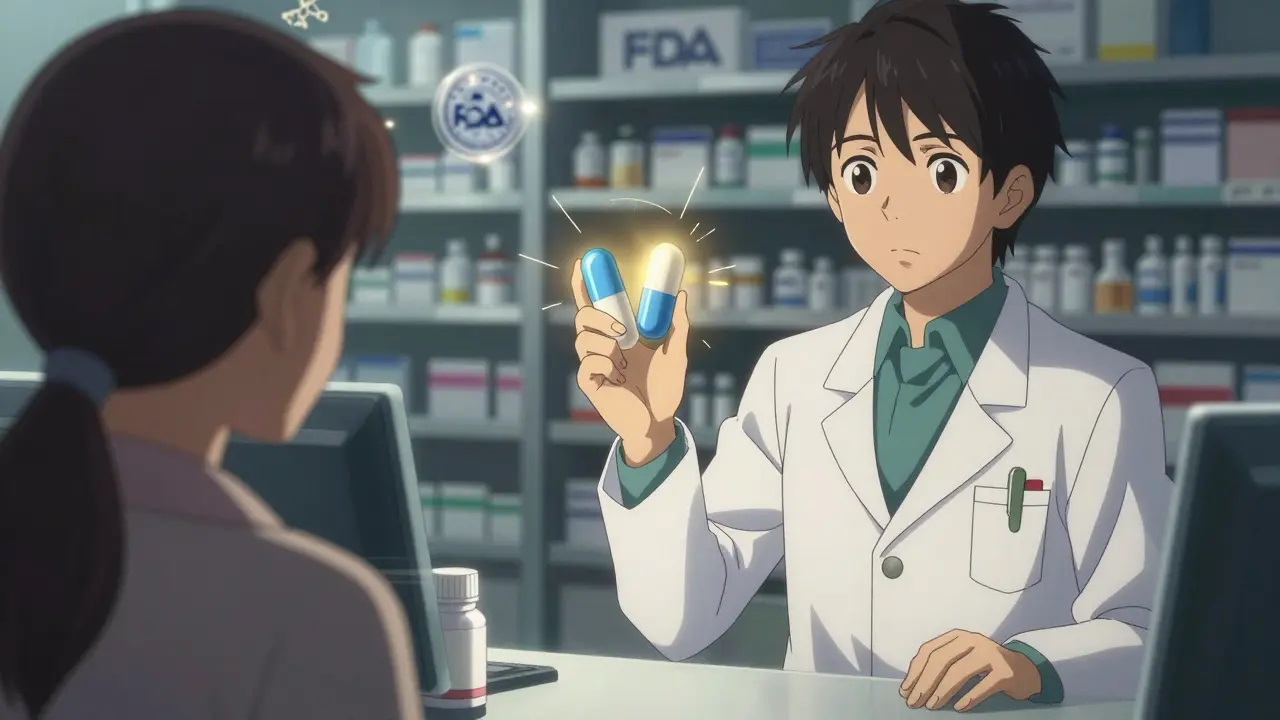
When a patient picks up a prescription and sees a pill that looks completely different from what they’ve been taking, it’s natural to wonder: Is this really the same medicine? For providers, especially pharmacists, this moment is critical. It’s not just about filling a script-it’s about building trust, clearing up myths, and ensuring the patient actually takes the drug they need.
Generic drugs aren’t cheap knockoffs. They’re FDA-approved copies of brand-name drugs that contain the exact same active ingredient, strength, and dosage form. They work the same way, in the same amount of time, and with the same safety profile. The difference? Price. Generics cost, on average, 80-85% less. In 2023, 90% of all prescriptions filled in the U.S. were generics-and they saved the healthcare system $373 billion that year.
Yet, despite the numbers, many patients still hesitate. Some worry the pill looks different. Others think if it’s cheaper, it must be weaker. A study in the Journal of General Internal Medicine found that nearly 3 in 10 patients are nervous about switching from brand to generic. And when they’re not properly counseled, adherence drops.
Why Patients Doubt Generics-And What to Say
The biggest concern isn’t science. It’s appearance.
Patients recognize their medication by color, shape, and imprint. When a blue oval becomes a white capsule, they assume something changed. But that’s because of trademark laws. Generic manufacturers can’t copy the exact look of the brand-name drug. So they change the shape, color, or coating. The active ingredient? Still identical.
Here’s what works: Start with honesty. Don’t say, “It’s the same.” Say, “This pill has the same medicine inside as your old one, but it looks different because of how it’s made. The FDA requires it to work exactly the same way.”
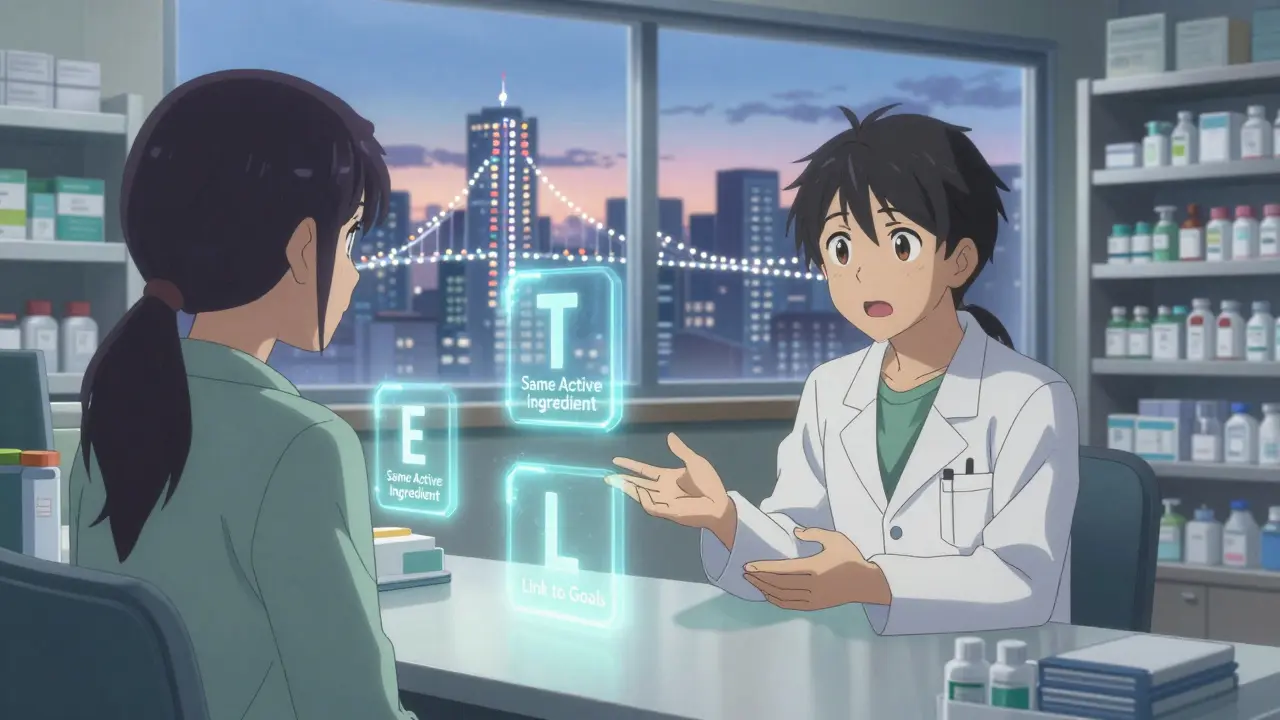
Use the TELL framework: Tell them generics have the same active ingredient. Explain why the pill looks different. Listen to their worries-don’t interrupt. Link the switch to their goals: “This change means you’ll save $150 a month, so you can keep taking it without worrying about the bill.”
A 2022 GoodRx survey showed that 78% of patients who got a clear explanation were satisfied. Only 42% of those who got a quick “It’s fine” felt the same.
What the Science Actually Says
There’s a myth that generics are less effective. They’re not.
The FDA requires bioequivalence testing: the generic must deliver the same amount of active ingredient into the bloodstream within 80-125% of the brand-name drug. That’s a tight range-tighter than the variation you’d see between two different batches of the same brand-name drug.
A 2008 review of 47 studies involving over 9,000 patients found no meaningful difference in outcomes between generic and brand-name cardiovascular drugs. Same for antidepressants, diabetes meds, and blood pressure pills.
Even for drugs with narrow therapeutic windows-like warfarin or levothyroxine-FDA requires extra scrutiny. Generics for these drugs must meet stricter bioequivalence standards. And in real-world use, studies show no increase in adverse events when switching.
So why do some patients say, “The white pill didn’t work”? Often, it’s the placebo effect-or a change in inactive ingredients. A small number of people react to dyes or fillers. That’s rare, but real. If a patient reports a new side effect after switching, don’t dismiss it. Check the label. Maybe the new generic uses a different coating or coloring. Switch back to the original generic or try another manufacturer.
When Generics Are the Best Choice
Generics shine where cost is a barrier.
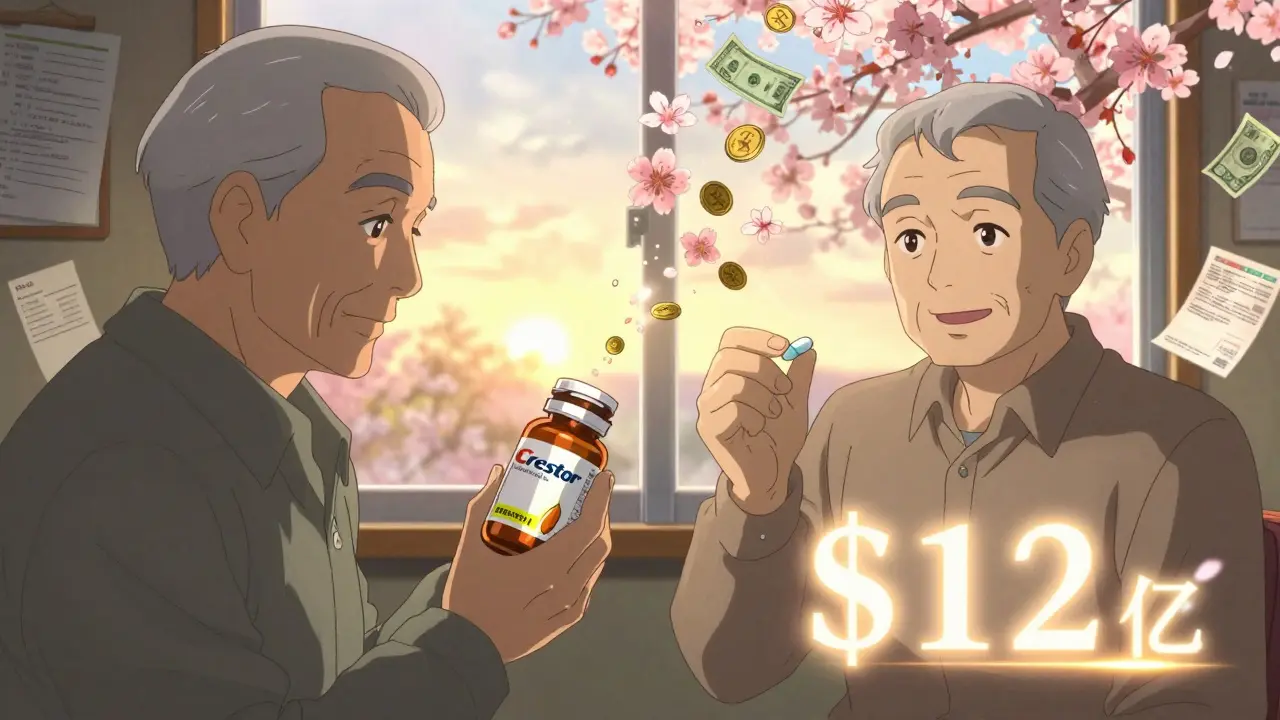
Think of a 68-year-old on Medicare taking rosuvastatin. The brand-name Crestor costs $280 a month. The generic? $12. That’s not a savings-it’s a lifeline. Without the generic, many would skip doses or stop entirely.
Chronic conditions are where generics make the biggest difference. High blood pressure, cholesterol, asthma, diabetes-these require daily meds for years. If the price is too high, adherence plummets. Generics fix that.
Insurance companies know this. Over 80% of health plans put generics in the lowest cost tier. Some even require them before covering brand-name versions. That’s not just policy-it’s smart care.
What to Do When Patients Push Back
Some patients will say: “My doctor prescribed the brand. I want that.”
Don’t argue. Ask why. Maybe they had a bad experience years ago. Maybe they heard a story from a friend. Maybe they associate the brand with “better quality.”
Use the teach-back method. After explaining, ask: “Can you tell me in your own words why this generic is safe to take?” If they can repeat it back correctly, they’re more likely to stick with it. Studies show this boosts retention by 40%.
If they still refuse, don’t force it. Offer an authorized generic. That’s the brand-name company’s own generic version-same pill, same packaging, just cheaper. For example, the authorized generic for Lipitor is made by Pfizer. It looks and tastes just like the brand. That often eases the transition.
And if they’re still unsure? Offer to call the prescriber together. Sometimes, hearing it from their doctor makes all the difference.
How Pharmacists Are Changing the Game
Pharmacists are the most trusted source for generic info. Sixty-seven percent of patients get their info about generics from their pharmacist-not their doctor.
That’s a huge responsibility. And a huge opportunity.
Top-performing pharmacies now schedule 3-5 minute counseling sessions for every generic switch. They use checklists. They document concerns. They follow up in a week.
One pharmacy chain in Bristol saw adherence to cholesterol meds jump from 62% to 81% after implementing structured generic counseling. The key? They didn’t assume patients understood. They asked. They listened. They explained.
Training helps. The American Pharmacists Association offers a certification in communicating about generics. Pharmacists who complete it report a 65% boost in confidence. That confidence translates to better patient outcomes.
The Bigger Picture: Generics Are Here to Stay
The global generic market is expected to hit $753 billion by 2030. More biosimilars-complex generics for biologic drugs like insulin and rheumatoid arthritis treatments-are coming. The FDA approved 43 biosimilars by the end of 2023.
These aren’t just cheaper drugs. They’re essential tools to make healthcare sustainable.
But they only work if patients take them. And patients only take them if they trust them.
That’s where you come in. Not as a salesperson. Not as a bureaucrat. As a guide.
When you take five minutes to explain the science, validate the concern, and connect the cost to the patient’s life-you’re not just filling a prescription. You’re helping someone stay healthy.
And that’s the real win.
Are generic drugs really as effective as brand-name drugs?
Yes. Generic drugs must meet the same FDA standards as brand-name drugs. They contain the same active ingredient, in the same strength and dosage form, and must prove they deliver the same amount of medicine into the bloodstream at the same rate. Studies involving thousands of patients show no meaningful difference in effectiveness for conditions like high blood pressure, diabetes, or depression.
Why do generic pills look different from brand-name ones?
Trademark laws prevent generic manufacturers from copying the exact appearance of brand-name drugs. So they change the color, shape, or coating. These differences are only in inactive ingredients-like dyes or fillers-which don’t affect how the medicine works. The active ingredient is identical.
Can switching to a generic cause side effects?
Rarely. Most side effects are caused by the active ingredient, which doesn’t change. But some people are sensitive to inactive ingredients like dyes or fillers. If a patient reports new symptoms after switching, check the label of the new generic. Switching to a different manufacturer’s version may help. Always document the concern and follow up.
Are generics safe for chronic conditions like thyroid disease or epilepsy?
Yes. The FDA requires stricter bioequivalence testing for drugs with narrow therapeutic windows-like levothyroxine or phenytoin. All approved generics meet these higher standards. While some providers prefer to keep patients on the same generic manufacturer for consistency, switching between FDA-approved generics is safe and effective for the vast majority of patients.
What if my patient insists on the brand-name drug?
Don’t argue. Ask why. They may have had a bad experience, heard misinformation, or simply feel more comfortable with the brand. Offer an authorized generic-it’s made by the original brand company and looks identical. If they still refuse, respect their choice but document the conversation. You can also suggest calling the prescriber together to discuss options.
How much money can patients save with generics?
On average, patients save 80-85% per prescription. For example, switching from brand-name Crestor to generic rosuvastatin can cut a $280 monthly bill to $12. Medicare beneficiaries saved an average of $1,269 per year in 2022 thanks to generics. For chronic conditions, that adds up to thousands over time.
Is there a difference between generic manufacturers?
All FDA-approved generics must meet the same standards, so effectiveness is consistent. But inactive ingredients (like fillers or coatings) can vary between manufacturers. This is why some patients report different experiences with different generics. If a patient has a negative reaction, try switching to another manufacturer’s version. Most pharmacies can help with this.
What to Do Next
Start small. Pick one patient this week who’s on a brand-name drug. Ask them if they know it has a generic version. If they don’t, take three minutes to explain. Use the TELL method. Ask them what they’re worried about. Then listen.
Document the conversation. Even a simple note in the chart-“Patient counseled on generic rosuvastatin; expressed concern about appearance; reassured with FDA equivalence data”-makes a difference.
And if you’re not already using the teach-back method? Try it. Ask the patient to explain back what you told them. You’ll be surprised how often they misunderstand-even when they say they get it.
Generics aren’t just about saving money. They’re about making sure patients can keep taking their meds. And that’s the whole point.
15 Comments
January 27, 2026 Curtis Younker
Let me tell you, I’ve seen this play out a hundred times-patients staring at their new generic pill like it’s a alien artifact. I had this one guy come in furious because his blood pressure med went from a blue oval to a white capsule. I showed him the FDA’s bioequivalence charts, broke down the active ingredient, and even pulled up the manufacturer’s lot number. He didn’t believe me until I said, ‘If this pill didn’t work, your body would’ve told you by now-and you’d be in the ER, not my counter.’ He left with a smile and a $140 savings. That’s the power of clarity, not just compliance. Don’t just say it’s the same-show them why it matters to their wallet, their health, their life.
Generics aren’t ‘cheap alternatives.’ They’re the backbone of accessible medicine. And if you’re not explaining that to your patients, you’re doing them a disservice. It’s not about pushing pills-it’s about empowering people to stay healthy without going broke.
I’ve started printing little one-pagers with the TELL framework for my staff. We hand them out with every generic switch. Results? Adherence’s up 30% in six months. Simple. Human. Effective. We’re not pharmacists-we’re health translators.
January 28, 2026 Shawn Raja
Oh wow. A whole article about how to tell people the truth. Groundbreaking. The FDA says it’s the same, so it’s the same. Who knew? I mean, I guess if you’re a pharmaceutical exec trying to sell more brand-name drugs, you’d want people to believe the white pill is ‘less real.’ But hey, at least now we have a 12-page manifesto on why your grandma’s $12 statin isn’t secretly made in a basement with expired yeast.
Meanwhile, in India, people take generics for everything-antibiotics, insulin, even cancer drugs-and don’t have time to fuss over color. They’re too busy surviving. Meanwhile, we’ve turned pharmacy counters into therapy sessions for pill anxiety. Maybe we should just stop calling them ‘generics’ and call them ‘real drugs.’
Also, why is every single patient in this article white and middle-aged? What about the 70-year-old immigrant who doesn’t speak English and just wants the blue pill? You didn’t mention that. Just like you didn’t mention how brand-name companies still own 40% of the generic market. But hey, keep preaching to the choir. The system’s working great, right?
January 29, 2026 Ryan W
Incorrect terminology. The FDA does not require generics to be ‘identical.’ They require bioequivalence within 80–125% AUC and Cmax ranges. That’s a 45% window. That’s not identical. That’s statistically acceptable variance. And while 90% of prescriptions are generic, that doesn’t mean efficacy is uniform. Variability in excipients can alter dissolution profiles-especially with enteric-coated or extended-release formulations. You cite a 2008 review, but that study excluded neurologic and psychiatric drugs with narrow therapeutic indices. Levothyroxine? The 2017 FDA guidance explicitly warns against switching manufacturers without monitoring TSH. This isn’t about trust-it’s about pharmacokinetic rigor. Stop romanticizing cost savings as clinical equivalence. It’s dangerous.
Also, ‘authorized generic’ is not a regulatory term. It’s a marketing term. Pfizer doesn’t make a ‘generic Lipitor.’ They make Lipitor under a different label. That’s not generic-that’s the brand with a different sticker.
And your TELL framework? It’s emotional manipulation dressed as education. You’re not counseling. You’re conditioning.
January 31, 2026 Henry Jenkins
I’ve been thinking a lot about this lately. It’s fascinating how much of our trust in medicine is tied to appearance. We’ve been trained to equate visual familiarity with safety. That’s not science-that’s psychology. And it’s not just patients. I’ve seen doctors hesitate to switch patients to generics too, even when they know the data. Why? Because they’re afraid of being blamed if something goes wrong.
But here’s the thing: the real risk isn’t the pill. It’s the silence. When we don’t explain, we leave space for fear to grow. And fear doesn’t care about bioequivalence. Fear cares about stories. A cousin’s bad reaction. A TV ad. A Reddit thread.
So maybe the real solution isn’t more data. It’s more storytelling. Not just TELL-but SHOW. Bring in the old pill. Show the new one. Let them hold them. Let them see the same active ingredient listed on both. Let them feel the weight difference. Make it tactile.
And for the love of science, stop saying ‘it’s the same.’ Say ‘it’s the same medicine, just dressed differently.’ That’s not just semantics-it’s cognitive framing. It changes how the brain processes the change.
January 31, 2026 Aishah Bango
This is exactly why America is falling apart. People don’t care about science. They care about ‘brand.’ They want the blue pill because it’s ‘the real one.’ And now we’re supposed to kiss their butts and coddle their ignorance with TELL frameworks and pamphlets? No. If you can’t afford your meds, get on assistance. If you’re too lazy to read the label, that’s your problem. Stop rewarding people for being paranoid and uneducated. The government already pays for these drugs-don’t make pharmacists into emotional babysitters.
Also, generics are often made in China or India. Do you even know what’s in them? I don’t trust foreign factories. The FDA can’t inspect every plant. So don’t tell me it’s ‘safe.’ It’s not. It’s a gamble. And I won’t be the one telling my grandma to swallow a mystery pill just to save $150.
February 1, 2026 Simran Kaur
Oh my god, this made me cry. I’m from India, where we’ve been using generics for decades because we have no choice. My aunt took generic levothyroxine for 12 years. She never missed a dose. She’s still alive, healthy, and dancing at weddings. Here in the U.S., I see people treating medicine like it’s a luxury item. Like the color of the pill matters more than their life.
I remember when I first came to America and saw a patient refuse a generic because it was ‘too small.’ I wanted to hug them and say: ‘Baby, your body doesn’t care about the shape. It cares about the medicine inside.’
But I didn’t. I just smiled and said, ‘Let me show you something.’ I pulled out my phone, showed them a photo of my aunt’s medicine bottle from Mumbai-same active ingredient, different color, different shape-and said, ‘This is what real saving looks like.’ They cried. We hugged. They took the pill.
Generics aren’t just cheaper. They’re a quiet act of love. And we’ve forgotten that.
February 2, 2026 Jessica Knuteson
The whole thing is performative. You think people care about the science? They care about the brand because the brand made them feel something. The generic doesn’t have a TV ad. Doesn’t have a jingle. Doesn’t have a story. So they feel abandoned. That’s not ignorance. That’s capitalism. And you’re just the guy who gets paid to soothe the wound while the machine keeps bleeding them dry.
February 3, 2026 Geoff Miskinis
Utterly predictable. A long-winded, emotionally manipulative piece disguised as clinical guidance. The TELL framework? That’s not evidence-based medicine-that’s a sales script from a pharma marketing seminar. And let’s be honest: the real reason generics are pushed is because insurers and PBMs are squeezing margins. Patients are collateral.
And the claim that ‘90% of prescriptions are generics’? Meaningless without context. Most are for antibiotics, antihistamines, and NSAIDs-drugs where bioequivalence is trivial. But for antiepileptics? Anticoagulants? Psychotropics? The data is murkier. And yet, you gloss over it. Classic American optimism: if you say it loud enough, it becomes true.
Also, ‘authorized generic’ is a loophole. Not a solution. And ‘the pharmacist is the most trusted source’? That’s not a win. That’s a failure of the entire medical system.
February 5, 2026 Betty Bomber
I just had a patient yesterday who refused the generic because the pill was ‘too white.’ I didn’t argue. I just said, ‘Okay, let’s see what your doctor says.’ She called him. He said, ‘It’s fine.’ She took it. No drama. No pamphlets. Just a 30-second conversation. Sometimes the best counseling is knowing when to shut up.
February 6, 2026 Renia Pyles
You’re all lying. Generics are worse. I switched to a generic for my anxiety med and felt like I was drowning in slow motion for three weeks. The brand? Perfect. The generic? Toxic. The FDA doesn’t care. Your ‘studies’ are paid for by Big Pharma. I’m not your guinea pig. And no, I won’t take your ‘authorized generic’-I know what that really means. You’re just trying to get me to take the cheap stuff so you can keep your job. I’m not falling for it.
February 8, 2026 Ashley Porter
From a clinical pharmacy standpoint, the real issue isn’t patient perception-it’s supply chain fragmentation. With 15+ manufacturers for a single generic, the excipient variability can lead to inconsistent dissolution kinetics. Especially with BCS Class II drugs. The FDA’s 80–125% bioequivalence window is a population-level metric. Individual pharmacokinetic variability? Not captured.
And yet, we’re expected to treat all generics as interchangeable. That’s not pharmacology. That’s logistics masquerading as science. We need batch-level tracking and patient-specific bioequivalence monitoring. Until then, we’re playing Russian roulette with chronic disease management.
February 8, 2026 shivam utkresth
Man, this hit different. In India, we don’t have the luxury of brand loyalty. My uncle takes generic metformin, generic atorvastatin, even generic insulin. He’s 72. Still walks three miles a day. No hospital visits in five years. We don’t care what the pill looks like-we care that it keeps him alive.
But here’s the thing: I’ve seen American patients get mad because the generic was ‘too small’ or ‘too bitter.’ And I thought-why? It’s the same medicine. Then I realized: it’s not about the pill. It’s about control. When you’re sick, you want something familiar. Something that says, ‘I’m still me.’
So yeah, use TELL. But also, let them hold the pill. Let them smell it. Let them feel the difference. Then say, ‘This is the same heart medicine. Just cheaper. And it’s saving your life.’
That’s not counseling. That’s dignity.
February 10, 2026 John Wippler
I’ve been doing this for 22 years. I’ve seen patients cry because they thought the generic was ‘fake.’ I’ve seen them refuse to take it, then show up two weeks later with a $2,000 ER bill because they stopped their blood pressure med.
Here’s what I’ve learned: people don’t hate generics. They hate feeling powerless. So I don’t start with science. I start with: ‘I know this looks weird. I’d be freaked out too.’
Then I say, ‘But here’s what’s not weird-your body doesn’t know the difference. And you’re still gonna live.’
Then I hand them the bottle. ‘Look. Same active ingredient. Same strength. Same expiration. Just a different face.’
And then I ask, ‘What’s more important? The color… or your next birthday?’
Most of them just nod. And that’s when the real work begins.
Because healing isn’t about pills. It’s about hope. And sometimes, hope comes in a white capsule.
February 12, 2026 Aurelie L.
I don't care.
February 13, 2026 Curtis Younker
Wait-I just saw Jessica’s comment. And I’m thinking… she’s not wrong. But she’s also not the whole story. The system is broken. But we’re not the system. We’re the people who show up anyway. Even when patients are scared. Even when insurers are cheap. Even when the FDA’s data is imperfect.
I had a patient last week who said, ‘I don’t trust the white pill.’ I didn’t argue. I said, ‘I get it. I don’t trust the blue one either. But I trust the science behind it.’ Then I gave her a sample of the authorized generic-same look, same name, same pill, just cheaper.
She took it. Two weeks later, she brought me a cookie. Said, ‘I didn’t die. And I saved $130.’
That’s not policy. That’s human.
So yeah, the system’s rigged. But we still get to choose how we show up. And I choose to be the one who says, ‘Here. Take this. You’re worth more than your bill.’
Write a comment