
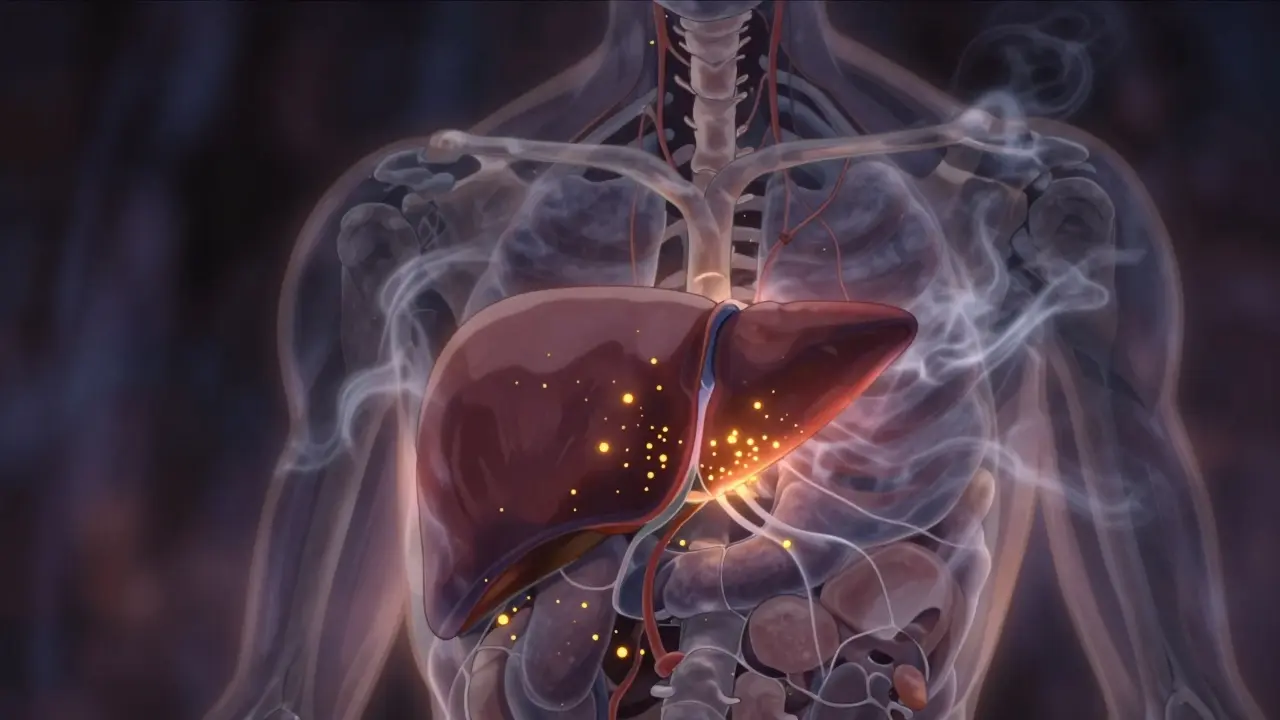
When you’re over 65, your body doesn’t process medications the same way it did when you were 40. It’s not about being weak or slow-it’s about biology. Your liver and kidneys, the two main organs that clear drugs from your system, change as you age. And those changes can turn a safe dose into a dangerous one.
What Happens to Your Liver as You Age?
Your liver shrinks. By the time you reach 70, it’s about 30% smaller than it was in your 30s. Blood flow to the liver drops by nearly 40%. That means drugs don’t get processed as quickly. Some medications rely on the liver to break them down before they enter your bloodstream. When that process slows, those drugs build up. You might feel dizzy, confused, or overly sleepy-not because the drug is too strong, but because your body can’t clear it fast enough.Not all drugs are affected the same. Some, like propranolol, lidocaine, and morphine, are called flow-limited. Their clearance depends almost entirely on how much blood reaches the liver. When blood flow drops, these drugs stick around longer. For someone over 75, their blood levels could be 40% higher than a younger person taking the same dose.
Other drugs, like diazepam, phenytoin, and theophylline, are capacity-limited. Their breakdown depends more on enzyme activity than blood flow. Here, the news is better: enzyme levels stay fairly stable with age. These drugs may only see a 10-15% drop in clearance. That doesn’t mean they’re safe without adjustment-but the risk is lower.
Then there’s the tricky case of prodrugs. These are inactive until the liver turns them into their active form. Perindopril, a blood pressure drug, is one example. In older adults, that conversion happens slower. You might think the medicine isn’t working-but it’s not that it’s ineffective. It’s just taking longer to kick in.
How Kidney Changes Impact Medication Clearance
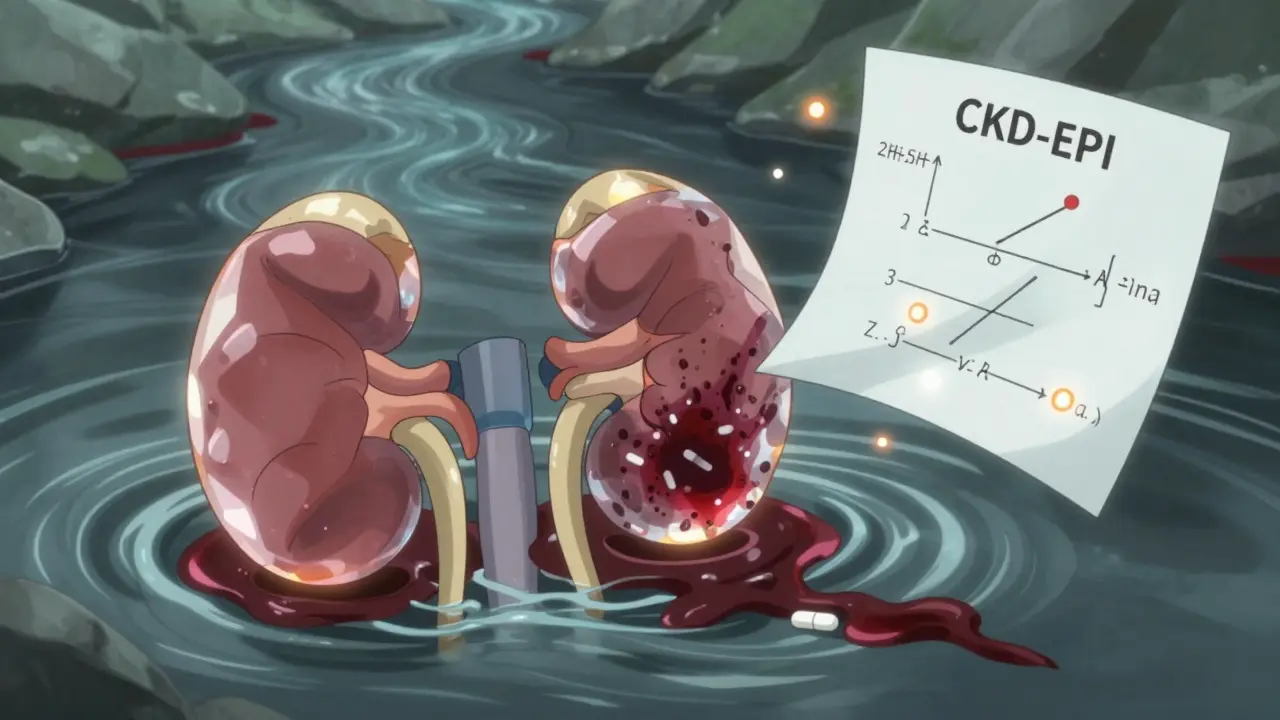
Your kidneys filter waste-and drugs-from your blood. As you age, your glomerular filtration rate (GFR) drops by 30-50% between ages 30 and 80. That’s a huge change. Many drugs, like metformin, digoxin, and vancomycin, are cleared almost entirely by the kidneys. If your kidneys aren’t filtering well, these drugs accumulate. That’s why kidney function, not just age, determines dosing.Here’s the catch: your blood test for creatinine might look normal. That’s because muscle mass decreases with age, and creatinine comes from muscle. So even if your kidneys are failing, your creatinine level can stay in the “normal” range. That’s why doctors need to calculate your estimated GFR using the CKD-EPI equation-not just rely on creatinine alone.
Doctors use the Cockcroft-Gault or CKD-EPI formulas to estimate kidney function. These numbers tell them how much to reduce your dose. For example, a standard dose of metformin can cause lactic acidosis in someone with reduced kidney function. But cut the dose by half based on GFR, and it’s safe.
Why Drug Interactions Get Riskier After 65
Most older adults take five or more medications. The 2017-2018 NHANES survey found that 41% of adults over 65 were taking five or more prescription drugs. That’s a recipe for trouble.Take acetaminophen. It’s in hundreds of over-the-counter cold and pain meds. Most people think it’s harmless. But in older adults with reduced liver function, even 3,000 mg a day-a common daily dose-can cause liver damage. The Acetaminophen Hepatotoxicity Registry shows it’s responsible for half of all acute liver failure cases in seniors.
Or consider amitriptyline, an old antidepressant still prescribed for nerve pain. It’s metabolized by the liver and cleared slowly in older adults. One Reddit user, “CaregiverInMA,” shared how their 82-year-old mother started on a standard 25 mg dose. Within days, she was stumbling, confused, and nearly falling. Her doctor later realized: her liver couldn’t break it down. The dose was cut to 10 mg-and her symptoms vanished.
Drug interactions don’t just happen between prescriptions. They happen between pills, supplements, and even grapefruit juice. Grapefruit blocks liver enzymes that break down over 85 drugs, including statins and blood pressure meds. In an older adult, that blockage can spike drug levels dangerously.
What Doctors Should Do-And Often Don’t
The Beers Criteria®, updated in 2019, recommends reducing initial doses by 20-40% for liver-metabolized drugs in people over 65. For those over 75, even more reduction may be needed. But many doctors still prescribe based on age alone-not actual liver or kidney function.Some still rely on serum creatinine without calculating GFR. Others don’t check for over-the-counter meds or herbal supplements. A 2020 meta-analysis in Age and Ageing showed that using the STOPP/START criteria-evidence-based tools for safe prescribing-reduced adverse drug events by 22% in nursing homes.
The FDA says 10% of hospital admissions in older adults are due to bad drug reactions. That’s 300,000 people a year in the U.S. alone. And it’s preventable. The $30 billion spent annually on these avoidable hospitalizations isn’t just money-it’s lost independence, broken hips, and confusion that turns into dementia-like symptoms.
What You Can Do Right Now
If you or someone you care for is over 65 and taking multiple medications:- Ask your doctor: “Is this dose right for my kidney and liver function?”
- Request a GFR test-not just a creatinine level.
- Make a full list of everything you take: pills, patches, vitamins, herbal teas, even cough syrup.
- Ask if any drugs can be stopped or replaced with safer ones.
- Watch for new symptoms: dizziness, confusion, fatigue, falls. These aren’t just “getting older.” They could be drug side effects.
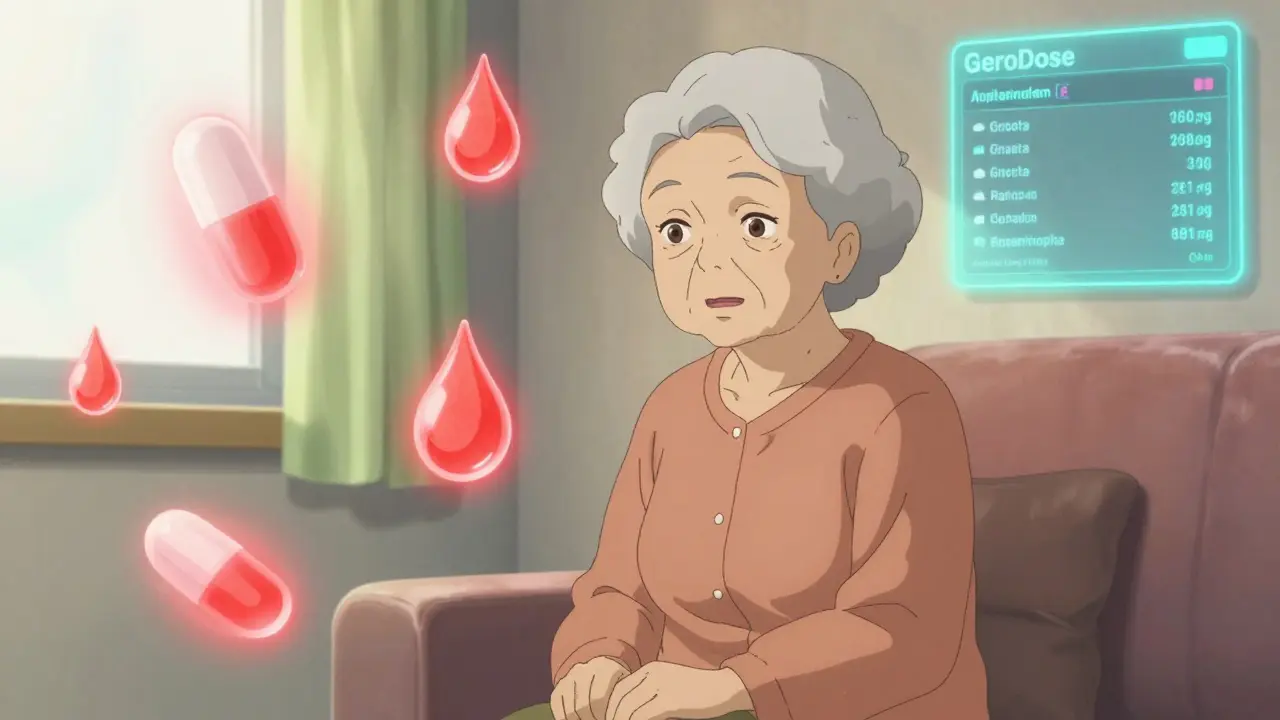
There’s no magic pill. But there is better science. The FDA approved GeroDose v2.1 in 2023-a software tool that simulates how a drug will behave in your body based on your age, weight, liver enzymes, and kidney function. It’s not in every clinic yet, but it’s coming.
Research is also uncovering why some older adults process drugs differently than others. A 2023 study found 17 gene methylation sites linked to liver enzyme activity that change with age. That means two 78-year-olds might need completely different doses of the same drug-not because of weight or diet, but because of their unique biology.
The Bottom Line
Aging isn’t just about wrinkles and gray hair. It’s about your body’s ability to handle chemicals-including medicines. Your liver and kidneys aren’t broken. They’re just different. And that difference changes everything about how drugs work.Safe prescribing for older adults isn’t about giving less. It’s about giving the right amount-based on real function, not just a number on a calendar. If your doctor hasn’t checked your kidney or liver function in the last year, ask. Your next dose could be the difference between feeling well-and ending up in the hospital.
11 Comments
December 18, 2025 Meenakshi Jaiswal
This is such an important post. I work with elderly patients in Delhi and see this every day. A grandma on 5 meds, all prescribed without checking kidney function, and then she falls and everyone says 'oh she's just getting old.' No, she's got drug toxicity. GFR isn't optional anymore. If your doc doesn't run it, ask again. And again. Your life depends on it.
Also, grapefruit juice? Yeah, I tell my patients to ditch it. Even one glass can turn a safe statin into a liver bomb. Simple swap: orange juice. Same vitamin C, no enzyme sabotage.
And stop assuming all seniors are on the same dose. Two 75-year-olds? One might need 1/4 of the standard dose. The other? Maybe 3/4. Biology isn't a spreadsheet.
December 19, 2025 bhushan telavane
Bro in India we don't even get GFR tests unless we pay extra. Doctors just look at age and say 'take half' like it's magic. My uncle took metformin for 3 years, creatinine normal, then one day he was in ICU with lactic acidosis. No one checked eGFR. Just assumed 'old man, less dose'.
And don't even get me started on ayurvedic stuff mixed with pills. Turmeric and blood thinners? Bad combo. But everyone thinks 'natural = safe'. Nope.
December 21, 2025 Mahammad Muradov
People still don't get it. It's not 'biological change'. It's poor lifestyle choices catching up. If you didn't eat clean for 40 years, of course your liver is junk. Stop blaming aging. Blame the burgers, the soda, the inactivity. This isn't some tragic inevitability-it's the result of decades of neglect.
And why are we letting people over 65 take 5+ drugs? That's not medicine, that's pharmacy roulette. If you're that frail, maybe you shouldn't be on so much. Just sayin'.
December 23, 2025 Connie Zehner
OMG I JUST REALIZED MY MOM IS ON ALL OF THESE!!! 😭 I'm so guilty!! She's on metformin, amitriptyline, and takes grapefruit juice every morning with her statin... and I never connected the dots!! I'm calling her doctor RIGHT NOW!! 😫 I feel like such a bad daughter 😭😭😭
December 23, 2025 Jedidiah Massey
It's fascinating how pharmacokinetic principles are being systematically ignored in geriatric prescribing. The hepatic first-pass metabolism reduction coupled with diminished renal clearance creates a non-linear pharmacodynamic profile that necessitates individualized dosing regimens based on CLcr and hepatic enzyme phenotyping-yet clinicians persist in relying on crude chronological age-based heuristics. The 2023 GeroDose v2.1 algorithm represents a paradigm shift, yet its adoption is hamstrung by EHR interoperability issues and reimbursement disincentives. We're in the age of precision geriatric pharmacology, but the infrastructure hasn't caught up.
Also, did you know that CYP3A4 polymorphisms vary significantly across ethnicities? That's why Indian populations may metabolize propranolol differently than Caucasians. This isn't just about age-it's about pharmacogenomics.
December 25, 2025 Alex Curran
Been a nurse for 22 years and this is still the biggest blind spot in care
Doctors look at creatinine and think 'all good' but if the patient is 80 and 110 lbs with no muscle? That number is meaningless
Had a patient on digoxin for years, creatinine normal, then one day she coded. Turned out her GFR was 28. Had been on the same dose since 2015
And grapefruit? Yeah it's a silent killer. I tell every patient: if it's not water, ask if it's safe with your meds
Also the prodrug thing-so many people think their blood pressure med isn't working because it takes 3 days to kick in. Nope. It's working. Just slow. Patience is medicine too
December 26, 2025 Allison Pannabekcer
I just want to say thank you for writing this with so much care. My dad turned 78 last month and he's on 6 meds. We’ve been scared to ask questions because doctors act like we’re being difficult. But this post gave me the language to speak up.
I printed it out. Took it to his appointment. Asked for GFR, asked about grapefruit, asked if any meds could be stopped. He cried afterward. Said no one had ever listened before.
It’s not about being a pain. It’s about being the person who remembers your body is changing. And that’s not weakness. It’s wisdom.
December 27, 2025 Nicole Rutherford
Of course this happens. People don't take care of themselves. They eat sugar, sit on the couch, smoke, drink, then expect the system to fix them at 70. It's not the drugs, it's the lifestyle. Stop playing victim.
And why are we even giving seniors so many meds? Maybe the real problem is that we're medicalizing aging. Maybe they just need less pills, not more science.
Also, GeroDose? Sounds like corporate jargon. Real doctors don't need software to tell them to cut the dose. Common sense still exists.
December 28, 2025 Mark Able
Wait wait wait I have to tell you what happened to my neighbor. She's 81. Took her amitriptyline like normal. Then she started walking into walls. Thought she had a stroke. Went to ER. Doctor said 'probably dementia'. I said 'did you check her meds?' Turned out she was on 25mg. They cut it to 10mg. Within 48 hours she was back to knitting and making cookies. No dementia. Just drug fog.
And her doctor didn't even ask about OTC stuff. She was taking NyQuil every night. That's another 25mg of diphenhydramine. No wonder she was zombified.
Y'all need to talk to your elders. Not just about meds. About everything.
December 29, 2025 Chris Clark
bro i just found out my pops been takin tylenol for his back pain like 4 a day for 5 years and his liver enzymes were sky high. he thought it was safe cause its 'over the counter' like it's herbal tea or sumthin
we got him switched to celecoxib and cut the dose in half based on his gfr. he's been feelin way better
also grapefruit? yeah we ditched it. now he drinks apple juice. no one told him it could kill him
and the gene thing? wild. my uncle and aunt are both 79, same weight, same meds, but uncle gets dizzy and aunt doesn't. guess their dna just got different settings
December 31, 2025 Dorine Anthony
My aunt is 80. She takes 7 meds. She also takes a 'heart health' supplement with garlic, ginkgo, and fish oil. None of her doctors knew about it. Last month she bruised all over from a light bump. Turns out the combo was thinning her blood. We pulled the supplement. No more bruises.
It's not about being scared. It's about being curious. Ask questions. Write things down. Bring a list. You don't have to be a doctor to save someone's life.
And if you're over 65? You're not broken. You're just different. And that's okay.
Write a comment