
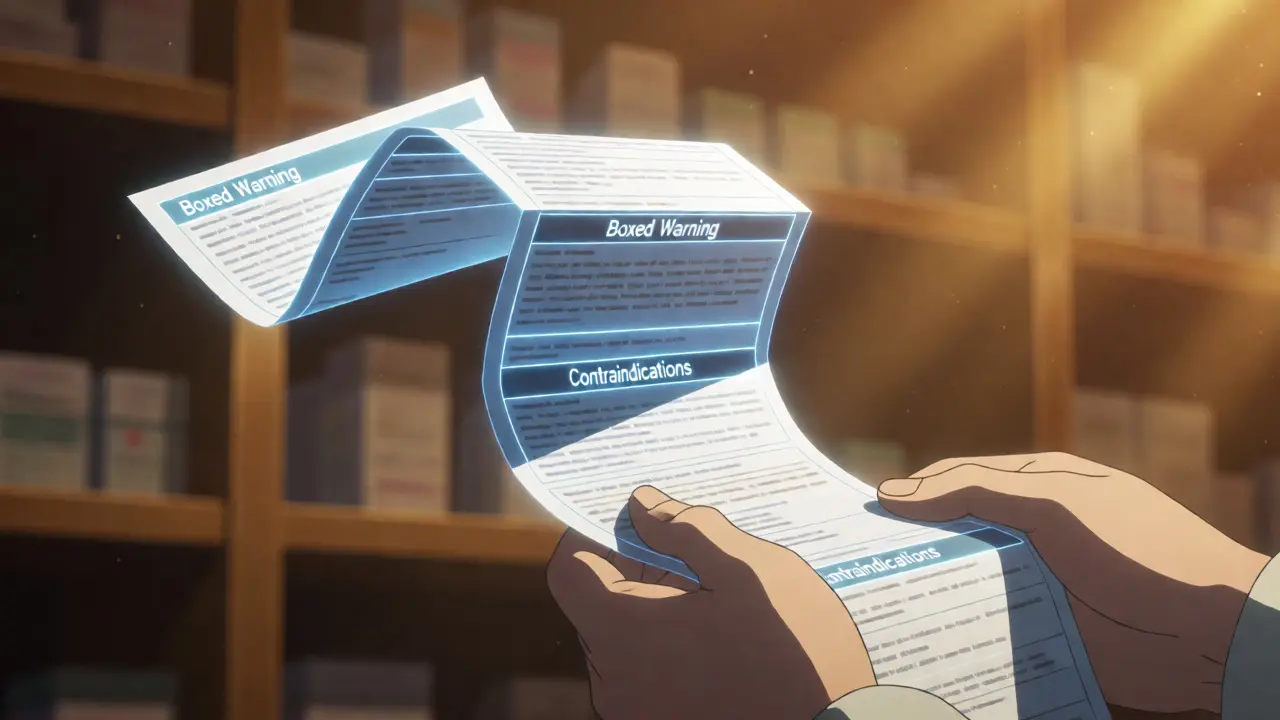
Drug Label Safety Interpreter
Confused by the fine print? Select a phrase you see on your medication label to understand its severity and what action you should take.
Quick Reference Guide
- Absolute Contraindication: Do NOT take the drug. It could be dangerous.
- Relative Contraindication: Consult your doctor. Dose adjustment or monitoring may be needed.
- Boxed Warning: Serious risk of death or injury. Requires close medical supervision.
- Side Effect: Common reaction (e.g., nausea). Usually manageable but report if severe.
You just picked up a prescription. The pharmacist hands you a bottle with a leaflet so long it could double as a bookmark for a novel. You glance at the side effects list-nausea, headache, dizziness-and assume it’s standard boilerplate. But buried in that text are critical instructions that could save your life or prevent a hospital visit. Most people skip this part. That’s a mistake.
Drug labels are legal documents designed to communicate risk. They aren't just suggestions; they are regulatory mandates from the U.S. Food and Drug Administration. Understanding how to read them separates safe medication use from accidental harm. This guide breaks down exactly what to look for, where to find it, and how to interpret the specific language used by manufacturers and regulators.
The Anatomy of a Prescription Label
Prescription drug labeling follows a strict structure defined by the FDA’s Physician Labeling Rule. It isn't random. Knowing the layout helps you find information fast. Think of the label as a hierarchy of urgency.
- Boxed Warning: The most serious alerts. If present, it appears first.
- Contraindications (Section 4): Situations where you should NOT take the drug.
- Warnings and Precautions (Section 5): Risks that require caution but don’t necessarily prohibit use.
- Adverse Reactions: Common side effects observed in trials.
If you only have thirty seconds, check the Boxed Warning and Section 4. These sections contain the deal-breakers. Everything else is context.
Decoding Contraindications: When Not to Take It
A contraindication is a clear "stop" sign. It identifies clinical situations where the risks of using a drug clearly outweigh any potential benefit. Unlike warnings, which suggest caution, contraindications often mean the drug is prohibited for certain patients.
Look for phrases like "Do not use," "Contraindicated in," or "Should not be administered." These indicate absolute barriers. For example, if a blood thinner lists "active pathological bleeding" as a contraindication, taking it while you have an open wound could lead to severe hemorrhage.
| Type | Meaning | Action Required |
|---|---|---|
| Absolute Contraindication | Risk is unacceptable regardless of condition severity. | Do not take the drug. Ask for an alternative. |
| Relative Contraindication | Risk is high but may be managed with monitoring or dose adjustment. | Consult your doctor. Weigh benefits vs. risks carefully. |
Many patients confuse relative contraindications with absolute ones. A relative contraindication might say, "Use with caution in patients with mild liver impairment." This doesn't mean you can't take it; it means your doctor needs to adjust the dose or monitor your liver enzymes more closely. Always ask your provider if a listed condition applies to you specifically.

Navigating Warnings and Precautions
Section 5, titled "Warnings and Precautions," is where the nuance lives. This section details serious adverse reactions that require active management. It’s organized by clinical significance, with the most dangerous risks listed first.
Here, you’ll find information on:
- Serious Adverse Events: Infections, organ damage, or cardiovascular issues.
- Monitoring Requirements: Blood tests or check-ups needed during treatment.
- Discontinuation Criteria: Signs that tell you to stop the medication immediately.
Pay attention to quantitative data. Modern labels increasingly include incidence rates. Instead of just saying "may cause infection," a label might state, "Serious infections occurred in 3.5 per 100 patient-years." This helps you gauge probability. A 1% risk feels different than a 10% risk, even if both are labeled "common."
Watch for conditional language. Phrases like "in patients with..." or "when co-administered with..." highlight specific scenarios. If you take multiple medications, scan this section for interaction warnings. Your pharmacist is your best resource here, but reading the label empowers you to ask better questions.
Understanding the Boxed Warning
The Boxed Warning, formerly known as the Black Box Warning, is the FDA's strongest safety alert. It highlights risks that may lead to death or serious injury. If a drug has one, it appears at the very top of the prescribing information, enclosed in a black border.
Not every drug gets a boxed warning. It’s reserved for significant dangers discovered during clinical trials or post-marketing surveillance. For instance, many antidepressants carry a boxed warning about increased suicidal thoughts in young adults. This doesn't mean everyone will experience it, but it signals a need for close observation during the first few weeks of treatment.
Don't panic when you see a boxed warning. It reflects the severity of the potential outcome, not necessarily its likelihood. Many drugs with boxed warnings are widely prescribed because their benefits outweigh these rare but serious risks. However, it does mean you should never start or stop these medications without direct medical supervision.

Over-the-Counter (OTC) Labels Are Different
OTC medications follow a different format called the "Drug Facts" label. There is no separate "Contraindications" section. Instead, contraindications are embedded within the "Warnings" panel under headings like "Do not use" and "Ask a doctor before use if."
When reading OTC labels:
- "Do not use": Treat these as absolute contraindications. Example: "Do not use if you have ever had an allergic reaction to this product."
- "Ask a doctor before use if": These are precautions. Example: "Ask a doctor before use if you have kidney disease."
- "Stop use and ask a doctor if": These are discontinuation criteria. Example: "Stop use and ask a doctor if symptoms persist for more than 7 days."
A study by the FDA found that only half of consumers correctly identify absolute contraindications from OTC labels. To avoid errors, read the entire "Warnings" section before purchasing. Don't rely solely on the front-of-package claims.
Practical Steps for Patients
Reading drug labels shouldn't be a passive activity. Here is a checklist to maximize safety:
- Check Allergies First: Scan Section 4 for hypersensitivity to any component. Cross-reference with your known allergies.
- Review Medical History: Compare listed conditions (e.g., pregnancy, liver disease) against your current health status.
- Identify Monitoring Needs: Note any required lab tests. Schedule them promptly.
- Clarify Ambiguities: If a warning says "use with caution," ask your doctor what "caution" looks like for you.
- Document Interactions: Keep a current list of all supplements and prescriptions. Check the "Drug Interactions" section (usually Section 7) against this list.
Remember, labels are living documents. Safety information updates frequently based on new data. If you've been on a medication for years, re-read the label after a refill. The manufacturer may have added new warnings based on post-market surveillance.
What is the difference between a side effect and a warning?
Side effects are common, expected reactions like nausea or dry mouth. Warnings highlight serious, potentially life-threatening risks that require specific actions, such as stopping the drug or getting immediate medical help. Side effects are listed in the "Adverse Reactions" section, while warnings appear in Sections 4 and 5.
Does a boxed warning mean I shouldn't take the drug?
No. A boxed warning indicates a serious risk, but it doesn't automatically prohibit use. Many effective drugs have boxed warnings. It means you must weigh the benefits against the risks with your healthcare provider and monitor for specific signs of trouble.
Why do some drugs have no contraindications listed?
Some drugs have very few absolute prohibitions other than allergy to the ingredient itself. Others may have contraindications listed in narrative form rather than a bulleted list. Always check the full label; absence of a bulleted list doesn't always mean zero restrictions.
Can I ignore warnings if I feel fine?
Not always. Some risks, like liver toxicity or internal bleeding, develop silently before symptoms appear. Warnings often include monitoring requirements precisely because early detection prevents severe outcomes. Follow the recommended check-ups even if you feel well.
Who writes the drug label?
The pharmaceutical manufacturer drafts the label based on clinical trial data. The FDA reviews and approves the content. Once approved, the label becomes a legal document. Changes require regulatory approval, ensuring consistency and accuracy across all products.
12 Comments
September 3, 2026 Rob Alderman
It is frankly amusing that the average consumer treats a legal regulatory document with the same casual disregard they afford a fast-food receipt. The Physician Labeling Rule exists for a reason, yet most people lack the intellectual fortitude to parse Section 4 properly. If you cannot distinguish between an absolute and a relative contraindication, you are essentially gambling with your physiology.
September 4, 2026 Jenn Bell
This is such a helpful breakdown! I always felt intimidated by those tiny print leaflets but knowing exactly where to look for the 'deal-breakers' makes it so much less scary. It really empowers us to have better conversations with our doctors instead of just blindly trusting the prescription.
I'm going to print out that checklist and keep it in my medicine cabinet drawer. Thanks for sharing this!
September 6, 2026 Eric Schultze
The FDA approves these labels based on data provided by pharmaceutical corporations whose primary fiduciary duty is to shareholders, not patients. You must understand that the 'Boxed Warning' is often a liability shield rather than a genuine safety alert. When a drug has a boxed warning regarding suicidal ideation, it is rarely accompanied by adequate long-term monitoring protocols mandated by the prescriber. We are being medicated into compliance under the guise of therapeutic benefit, while the true risks are buried in statistical noise. One must remain vigilant against the narrative that these substances are safe merely because they are regulated.
September 7, 2026 Jeremy Westcott
Yo, don't sleep on the OTC stuff though. That 'Drug Facts' panel is basically a trap for the uninitiated. I caught my buddy taking ibuprofen with his blood thinner because he didn't read the 'Ask a doctor before use if' section. He ended up in the ER with a GI bleed that could've been avoided if he'd just spent thirty seconds reading the back of the box instead of looking at the cartoon character on the front. It's wild how much we ignore the fine print until something goes sideways.
September 9, 2026 Aurelio Haney
Finally, someone explains this without dumbing it down too much. 👍 The distinction between warnings and contraindications is crucial. Many patients think 'caution' means 'maybe,' when it actually means 'active management required.' Great post. 📚
September 10, 2026 Jim Bisesi
Ugh, reading labels is exhausting. Why can't the drugs just work? I tried reading one last week and gave up after three sentences. My eyes started crossing and I got a headache, which ironically was probably a side effect of the stress of trying to be responsible. 😩
September 11, 2026 Louis Tarro
I feel like this is such a vital point for everyone navigating health issues. It’s easy to feel overwhelmed by the medical system, but having this kind of clarity helps us take ownership of our bodies. I’ve noticed that when I ask specific questions about the 'monitoring requirements' mentioned here, my providers seem more willing to engage in a collaborative dialogue rather than just handing me a script. It changes the dynamic from passive recipient to active participant, which feels empowering and respectful of our own intelligence. We deserve to understand what we are putting into ourselves, not just trust that it will be okay.
September 11, 2026 Shu Chowdhury
this is super useful
i always skimmed the warnings
now i know to check section 4 first
thanks for the tips
September 12, 2026 Amy B
I love how you broke down the quantitative data part. Seeing incidence rates like '3.5 per 100 patient-years' completely shifts the perspective from abstract fear to concrete probability. It makes me wonder why more prescriptions don't come with a simple visual chart explaining these numbers in plain English right on the bottle. Maybe if we saw the actual odds next to the scary words, fewer people would panic over common side effects or ignore serious ones. It’s all about context, really.
September 14, 2026 Falgun R Patel
Understanding the hierarchy of risk is a philosophical exercise in self-preservation. The label is a contract between the state, the manufacturer, and the individual. By reading it, you assert your autonomy. Do not let the complexity intimidate you; simplicity lies in the structure. Check the Boxed Warning, then Section 4. Everything else is secondary. This approach reduces anxiety and increases agency. Stay curious and stay safe.
September 14, 2026 Mary Tait
It is high time Americans stopped outsourcing their health literacy to pharmacists who are rushed and overworked. We live in the country that invented the FDA, yet we act like children when handed a pamphlet. Reading the label is a patriotic duty of informed citizenship. If you do not know what you are taking, you are not free; you are dependent. Take responsibility for your own biology and stop expecting others to hold your hand through every refill.
September 15, 2026 Pramay Dattani
Great info but honestly the font size on some of these inserts is criminal. Who decided that 6pt font is readable for elderly folks with cataracts? Its ridiculous. Also, half the warnings are just legal jargon to cover their backs. But yeah, checking for allergies is key. Don't mess around with that.
Write a comment