

When you buy a pill, an injection, or a medical device, you expect it to be safe. But how do you know the factory that made it followed the rules? The answer lies in FDA inspection records-the behind-the-scenes documents that show whether a manufacturer is actually doing what it claims. For companies producing drugs or medical devices, understanding these records isn’t just about staying compliant. It’s about survival.
What the FDA Can and Cannot See
The U.S. Food and Drug Administration doesn’t get unrestricted access to every document inside a manufacturing plant. There’s a clear line between what’s open for inspection and what’s protected. Under Compliance Policy Guide (CPG) Sec. 130.300, internal quality assurance audits-those honest, self-critical reviews companies do to find their own mistakes-are generally off-limits. This policy was designed to encourage companies to dig deep into their own systems without fear that every slip-up will become a public enforcement action.
But here’s the catch: if an internal audit uncovers a problem and the company launches a formal investigation into a product failure, that investigation file? That’s fair game. The FDA can-and will-demand to see it. The same goes for deviation reports, complaint investigations, and CAPA (Corrective and Preventive Action) logs. These aren’t internal opinions. They’re evidence of how a company responds when things go wrong.
Think of it like this: your company can have a private safety meeting to talk about a broken machine. That’s protected. But if that machine caused 12 bottles of medicine to be mislabeled, and you document how you fixed it, that document becomes a regulatory record. The FDA doesn’t care about your internal politics. They care about whether you fixed the problem-and how.
Record Retention Rules You Can’t Ignore
It’s not enough to keep good records. You have to keep them long enough. For drug manufacturers, 21 CFR 211.180 says you must store all CGMP records for at least one year after the product’s expiration date. For medical devices, 21 CFR 820.180 requires records to be kept for the life of the device plus two years. That means if you made a pacemaker in 2020, you still need to hold its manufacturing logs until 2042.
These aren’t suggestions. The FDA’s 2024 Warning Letter Analytics Dashboard showed that 22% of warning letters issued last year cited failure to maintain contemporaneous records. That means someone wrote down what happened after the fact-maybe hours later, maybe days. The FDA calls that falsification. And it’s one of the fastest ways to trigger an enforcement action.
Companies that survive inspections don’t just have records. They have systems that force real-time documentation. A production operator doesn’t wait until shift end to sign off on a batch. They record temperature checks, equipment settings, and sample results as they happen. Digital systems with timestamped entries and electronic signatures are no longer optional-they’re the baseline.
The Two Types of FDA Inspections That Matter
Not all FDA inspections are the same. In 2024, about 75% of pharmaceutical inspections were routine surveillance checks. These are scheduled, often announced, and follow a standard checklist. During these visits, inspectors typically won’t ask for internal audit reports. They focus on production logs, validation reports, and complaint files.
The other 18%? Those are for-cause inspections. Triggered by complaints, product failures, or whistleblower tips, these are the ones that change everything. During a for-cause inspection, the FDA can demand access to every internal document-including audit reports they normally ignore. This is when companies that thought they were safe find out they weren’t.
Foreign facilities are under even more pressure. In 2023, only 12% of inspections at overseas plants were unannounced. By the end of 2025, that number will jump to 35%. The FDA’s goal? To catch companies that clean up their act only when they know inspectors are coming. If you’re manufacturing drugs in India, China, or elsewhere and you think you can hide behind a calendar, you’re wrong.
What Happens When the FDA Finds Something Wrong
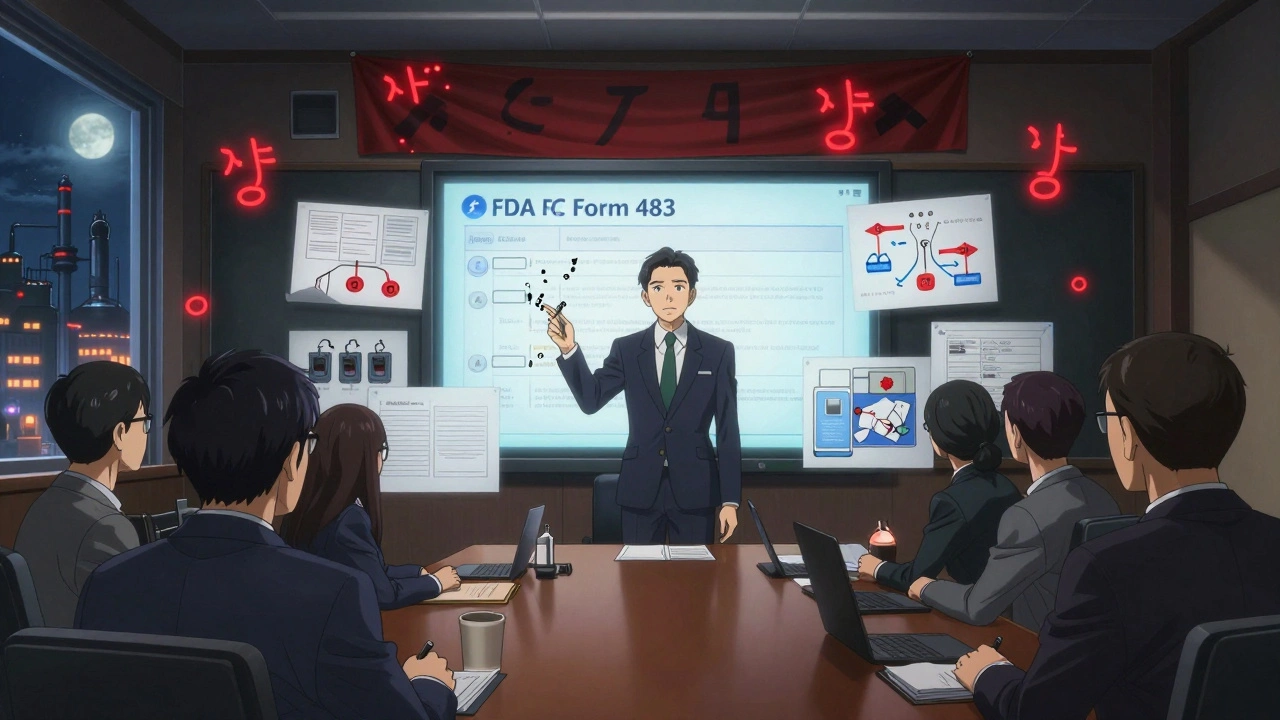
If an inspector spots a problem, they’ll hand you Form FDA 483-Notice of Inspectional Observations. This isn’t a fine. It’s a list of concerns. But it’s also a warning. You have exactly 15 business days to respond. Not 16. Not 20. Fifteen.
Your response isn’t just a letter. It’s a legal document. The FDA expects a root cause analysis. Not “we fixed it.” Not “we trained the staff.” You need to explain why the problem happened in the first place. Was it a flawed procedure? Poor training? A broken sensor? And then you have to prove you fixed the system-not just the symptom.
Companies that follow the FDA’s recommended methodology-documenting root causes, implementing changes, verifying effectiveness, and training staff-close 89% of their 483 observations within six months. Those that give vague answers? Only 62% get closure. And if you don’t respond at all? The FDA can issue a warning letter, block imports, or even shut you down.
How Companies Are Preparing-And Failing
Seventy-eight percent of pharmaceutical manufacturers now have dedicated inspection readiness teams. That’s up from 45% just five years ago. These teams spend an average of $385,000 a year training staff, updating documentation, and running mock inspections. Some hire former FDA inspectors to help them prep.
But even with all that investment, confusion remains. A 2024 survey of 215 quality professionals found that 41% saw different interpretations of the CPG Sec. 130.300 policy depending on which FDA district office conducted the inspection. One office says internal audits are off-limits. Another asks for them anyway. That inconsistency creates risk.
And then there’s the over-disclosure problem. Because they’re scared, many companies give the FDA everything-even the stuff they’re not supposed to. A Pfizer survey of 47 quality professionals found that 63% of companies accidentally handed over protected audit reports during inspections. That might seem safe, but it’s not. Once you give up your internal audit, you lose the legal protection it had. And you signal to the FDA that you don’t understand the rules.

Remote Inspections Are Changing the Game
In July 2025, the FDA finalized its guidance on Remote Regulatory Assessments (RRAs). This isn’t a full inspection. It’s a virtual review. The FDA can ask for read-only access to your digital systems, request electronic records, or even conduct live video walkthroughs of your facility.
RRAs don’t generate Form 483s. But they’re becoming a gateway to full inspections. If the FDA sees red flags during an RRA-missing timestamps, inconsistent data, or poor record organization-they can quickly follow up with a physical inspection. Companies that have invested in RRA-ready systems report 65% less production downtime during inspections. That’s not just efficiency. It’s a competitive advantage.
By Q1 2025, 73% of Fortune 500 pharmaceutical companies had already built RRA-compatible systems. If you haven’t, you’re falling behind. The FDA isn’t replacing physical inspections. They’re using remote tools to find the weak spots faster.
The Bigger Picture: Why Transparency Isn’t Optional
The global market for pharmaceutical compliance solutions hit $12.7 billion in 2024-and it’s growing at 8.3% a year. Why? Because regulators aren’t just watching. They’re demanding proof. The 2024 bipartisan Pharmaceutical Supply Chain Transparency Act proposed making some inspection findings public. While the industry fought back, arguing it would kill internal audits, the message was clear: the public wants to know.
Manufacturing transparency isn’t about showing off. It’s about building trust. When the FDA can see your records and verify your controls, they’re less likely to block your products. When patients know the system works, they trust the medicine. And when your team knows the rules and follows them, you stop living in fear of the next inspection.
The companies that thrive aren’t the ones with the cleanest facilities. They’re the ones with the cleanest records. The ones who document everything in real time. The ones who know the difference between a protected audit and a required investigation. The ones who respond to Form 483s with real fixes-not excuses.
If you’re in manufacturing, your records are your reputation. And the FDA isn’t asking for them out of curiosity. They’re asking because your patients depend on it.
Can the FDA inspect my facility without notice?
Yes. For foreign facilities, the FDA plans to conduct 35% of inspections unannounced by the end of 2025. For domestic facilities, most inspections are scheduled, but the FDA can still show up unannounced if there’s reason to believe there’s a serious compliance issue. Unannounced inspections are more common for high-risk products and facilities with past violations.
What documents does the FDA always have the right to see?
The FDA can demand any records tied to current Good Manufacturing Practices (CGMP). That includes batch production records, equipment calibration logs, validation protocols, deviation reports, complaint investigations, CAPA documentation, and quality control test results. These are not optional. They must be kept and made available upon request.
Are internal quality audits protected from FDA review?
Generally, yes-but only if they’re truly internal and part of a written quality assurance program under CPG Sec. 130.300. If the audit leads to a formal investigation or identifies a product defect, that investigation record becomes subject to FDA inspection. The protection doesn’t apply to findings that result in action.
What happens if I don’t respond to a Form FDA 483?
Failing to respond within 15 business days is treated as a refusal to cooperate. The FDA may issue a warning letter, refuse to approve new products, or even seize your products. In severe cases, they can block imports or shut down operations. A response isn’t optional-it’s a legal requirement.
Can I use digital records instead of paper?
Yes. Electronic records are not only allowed-they’re encouraged. The FDA requires that digital systems be validated, secure, and have audit trails. Records must be contemporaneous, meaning they’re entered at the time of the activity. Systems must prevent tampering and allow for easy retrieval during inspections. Many companies now use cloud-based quality management systems to meet these standards.
How can I prepare for an FDA inspection?
Start by mapping all required records and ensuring they’re complete, accurate, and stored properly. Train staff on real-time documentation and the difference between protected and non-protected records. Conduct mock inspections. Review past Form 483s and warning letters to spot recurring issues. Invest in RRA-ready systems. And never guess-when in doubt, consult your quality team or a regulatory expert.
12 Comments
December 1, 2025 Jaswinder Singh
Bro this is straight fire. I work in a pharma plant in Bangalore and we got hit with a 483 last year because someone typed the temp check 2 hours late. FDA doesn’t care if you’re busy, they care if you lied. Now we use tablets on the floor and it’s a game changer.
December 3, 2025 patrick sui
CPG Sec. 130.300 is such a double-edged sword 😅. We had an internal audit that flagged a recurring deviation in lyophilization cycles. We didn’t document it as a CAPA because we thought it was ‘protected’… until the FDA asked for it during a for-cause inspection. Turned out they already knew from a complaint. Lesson learned: if it’s real, it’s traceable. 🤦♂️
December 4, 2025 Declan O Reilly
you ever notice how the FDA acts like its the only one who gives a damn about safety? Meanwhile in china they're making 200k vials a day with no audit trails and no one even blinks. we're over here spending 400k on digital systems just to prove we didn't forget to sign a clipboard. capitalism is a joke
December 4, 2025 Bee Floyd
Remote inspections are the quiet revolution. We did an RRA last month-FDA asked for 12 months of batch records via API. Took us 90 minutes to pull it all. They didn’t even ask for a walkthrough. Next thing you know, we’re getting a routine inspection scheduled. Feels like they’re using tech to find the weak links before they even show up. 🤫
December 5, 2025 Jeremy Butler
It is of paramount importance to underscore the legal and regulatory imperative that underpins the maintenance of contemporaneous documentation. The absence of such records constitutes a prima facie violation of 21 CFR Part 211, and any attempt to retroactively reconstruct data is not merely an administrative oversight-it is an act of regulatory noncompliance with potential criminal implications.
December 7, 2025 Courtney Co
So let me get this straight-you’re telling me I can’t even have a private think about my mistakes without the FDA breathing down my neck? 😭 I just wanted to cry in my spreadsheet and fix it quietly. Now I have to document my tears? This is emotional abuse. I need a therapist and a compliance officer.
December 8, 2025 Shashank Vira
Let’s be honest-most of these companies are just performing theater. They spend $385k on ‘inspection readiness’ so they can look good while their QA team is still using Excel sheets from 2012. The FDA knows. They’re just waiting for the right moment to pounce. This isn’t compliance. It’s survival theater with a PowerPoint.
December 10, 2025 Eric Vlach
Real talk-digital records are the future but most people still don’t get audit trails. I saw a guy yesterday edit a timestamp in his LIMS system and think it’s fine because he ‘changed it back’. Bro you don’t just undo a record. The system logs you. The FDA sees you. It’s not magic, it’s math.
December 11, 2025 Souvik Datta
Good piece. One thing people miss: the real win isn’t avoiding a 483-it’s turning every observation into a learning moment. I train teams to treat FDA findings like feedback from a tough coach. Not punishment. Progress. If you’re not using inspections to improve your culture, you’re just dancing around the fire.
December 11, 2025 Priyam Tomar
You think this is bad? Try working in a facility where the QA manager still uses a paper logbook and says ‘the FDA doesn’t read handwriting’. I swear to god I’m about to send their entire archive to the New York Times. This isn’t compliance-it’s a public health hazard wrapped in arrogance.
December 13, 2025 Jack Arscott
RRAs are kinda cool 🤖. My plant got one last month-FDA watched our HPLC system live. No one panicked. We had everything tagged, versioned, and searchable. They left saying ‘nice work’. No 483. No drama. Just clean data. This is what the future looks like.
December 14, 2025 Conor Forde
Let me be the only one to say this: the FDA doesn’t want transparency. They want control. They’ll demand your internal audits, then punish you for giving them too much. They’ll say ‘document everything’ then say ‘we don’t want your opinions’. It’s not about safety-it’s about power. And you’re all just playing their game. 😏
Write a comment