
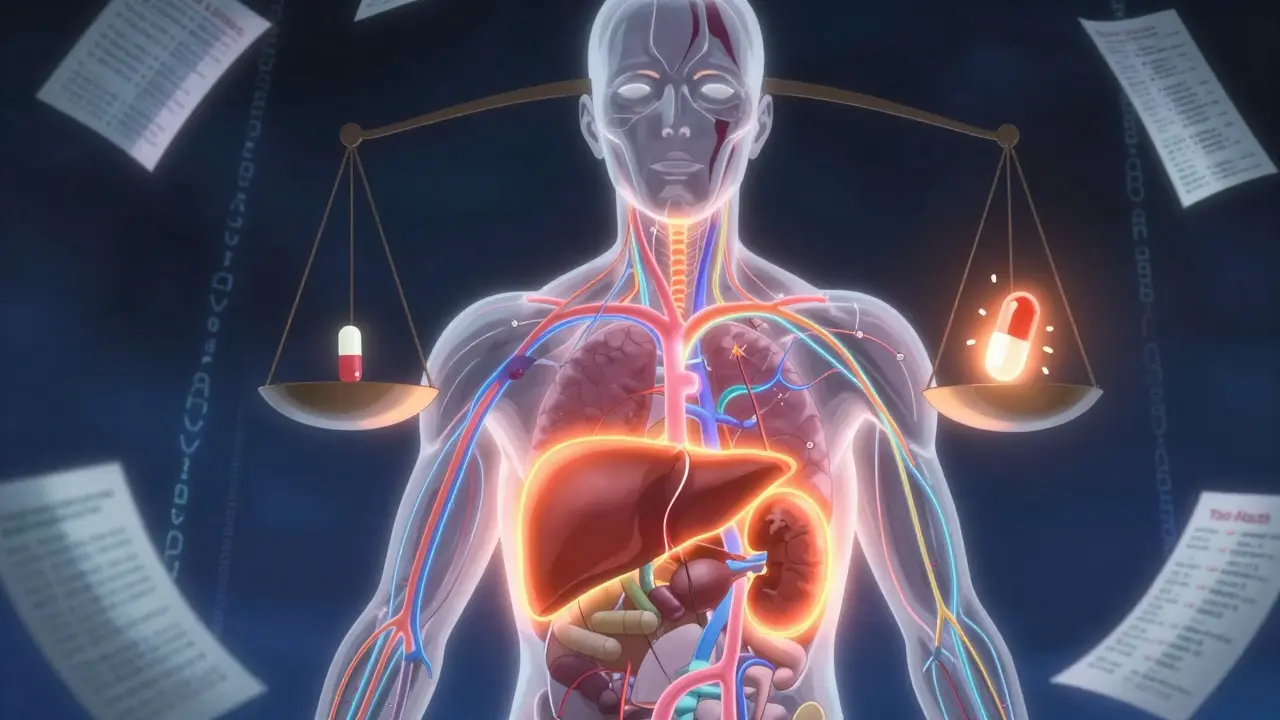
Narrow Therapeutic Index Drug Dosing Calculator
How Your Dosing Needs Are Calculated
This calculator estimates how factors like age, weight, and kidney function affect the need for dose adjustments of drugs with a narrow therapeutic index (NTI). These drugs require precise dosing because small errors can cause serious harm.
Your Dosing Adjustment Estimate
Getting the right dose of medication isn’t just about following the label. It’s about finding the narrow line between healing and harm. Too little, and the drug does nothing. Too much, and you could end up in the hospital-or worse. This isn’t theoretical. For drugs like warfarin, digoxin, or phenytoin, a small miscalculation can be deadly. And yet, millions of people take these medications every day without ever knowing why their dose changed, or whether it was truly right for them.
Why One Size Doesn’t Fit All
You might think that if a pill works for someone else, it should work for you. But that’s not how medicine works. Your body processes drugs differently than mine. Age, weight, kidney function, liver health, even your genes can change how a drug behaves inside you. For example, older adults often need 20-30% less of a drug just because their kidneys slow down. Someone who weighs 250 pounds may need a different dose than someone who weighs 130, even if they have the same condition.Then there’s genetics. About one in four commonly prescribed drugs are affected by genetic variations. If your body metabolizes a drug too quickly, it won’t work. If it metabolizes too slowly, the drug builds up and causes side effects. This isn’t rare. It’s routine. Yet most prescriptions still rely on average dosing based on clinical trials that mostly excluded older adults, pregnant women, and people with multiple health problems.
The Narrow Line: What Is a Therapeutic Index?
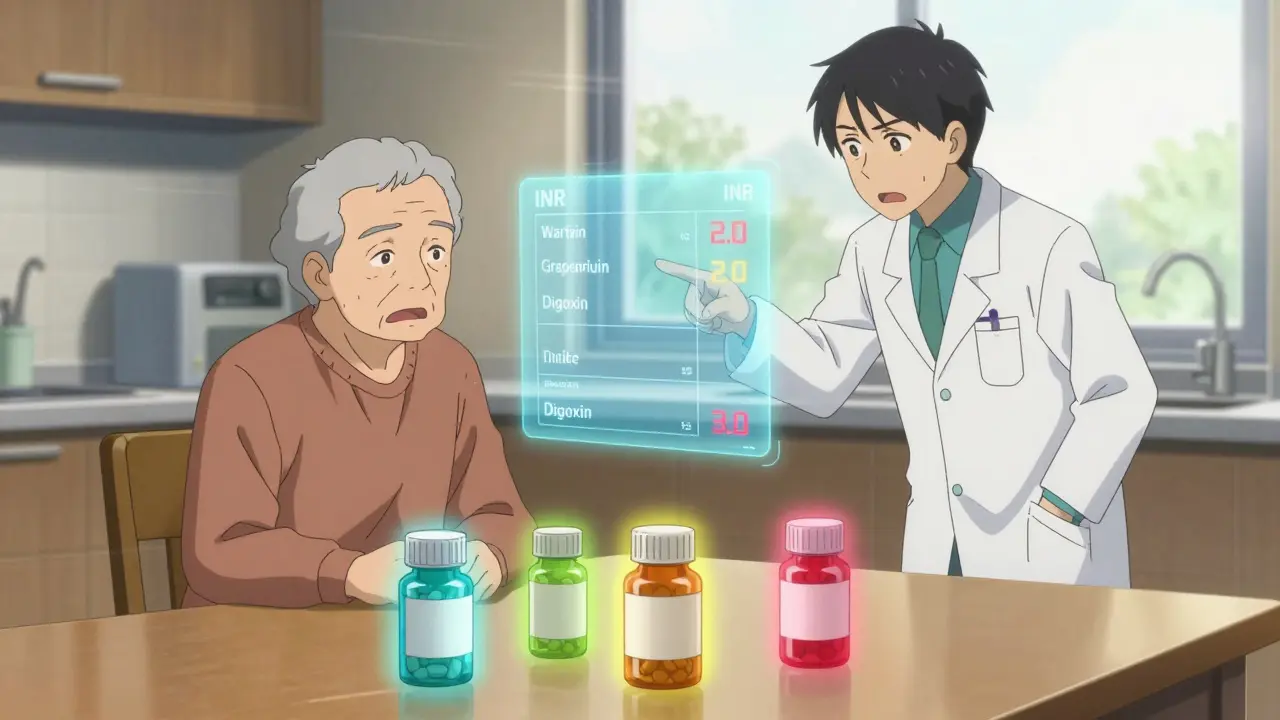
Every drug has what’s called a therapeutic index. It’s the ratio between the dose that helps and the dose that hurts. If the index is high-say, 15 or more-like with penicillin-you’ve got some room for error. But if it’s low-2 or 3-you’re walking a tightrope. These are called Narrow Therapeutic Index (NTI) drugs. They include blood thinners like warfarin, heart drugs like digoxin, and seizure meds like phenytoin.With NTI drugs, being off by even 10% can mean the difference between control and crisis. Digoxin, for instance, is lethal at just two and a half times the normal dose. That’s why people on warfarin get regular blood tests. The INR test checks how long it takes their blood to clot. If it’s below 2.0, they’re at risk of a stroke. Above 3.0, they risk internal bleeding. That’s why dose adjustments aren’t optional-they’re life-saving.
Who Needs the Most Careful Dosing?
Not everyone needs the same level of monitoring. But some groups are at higher risk. Elderly patients on five or more medications-what doctors call polypharmacy-are three times more likely to have a bad reaction. That’s not because they’re careless. It’s because their bodies can’t handle the load. Their liver and kidneys don’t clear drugs as fast. Their brain is more sensitive to side effects like dizziness or confusion.People with kidney disease need dose reductions for many drugs. A common mistake is using standard doses for someone with a creatinine clearance under 30 mL/min. The same goes for liver disease. A Child-Pugh score of C means the liver is barely working. Many drugs should be avoided entirely.
Obesity is another factor. Standard dosing often uses ideal body weight. But for someone who’s 100 pounds over their ideal weight, that can mean underdosing. Some guidelines suggest using 40% of excess weight plus ideal weight to calculate the right dose. It’s complicated. And most primary care doctors don’t have time to do the math.
The Role of Pharmacists and Monitoring
Pharmacists are the hidden experts in dose adjustment. They know how drugs interact. They understand pharmacokinetics-the way your body absorbs, moves, breaks down, and gets rid of a drug. They can spot when a new antibiotic is making your blood thinner too strong. They know that grapefruit juice can double the level of certain statins in your blood.Studies show that pharmacist-led clinics cut medication errors by 35% and hospitalizations by 22% in older adults. How? They don’t just hand out pills. They review every medication, check for interactions, adjust doses based on lab results, and call the doctor when something’s off. In transplant centers, where patients take immunosuppressants like cyclosporine, therapeutic drug monitoring is routine. Blood levels are checked weekly. Doses are tweaked. Survival rates are higher.
But in general practice? Only about 35% of providers consistently adjust doses for NTI drugs. That’s a gap. And it’s dangerous.
What Happens When Dosing Goes Wrong?
The consequences aren’t abstract. They’re real. An elderly woman on digoxin eats a banana-a good source of potassium-and her blood level spikes. She gets nausea, dizziness, and a dangerous heart rhythm. She ends up in the ER. A man on warfarin starts taking an over-the-counter painkiller. His INR jumps to 7. He has a brain bleed. A teenager on epilepsy meds gets a new antibiotic. Her seizure control collapses. Her dose was never adjusted.These aren’t edge cases. They’re predictable. And they’re preventable. The problem isn’t that doctors are careless. It’s that the system doesn’t make precision dosing easy. Clinical trials don’t include the very people who need it most. Guidelines are based on averages. And when you’re on five different meds, tracking how each one affects the others feels impossible.

How Precision Dosing Is Changing
The good news? Things are shifting. In 2019, the FDA and the University of North Carolina held a landmark meeting on precision dosing. They called it the next big step after safety (1938) and efficacy (1962). Today, software tools are being developed that use real-world data-age, weight, lab values, genetics-to predict the right dose. Some models use 20-30 patient factors. They’re 25-40% more accurate than traditional methods.Companies like InsightRX and DoseMe are building platforms that integrate with electronic health records. They pull data from blood tests, genetic reports, and even wearable sensors. They don’t guess. They calculate. And they’re being used in hospitals across the U.S. and Europe.
Even drug makers are starting to change. Instead of testing just one dose in trials, they’re now testing a range. They’re asking: What’s the best balance of benefit and risk? Not just for the average patient-but for the older, sicker, heavier, or genetically different ones too.
What You Can Do
If you’re on a medication-especially one that requires monitoring-here’s what you can do:- Ask your doctor or pharmacist: Is this an NTI drug? Do I need regular blood tests?
- Know your numbers: If you’re on warfarin, know your INR target. If you’re on digoxin, know your symptoms of toxicity-nausea, vision changes, irregular heartbeat.
- Keep a full list: Write down every pill, supplement, and herb you take. Bring it to every appointment. Even a simple antacid can interfere with absorption.
- Don’t skip appointments: If you’re told to get your blood drawn every four weeks, do it. Delaying a test can be as risky as taking too much.
- Speak up about side effects: Dizziness? Fatigue? Confusion? Don’t assume it’s just aging. It might be your dose.
And if you’re on multiple meds? Ask if any can be stopped. The American Academy of Family Physicians says deprescribing-removing unnecessary drugs-is just as important as prescribing. Fewer pills often mean fewer side effects and better outcomes.
The Future Is Personal
The goal isn’t to make everyone take the same dose. It’s to make sure every dose is right for the person taking it. In the next decade, we’ll see more genetic testing built into routine care. More AI tools helping doctors decide. More patients knowing their own numbers.But until then, the best tool you have is awareness. Don’t assume your dose is set in stone. Ask questions. Track your symptoms. Know your meds. And if something feels off-it probably is. Your body isn’t a lab model. It’s unique. And your dose should be too.
13 Comments
March 3, 2026 Levi Viloria
I've been on warfarin for 8 years. Nobody ever explained why my INR target is 2.5, not 2.0 or 3.0. Turns out, it's because I had a minor stroke in 2017. My doctor just said 'stick to the range' like it was gospel. Never asked if I understood why. Guess I'm lucky I didn't bleed out before I figured it out myself.
March 4, 2026 Siri Elena
Oh sweetie, you think this is groundbreaking? I worked in a geriatric pharmacy in Boston. We had a 78-year-old woman on 11 meds who didn't know half of them were for conditions she didn't have anymore. Her daughter finally asked why she was still taking furosemide after her kidneys improved. We pulled the plug. She stopped feeling dizzy. Her BP dropped 20 points. The system isn't broken-it's just lazily designed for people who don't ask questions.
March 5, 2026 Dean Jones
The real tragedy isn't that dosing is imprecise-it's that we've normalized it. We treat human biology like a spreadsheet with one default setting. Clinical trials exclude the elderly, the obese, the chronically ill, and then we act shocked when those exact people end up in the ER. We're not failing because we lack data-we're failing because we refuse to accept that individuality matters. The therapeutic index isn't a number on a chart. It's a living, breathing boundary between life and death, and we're treating it like a suggestion.
March 6, 2026 Divya Mallick
In India, we don't have access to these fancy algorithms. My aunt took digoxin for 12 years. They never tested her levels. She got nauseous, confused, and started seeing halos. The doctor said 'it's just old age.' She died from arrhythmia. This isn't a Western problem-it's a human one. We treat people like statistics, not bodies. And until we stop, we'll keep burying people who just needed someone to listen.
March 7, 2026 Pankaj Gupta
I appreciate the depth of this post. The emphasis on pharmacokinetics and genetic variability is scientifically sound. However, I would argue that the systemic failure lies not only in dosing protocols but in the fragmentation of care. Primary care physicians, specialists, pharmacists, and labs rarely communicate effectively. A patient’s INR result may be available in the system, but if the cardiologist doesn’t see it and the PCP doesn’t act, the adjustment never happens. Integration-not just innovation-is what we need.
March 8, 2026 Zacharia Reda
I used to work in a hospital pharmacy. We had this one guy on cyclosporine after a transplant. Every week, his levels were off by 20%. We’d adjust, he’d come back next week, same thing. Turned out he was taking St. John’s Wort for 'depression'-no one asked. He didn’t think it mattered. We started asking. We started listening. He’s alive today because someone finally said: 'What else are you taking?' It’s not rocket science. It’s basic humanity.
March 10, 2026 Betsy Silverman
I’m a nurse. I’ve seen this too many times. A patient comes in with a new prescription. They’re handed a pill bottle and told 'take one daily.' No discussion. No warning. No follow-up. I had a patient on phenytoin who started vomiting and slurring. Her family thought she was drunk. She was nearly dead. We caught it because we checked her levels. If we hadn’t, she wouldn’t be here. This isn’t about tech. It’s about care.
March 11, 2026 Mariah Carle
We’re all just atoms in a machine trying to find meaning. The body is a symphony, not a machine. A dose isn’t a setting-it’s a whisper. And sometimes, the whisper gets lost in the noise of bureaucracy, insurance forms, and rushed appointments. But if you listen… really listen… to your body, it tells you. It’s always telling you. You just have to stop being afraid to hear it.
March 11, 2026 Ivan Viktor
I read this while eating a banana. Wonder if it’s affecting my meds. Probably not. I’m 32. I don’t have 11 pills. I just take a statin and a vitamin D. But still. Makes you think. Maybe I should ask my doctor what 'NTI' even means. Probably sounds cooler than 'your liver hates this.'
March 12, 2026 Jeff Card
My mom’s on warfarin. She’s 79. She doesn’t remember her INR number. She doesn’t know what 'target range' means. But she knows she feels better when she gets her blood drawn. She calls every 4 weeks like clockwork. She’s not a patient. She’s a survivor. And she didn’t need AI to figure it out. She just needed someone to tell her: 'This matters.'
March 12, 2026 Donna Zurick
Stop overcomplicating it. Ask your doctor if your med has a narrow window. Get tested. Know your numbers. Speak up. That’s it. No apps. No algorithms. Just you and your body and the courage to ask the question.
March 14, 2026 Raman Kapri
This post is a textbook example of Western medical arrogance. You assume all patients have access to blood tests, pharmacists, and electronic records. In rural India, a man takes a single pill because his village has no lab. A woman dies because her family can’t afford a second visit. Precision dosing is a luxury. The real issue is equity-not pharmacokinetics.
March 14, 2026 Alex Brad
If you're on a drug that needs monitoring, don't wait for your doctor to bring it up. Ask. Write it down. Bring a list. Even if it's just 'Is this one of those meds that needs blood tests?' That one question can save your life. You don't need to be an expert. Just be persistent.
Write a comment