
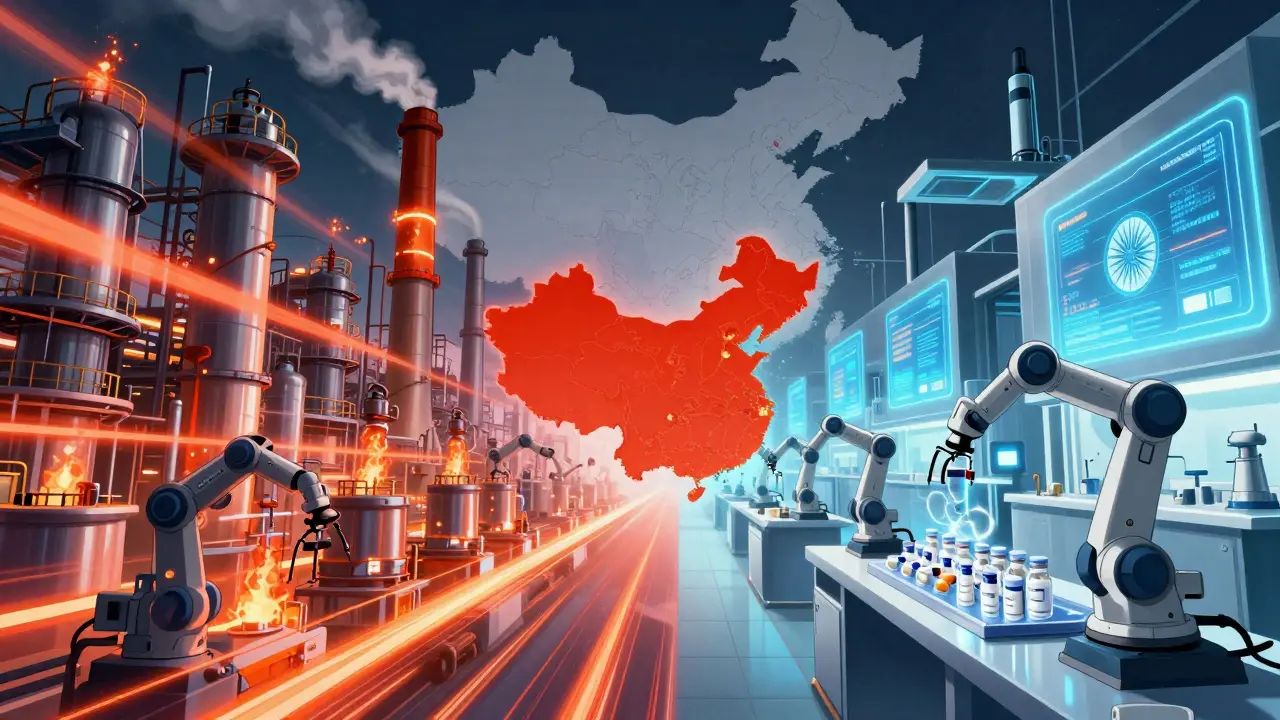
You might assume that buying generic drugs or active pharmaceutical ingredients (APIs) from the cheapest source is always the smartest business move. But in the global pharmaceutical supply chain, price often hides a much steeper cost: regulatory risk. When you look at the two giants of drug manufacturing-China and India-the choice isn't just about who can produce the most volume. It's about who can keep the US Food and Drug Administration (FDA)the federal agency responsible for protecting public health through regulation of food, drugs, medical devices, and cosmetics off your back.
The landscape has shifted dramatically over the last decade. China controls roughly 80% of the global generic API supply chain, making it the undisputed king of raw materials. India, on the other hand, holds the title of the world’s "pharmacy" for finished generics, with over 100 FDA-approved plants compared to China’s 28. This divergence creates a complex web of dependencies and risks that every procurement manager, quality assurance director, and supply chain strategist needs to understand. If you are sourcing from these regions, you aren't just buying chemicals; you are inheriting their regulatory histories.
The Scale vs. Compliance Divide
To understand the risk profile, you have to look at what each country actually does. China is the engine room of the industry. They produce the bulk drugs and intermediates that form the foundation of most medications. According to data from PharmaBoardroom, China accounts for approximately 50% of Asia's pharmaceutical manufacturing output. Their advantage is scale and cost. A World Bank study noted that manufacturing APIs in China offers a 40% cost advantage compared to production in the US or Europe. That margin is hard to ignore.
However, scale comes with scrutiny. The FDA has historically viewed Chinese facilities with higher skepticism due to past compliance issues. In 2023, import alert statistics showed that 37% of Chinese pharmaceutical facilities faced import alerts, compared to only 18% of Indian facilities. This isn't just a statistic; it represents real-world delays, rejected shipments, and potential product recalls. When the FDA inspects a facility, they are looking for adherence to Current Good Manufacturing Practices (cGMP). Chinese manufacturers, while improving, still face challenges with consistency across smaller suppliers.
India took a different path. Following the amendments to its Patents Act in 1970, India built its industry around generic drug production for export. Their competitive edge isn't just low cost-it's regulatory alignment. Indian companies have spent decades aligning their operations with Western standards. Over 100 Indian plants are FDA-approved, giving them a 257% advantage in certified capacity over China. This means that when an Indian manufacturer ships a batch of antibiotics to New York, the paperwork and quality controls are already pre-validated by the regulator. For many US-based pharma companies, this reduces "audit fatigue" significantly.
| Metric | China | India |
|---|---|---|
| FDA-Approved Plants | 28 | 100+ |
| Global Generic API Share | ~80% | Significant but secondary |
| Import Alert Rate (2023) | 37% | 18% |
| Primary Strength | Scale & Cost Efficiency | Regulatory Compliance |
| Regulatory Focus | ISO, CE, RoHS | WHO-GMP, FDA cGMP |
The Hidden Risk: India’s Dependency on China
Here is where the picture gets complicated. You might think switching entirely to India solves all your regulatory headaches. But there is a catch. India is heavily dependent on China for the very raw materials it needs to make those generics. In FY2024, approximately 72% of India’s bulk drug and intermediate imports came from China, up from 66% in FY2022. This creates a single point of failure in the supply chain.
If geopolitical tensions rise or trade restrictions tighten between the US and China, India feels the pain too. As one senior sourcing executive at a major US pharmaceutical company noted in interviews with Bain & Company, "The 72% import dependency on China for bulk drugs creates a single point of failure in our supply chain that we're urgently trying to address." So, while India offers a safer final assembly line, the foundation is still largely Chinese. This interdependence means that diversifying away from China entirely is nearly impossible without significant investment in new infrastructure elsewhere.
FDA Monitoring and Inspection Trends
The FDA doesn't treat all countries equally. Its monitoring practices are risk-based, meaning facilities with a history of violations get more attention. For years, Chinese facilities received a disproportionate number of Form 483 observations-documents issued by inspectors detailing significant deficiencies found during inspections. Between 2020 and 2023, industry analyses showed that Indian facilities received 30% fewer Form 483 observations than their Chinese counterparts.
This trend is driven by cultural and structural differences in how quality systems are implemented. Indian manufacturers have invested heavily in digital interventions across plants to eliminate errors and ensure consistent quality, as reported by Bain & Company in 2024. They speak the language of Western regulators, both literally (English proficiency) and procedurally (familiarity with FDA 21 CFR Part 211 requirements). In contrast, Chinese manufacturers are often navigating a transition from state-led industrial policies to global quality standards. While they have made progress in meeting ISO and CE certifications, the leap to full FDA compliance is steep and inconsistent across the board.
For a buyer, this means that auditing a Chinese supplier requires deeper resources and more frequent visits. You need to build a robust vendor qualification program that goes beyond checking certificates. You need to verify data integrity, traceability, and environmental controls firsthand. With Indian suppliers, the baseline trust is higher, allowing you to allocate quality resources toward innovation and speed-to-market rather than basic compliance checks.
The 'China+1' Strategy in Action
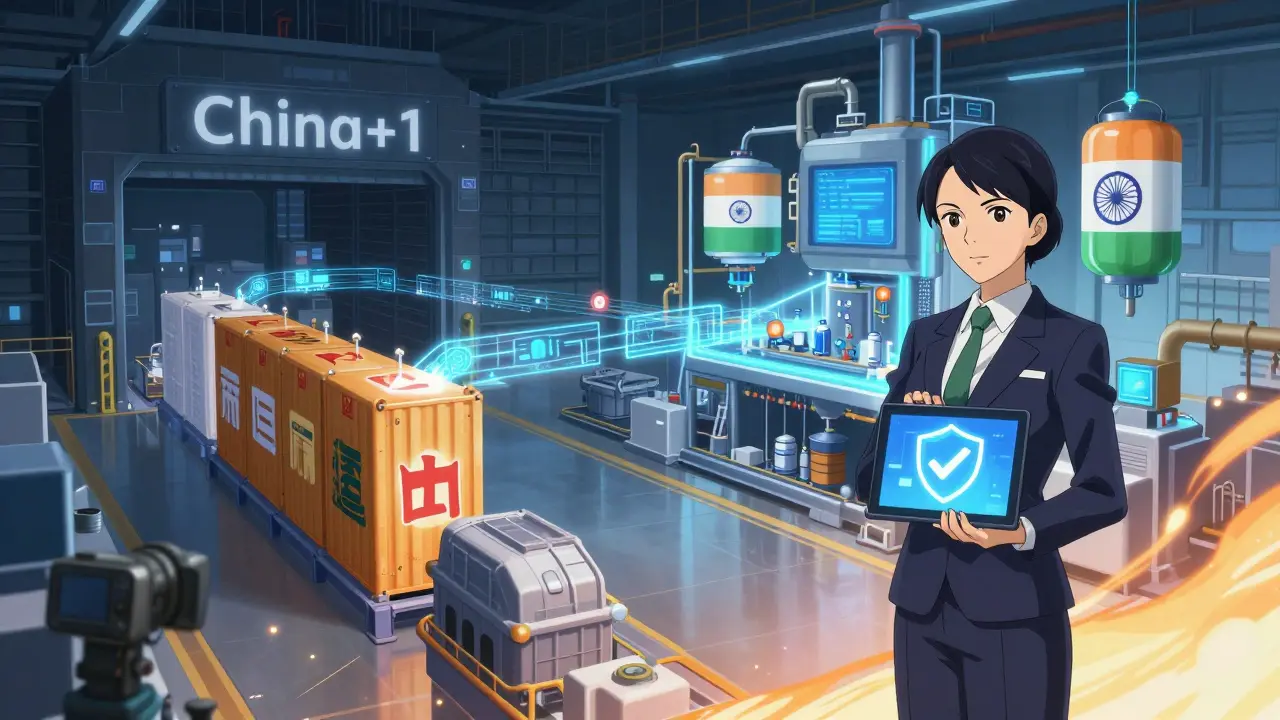
Given these dynamics, most multinational pharmaceutical companies have adopted a "China+1" strategy. This doesn't mean abandoning China; it means adding a reliable alternative to mitigate risk. India is the primary beneficiary of this shift. Medstown’s 2023 analysis highlights that global pharmaceutical companies have added credibility to India due to its "solid compliance history," good pricing, and skilled labor force.
In practice, this looks like sourcing APIs from China for cost efficiency but performing final formulation and packaging in India for regulatory safety. Or, increasingly, moving mid-stream chemical synthesis to India to reduce exposure to Chinese raw material volatility. The goal is resilience. By splitting the supply chain, companies can maintain cost competitiveness while ensuring that any regulatory hiccup in one region doesn't halt production entirely.
However, implementing this strategy isn't plug-and-play. Establishing manufacturing relationships in India involves a learning curve. Regulatory compliance alignment can take 6-9 months, compared to 3-6 months in China. But remember, China’s faster setup often leads to subsequent remediation costs if compliance gaps are discovered later. India’s revised Schedule M regulations from 2023 are designed to further improve compliance, boosting the adoption of specialty generics and innovative products. This regulatory tightening is a positive signal for buyers seeking long-term stability.
Future Outlook: Biologics and Innovation
The gap isn't closing everywhere. While India dominates generics, China is aggressively pivoting toward high-value biologics and R&D. China’s biopharmaceutical market was projected to grow at a 19.3% CAGR between 2015 and 2024, outpacing India’s growth in this specific segment. China is investing billions in becoming a global innovation leader, not just a factory floor. This means that for next-generation therapies, cell and gene treatments, and complex biologics, China may soon offer a more attractive proposition than today.
India, meanwhile, is focusing on scaling its biosimilars market, which is projected to reach USD 12 billion by 2025 with a 22% CAGR. The government’s "Make in India" initiative has allocated close to $3 billion for pharmaceutical and medical device production-linked incentives (PLIs), attracting nearly $4 billion in investments as of April 2024. These incentives are aimed at reducing dependency on imported APIs and moving up the value chain.
By 2047, Bain & Company projects India could reach $350 billion in pharmaceutical exports, contingent on successfully reducing its reliance on Chinese inputs. For now, however, the reality remains: China provides the bricks, and India builds the house. Understanding this division of labor is key to managing risk.
Practical Steps for Sourcing Managers
If you are responsible for sourcing decisions, here is how to navigate this dual-supplier landscape:
- Map Your Dependencies: Identify exactly which steps in your supply chain rely on Chinese APIs. Even if your contract manufacturer is in India, trace the raw materials back to their source.
- Diversify Strategically: Don't put all your eggs in one basket. Use India for finished goods requiring strict FDA compliance and China for non-critical or high-volume raw materials where cost is paramount.
- Invest in Audits: Allocate more budget for third-party audits of Chinese suppliers. Look for signs of data integrity issues and inadequate change control processes.
- Monitor Regulatory Changes: Keep an eye on India’s Schedule M revisions and China’s NMPA (National Medical Products Administration) updates. Regulatory shifts can open or close opportunities overnight.
- Build Relationships: Work closely with your Indian partners to help them secure local sources for critical intermediates. Supporting their vertical integration strengthens your own supply chain resilience.
The bottom line is that there is no perfect supplier. China offers unbeatable scale and cost, but carries higher regulatory baggage. India offers regulatory peace of mind and strong compliance records, but depends on China for its inputs. The winning strategy isn't choosing one over the other-it's managing the relationship between them with transparency, rigorous monitoring, and a clear understanding of where the real risks lie.
Why does the FDA inspect Chinese facilities more frequently?
The FDA uses a risk-based approach to inspections. Historically, Chinese pharmaceutical facilities have had higher rates of compliance violations, such as data integrity issues and inadequate quality control systems. This history triggers more frequent and stringent inspections to ensure patient safety and adherence to cGMP standards.
What is the 'China+1' strategy in pharmaceuticals?
The 'China+1' strategy involves maintaining manufacturing relationships in China for cost efficiency while simultaneously developing a secondary supply base in another country, typically India. This mitigates risks associated with geopolitical tensions, regulatory crackdowns, or supply chain disruptions in China.
How dependent is India on China for pharmaceutical raw materials?
India is highly dependent on China for Active Pharmaceutical Ingredients (APIs) and intermediates. In FY2024, approximately 72% of India's bulk drug imports came from China. This dependency poses a significant supply chain risk if trade relations between the two nations deteriorate.
Which country has more FDA-approved manufacturing plants?
India has significantly more FDA-approved manufacturing plants than China. As of recent reports, India operates over 100 FDA-approved facilities, while China has approximately 28. This gives India a substantial advantage in exporting finished generic drugs to the US market.
What are the main regulatory risks of sourcing from China?
Main risks include higher rates of import alerts, potential data integrity issues, and variability in quality control among smaller suppliers. Additionally, geopolitical tensions can lead to sudden trade restrictions or increased scrutiny, causing supply chain delays.
Is India becoming a leader in biopharmaceuticals?
India is growing rapidly in the biosimilars market, with projections reaching USD 12 billion by 2025. However, China currently maintains a strategic lead in broader biopharmaceutical R&D and complex biologics, with a higher projected CAGR in this specific high-value segment.