
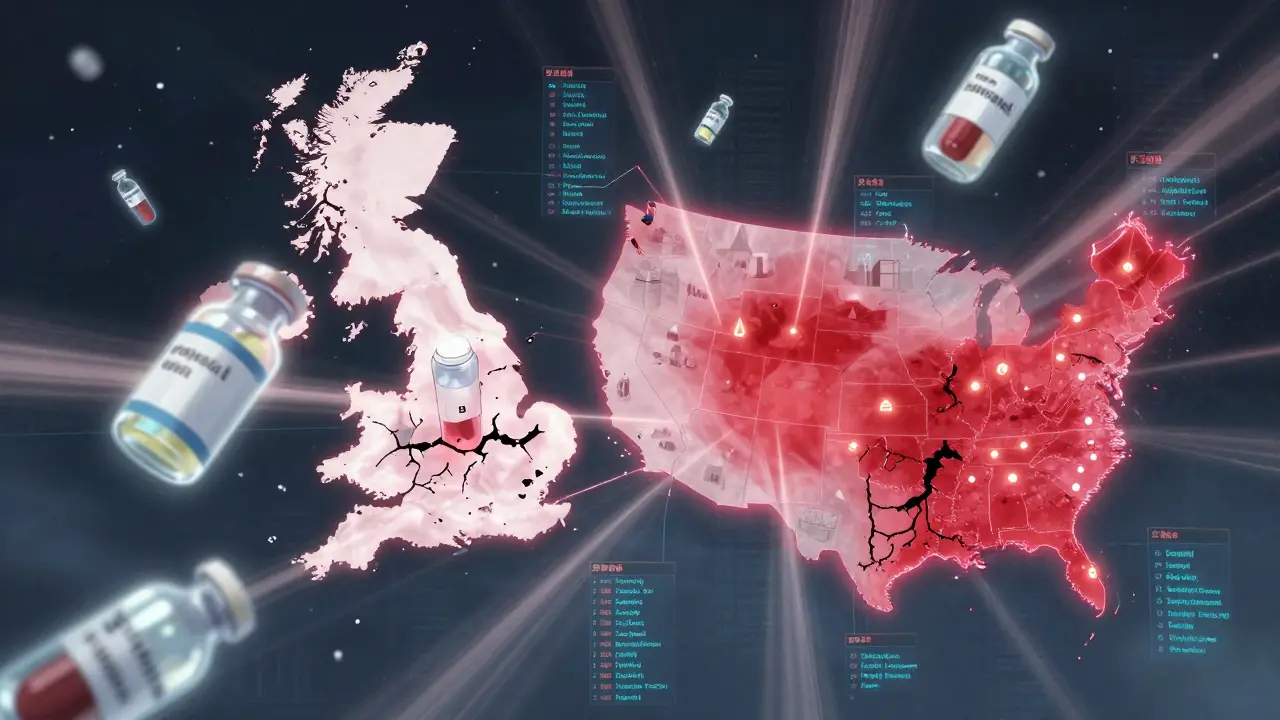
By 2026, more than 1 in 5 prescription drugs in the UK and US are at risk of running out. Not because of a sudden crisis, but because we’ve been ignoring the warning signs for years. Drug shortages aren’t random accidents. They’re predictable. And if we don’t change how we forecast them, they’ll get worse - not better.
Why drug shortages happen - and why we keep missing them
Most people think drug shortages happen because a factory broke down or a shipment got stuck in customs. That’s part of it. But the real reasons are deeper. They’re built into how drugs are made, who makes them, and where they’re made.Over 70% of active pharmaceutical ingredients (APIs) used in the UK and US come from just two countries: India and China. That’s not a coincidence. It’s a cost-cutting decision made over the last 20 years. When companies moved production overseas, they didn’t just save money. They cut redundancy. They stopped keeping backup suppliers. They stopped stockpiling raw materials. And now, when one factory shuts down - whether from a flood in Hyderabad or a regulatory shutdown in Shanghai - the whole chain snaps.
It’s not just about where they’re made. It’s about how few people make them. For some life-saving drugs - like insulin, heparin, or certain antibiotics - there are only one or two manufacturers left. If one of them has a quality issue, the entire market runs out. No alternatives. No backups. No quick fixes.
The data behind the next wave of shortages
The UK’s Medicines and Healthcare products Regulatory Agency (MHRA) started tracking shortage risks in 2023. By 2025, they identified 87 drugs with a high probability of shortage by 2027. These weren’t obscure drugs. They were the ones hospitals rely on daily: chemotherapy agents, anesthetics, dialysis fluids, and critical antibiotics.Here’s what the data shows:
- 72% of high-risk drugs have a single-source manufacturer
- 61% rely on APIs from facilities with a history of FDA or EMA compliance issues
- 48% have been on shortage at least once in the last 5 years
- 33% are used in emergency care - ICU, trauma, or stroke units
These aren’t guesses. They’re patterns. And they’re repeating.
The World Health Organization’s 2025 Global Drug Supply Report found that 1 in 4 countries now experience at least one critical drug shortage every month. In the UK, the NHS recorded 214 separate shortages in 2024 - up from 127 in 2020. The trend is accelerating. And it’s not just about quantity. It’s about timing. Many of these drugs have no shelf life buffer. Once they’re gone, it takes 9-18 months to restart production.
What’s driving the next five years of scarcity?
Five forces are shaping the future of drug shortages. And none of them are going away.1. Supply chain fragmentation
After the pandemic, many companies tried to “friend-shore” production - moving supply chains to allies like Mexico, Poland, or Vietnam. But these new suppliers lack the infrastructure. They don’t have the skilled chemists. They don’t have the clean-room facilities. And they’re not certified. The result? More delays. More rejections. More uncertainty.
2. Regulatory delays
The FDA and EMA are backlogged. A new drug facility inspection now takes 14 months on average - up from 7 months in 2019. Meanwhile, manufacturers are rushing to meet demand, skipping steps, cutting corners. That leads to more recalls. More shutdowns. More shortages.
3. Economic pressure
Generic drug prices have been falling for 15 years. Manufacturers are barely breaking even. Some are leaving the market. Others are cutting R&D, quality control, and inventory buffers. When profit margins are 3%, you don’t stockpile. You barely make enough to pay the lights.
4. Climate and resource stress
Water shortages in India are affecting antibiotic production. Power outages in China are halting API synthesis. Extreme weather is disrupting shipping routes. These aren’t one-off events anymore. They’re becoming the norm.
5. Aging populations and new treatments
By 2030, 22% of the UK population will be over 65. More elderly people means more drugs - for heart disease, diabetes, dementia. At the same time, new therapies like gene treatments and personalized cancer drugs are exploding. These aren’t made in bulk. They’re made in tiny batches. They need special handling. They’re harder to scale. And they’re expensive to store.
How forecasting works - and why most models fail
Forecasting drug shortages isn’t like predicting the weather. It’s more like predicting a traffic jam in a city where half the roads are hidden.Most companies still use simple models: “If demand goes up by 10%, and supply drops by 5%, we’ll run out in 6 months.” That’s outdated. Real forecasting now needs to track 12+ variables:
- Raw material availability
- Factory inspection schedules
- Regulatory approval timelines
- Shipping delays from key ports
- Political instability in supplier countries
- Price trends for APIs
- Inventory levels across distributors
- Historical shortage patterns
- Climate event forecasts
- Labour shortages in manufacturing hubs
- Changes in prescribing patterns
- Emerging drug approvals
Only a handful of organizations - like the UK’s MHRA, the US FDA’s Drug Shortages Program, and a few private analytics firms - are doing this level of tracking. Most hospitals? They’re still using spreadsheets.
Real-world examples: What’s already broken
In 2024, the UK ran out of propofol - a common anesthetic used in surgeries and ICU sedation. Why? One factory in India had a power outage. No backups. No stock. Over 300 planned surgeries were delayed. Patients were moved to private clinics at triple the cost.Same year, levothyroxine - the thyroid medication millions rely on - had a 4-month shortage. The manufacturer switched suppliers without telling regulators. The new API didn’t dissolve the same way. Patients got sick. Some had heart palpitations. Others stopped taking it. The MHRA had to issue emergency guidance.
These weren’t freak events. They were predictable. And they were ignored.
What’s being done - and what’s not enough
The UK government launched the Drug Resilience Initiative in 2025. It’s a start. It includes:- Strategic stockpiles of 15 critical drugs
- Fast-track approvals for backup suppliers
- Incentives for domestic API production
- Real-time tracking of inventory across NHS trusts
But it’s still too small. The stockpile covers only 6 weeks of demand. The incentives are too weak to bring back manufacturing. And the tracking system doesn’t connect to private pharmacies or wholesalers.
The US has a similar program - but it’s even more fragmented. States manage their own lists. Hospitals report shortages manually. There’s no national database. No real-time alerts.
Meanwhile, private companies like PharmAlliance Analytics and MedTrack AI are building better models. They use machine learning to predict shortages 8-12 months in advance. One model flagged a shortage of vancomycin 9 months before it happened. The NHS used that warning to reroute supply. No patient was left without treatment.
What you can do - even if you’re not a policymaker
You don’t need to be in government to help. Here’s what works:- Hospitals: Start tracking your own inventory daily. Don’t wait for alerts. Use open-source tools like DrugShortageTracker.org (free, UK-based).
- Pharmacists: Push for backup drug lists. Not just one alternative - three. And test them. Not all substitutes work the same.
- Patients: Ask your doctor: “Is this drug at risk of shortage?” If it is, ask about alternatives now - not when it’s gone.
- Prescribers: Don’t default to brand names. Generic versions are often more stable. And cheaper.
One GP in Bristol started keeping a printed list of high-risk drugs in her waiting room. Patients asked questions. Pharmacists adjusted orders. No one ran out.
The bottom line
Drug shortages aren’t going away. They’re getting worse. And we’re still treating them like emergencies - not inevitabilities.The future won’t be saved by better logistics. It’ll be saved by better foresight. By data. By transparency. By admitting that we can’t rely on one factory in one country to keep millions alive.
If we keep ignoring the patterns, we’ll keep seeing the same headlines: “Drug runs out. Patients suffer. Officials promise change.”
Change doesn’t come from promises. It comes from preparation.
Why do drug shortages keep happening even when we know about them?
Because the system is built to avoid cost, not to prevent risk. Manufacturers cut corners because they’re pressured to sell drugs at the lowest price. Regulators are overwhelmed. Hospitals don’t track inventory well. And no one has the authority to force change. It’s a perfect storm of incentives that reward short-term savings over long-term stability.
Can we make drugs in the UK again to avoid shortages?
Yes - but it’s not simple. Building a single API manufacturing plant costs £200 million and takes 5 years. It requires highly trained chemists, strict regulatory compliance, and reliable energy and water supplies. The UK tried this in the 1990s and shut down most plants because they couldn’t compete with cheaper imports. Now, with government subsidies and tax breaks, some new facilities are starting up - but they’re small. They can’t replace what’s lost.
Are generic drugs more likely to be in shortage than brand-name drugs?
Yes - by a lot. Generic drugs make up 90% of all prescriptions in the UK, but only 20% of pharmaceutical profits. That means manufacturers have little incentive to invest in backup production, quality control, or inventory. Brand-name drugs often have multiple suppliers and higher margins. Generics? Often one factory, one line, no buffer.
How far in advance can we predict a drug shortage?
With good data, 8-12 months. Simple models only catch shortages 1-3 months ahead - too late. Advanced systems track factory inspections, raw material orders, shipping delays, and regulatory filings. When a manufacturer misses an inspection deadline or stops reporting API shipments, that’s a red flag. The MHRA now uses this data to issue early warnings - but not all hospitals use it.
What’s the most common drug to run out in the UK right now?
In 2025, the top three were heparin (blood thinner), propofol (anesthetic), and levothyroxine (thyroid medication). All three are generics. All three have one main supplier. And all three are critical for emergency care. The NHS has issued formal alerts on all three, but stockpiles are still too small to cover demand.
Is there a global database for drug shortages?
Not a real-time one. The WHO maintains a list of critical shortages, but it’s updated quarterly. The US FDA has a public tracker - but it only covers drugs sold in the US. The UK’s MHRA has the most detailed system, but it’s not linked to other countries. Without a global standard, shortages in India or China don’t show up in UK hospitals until it’s too late.
If you work in healthcare, you’ve seen it: a drug vanishes. No warning. No backup. Just silence. That’s not an accident. It’s a design flaw. And it’s fixable - if we stop treating shortages as surprises, and start treating them as signals.
15 Comments
March 3, 2026 Alex Brad
Just saw the stats on single-source manufacturers. 72% of high-risk drugs? That's not a supply chain issue-it's a policy failure. We've outsourced critical infrastructure like it's a cost center, not a lifeline.
March 4, 2026 Siri Elena
Oh wow, another ‘wake up call’ from someone who just read the MHRA report. Congrats, you noticed the obvious. The real scandal? No one in power has the guts to say: we need to pay more for generics. Or build factories. Or stop pretending profit margins are a valid metric for life-saving drugs.
Meanwhile, hospitals are still using Excel sheets. I’m not shocked. I’m just tired.
March 6, 2026 Deborah Dennis
So... we’re supposed to trust a government that can’t even manage a paper ballot system to handle drug supply chains? This feels like asking a toddler to pilot a jet.
March 8, 2026 marjorie arsenault
You’re right-it’s fixable. But fixable doesn’t mean easy. It means we need to stop treating healthcare like a startup and start treating it like infrastructure. Like roads. Like power grids.
Start small: hospitals can share inventory data. Pharmacists can advocate for backup lists. Patients can ask questions. Change doesn’t come from legislation alone-it comes from millions of small acts.
One GP in Bristol kept a printed list. No one ran out. Imagine if every clinic did that.
We don’t need a hero. We need a habit.
March 8, 2026 Sharon Lammas
It’s eerie how this mirrors the climate crisis. We have the data. We have the models. We even have the solutions. But we keep waiting for a ‘perfect’ moment to act-like the moment we run out of propofol will somehow be the one that finally wakes us up.
It won’t be. We’ll just scramble. Again. And again. And again.
What’s missing isn’t intelligence. It’s collective will.
March 10, 2026 Pankaj Gupta
India and China produce 70% of APIs not because of malice, but because of economic logic. Labor is cheaper. Scale is higher. Infrastructure is mature. To blame them is to ignore the incentives that led us here.
The real question: Why did Western nations abandon domestic production? Was it short-term savings? Political inertia? Or a belief that globalization would always protect us?
It’s not about nationalism. It’s about resilience. And resilience requires redundancy-not just in factories, but in policy.
March 11, 2026 Divya Mallick
Western countries have the nerve to lecture us on quality while they outsource everything? We built the infrastructure. We trained the chemists. We kept production running through pandemics, floods, and lockdowns.
And now you want to blame us for your own failure to invest? We are not your emergency backup. We are your backbone.
Stop treating our factories like disposable parts. Start treating them like partners.
March 12, 2026 Jeff Card
I’ve worked in ICU for 12 years. I’ve watched patients wait because propofol was gone. I’ve seen nurses cry because they had to choose who got the last dose.
This isn’t policy. It’s moral failure.
And yet no one in charge seems to feel it.
March 12, 2026 Diane Croft
Let’s not forget: the NHS recorded 214 shortages in 2024. That’s more than one per day. That’s not a glitch. That’s a system in collapse.
But here’s the good news: we know how to fix it. We just need to choose to.
March 14, 2026 Renee Jackson
Every hospital should implement daily inventory tracking. Every pharmacist should have three alternatives on file. Every patient should be empowered to ask: Is this drug at risk?
These aren’t radical ideas. They’re basic hygiene.
And if we start treating them that way-routine, non-negotiable, non-optional-we can stop the bleeding before the next crisis hits.
March 14, 2026 Helen Brown
Who really controls the drug supply? Big Pharma? The FDA? Or the Chinese Communist Party? I’ve seen the documents. They’re not just manufacturing drugs-they’re controlling access. This isn’t a shortage. It’s a strategic lever.
March 15, 2026 Tildi Fletes
There’s a reason why the UK’s Drug Resilience Initiative only covers 6 weeks of demand. It’s not incompetence. It’s political calculation. Stockpiling is expensive. And politicians get voted out before the next shortage.
Long-term planning requires long-term vision. We don’t have either.
Until we change how we measure success-from quarterly profits to patient survival-we’ll keep having the same conversation.
March 15, 2026 RacRac Rachel
One sentence: We’re not running out of drugs-we’re running out of courage.
March 16, 2026 Raman Kapri
Let me be clear: the claim that India and China are responsible for shortages is a distraction. The real issue is Western regulatory capture. The FDA and EMA are not watchdogs-they’re gatekeepers. They delay approvals to protect domestic manufacturers. This isn’t about supply-it’s about market control.
March 16, 2026 Siri Elena
And yet, somehow, the same people who blame China for the shortages also scream about ‘Made in USA’ when it comes to iPhones. Double standards aren’t policy-they’re hypocrisy.
Write a comment