
Drug Interaction Checker
Enter your medications to check for dangerous interactions based on FDA warnings and clinical evidence. The FDA reports that 41% of patients on five or more drugs miss interaction warnings.
Why Prescription Drug Labels Have Safety Warnings
Every time you pick up a prescription, the label isn’t just telling you how much to take-it’s trying to keep you alive. The safety and warnings section is the most important part of that label. It’s not filler. It’s not bureaucracy. It’s the difference between feeling better and ending up in the hospital.
In the U.S., the FDA requires every prescription drug to include clear, standardized warnings. These aren’t random. They’re based on real data from clinical trials and years of patient reports. About 400 medications carry what’s called a boxed warning-the most serious type. These drugs can cause life-threatening side effects like liver failure, heart rhythm problems, or even sudden death if used incorrectly.
Take clozapine, used for severe schizophrenia. It can wipe out white blood cells, leaving you defenseless against infections. That’s why it has a boxed warning and requires monthly blood tests. Miss the test? You could die. That’s not scare tactics. That’s science.
What’s a Boxed Warning? (And Why It Matters)
Look for a black rectangle on the label. That’s the boxed warning. It’s not printed in small font. It’s bold, it’s surrounded by a thick black border, and it’s placed right at the top of the prescribing information. This isn’t just for doctors-it’s for you.
Boxed warnings mean one thing: this drug has been linked to serious or deadly side effects. The FDA doesn’t add these lightly. Only 8.7% of prescription drugs have them, but they account for a huge portion of preventable harm. If your medication has one, don’t ignore it. Don’t assume your doctor already covered it. Ask: “What exactly could go wrong if I skip a dose or mix this with something else?”
Examples: Warfarin (blood thinner) can cause fatal bleeding if taken with certain painkillers. Metformin can cause lactic acidosis in people with kidney problems. These aren’t rare. They’re well-documented. And they’re preventable-if you know what to look for.
Understanding Warnings and Precautions
Beneath the boxed warning, you’ll find a section called “Warnings and Precautions.” This is where the details live. It’s not just a list of side effects like nausea or dizziness. It’s about risks that could kill you-or land you in the ER.
Here’s how to read it:
- Look for phrases like “may cause,” “has been associated with,” or “risk increased.” These mean the danger is real, even if it doesn’t happen to everyone.
- Watch for conditions like “avoid if you have liver disease,” “do not use during pregnancy,” or “monitor blood pressure weekly.” These aren’t suggestions. They’re rules.
- Pay attention to timing. “Take on an empty stomach” isn’t about comfort-it’s about absorption. Take it with food, and the drug might not work. Take it too close to another medication, and it could become toxic.
One patient I read about took dextromethorphan (a cough syrup) while on an SSRI antidepressant. The label said “avoid with SSRIs.” He didn’t think it applied because he’d taken cough medicine before. He ended up in the hospital with serotonin syndrome-a dangerous overstimulation of the nervous system. That warning was there. He just didn’t see it.
Drug Interactions: The Silent Killer
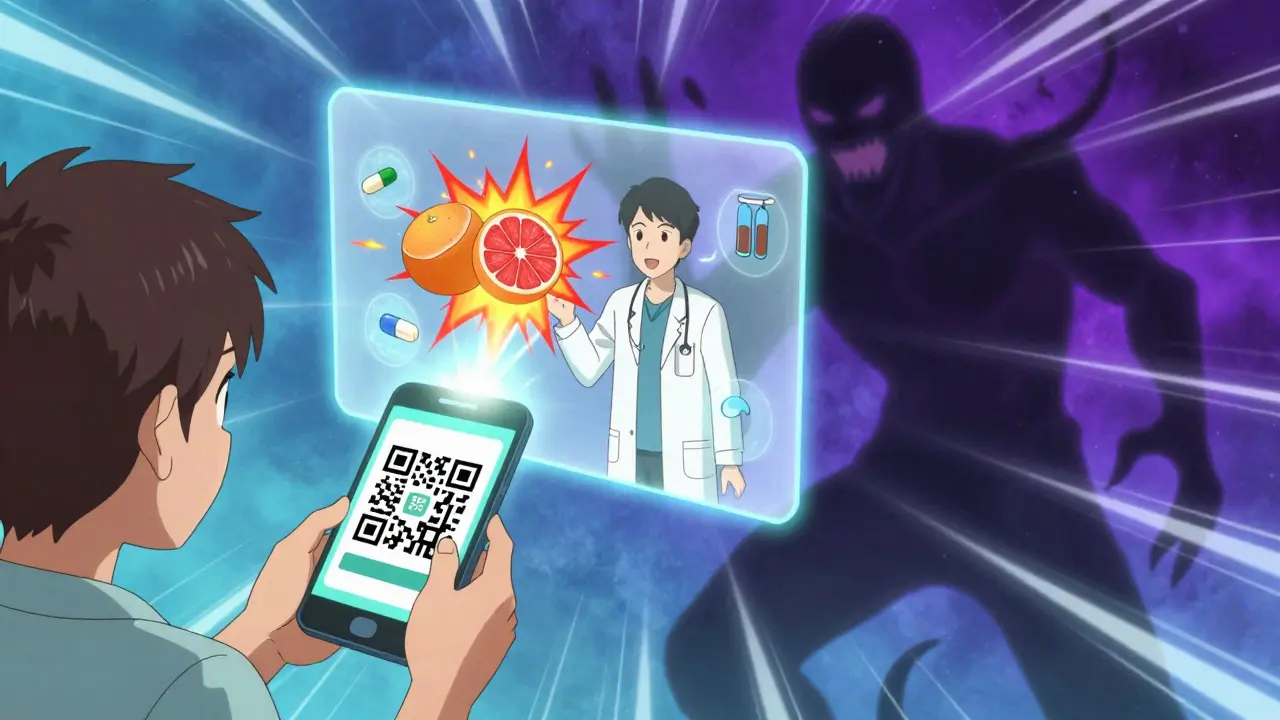
Most people know not to mix alcohol with painkillers. But what about grapefruit juice and statins? Or antacids and antibiotics? These are the hidden dangers.
The “Drug Interactions” section tells you exactly which medicines, foods, or supplements can change how your drug works. It’s not vague. It’s technical. For example: “CYP3A4 inhibitors may increase plasma concentrations of Drug X by up to 400%.” That’s a mouthful, but here’s what it means: if you’re taking something like clarithromycin (an antibiotic) with simvastatin (a cholesterol drug), your body can’t break down the statin properly. That builds up to toxic levels-and can cause muscle damage or kidney failure.
Don’t rely on memory. Write down every medication you take-prescription, over-the-counter, vitamins, herbs. Bring it to your pharmacist. Ask: “Which of these could interact with my new drug?” Most pharmacies now have digital tools that scan your full list and flag risks in seconds.
What’s on the Pharmacy Label? (And Why It’s Different)
The bottle you take home doesn’t have the full FDA label. It has a simplified version printed by the pharmacy. That’s where you’ll see stickers like:
- “May cause drowsiness-do not drive or operate machinery.”
- “Take on an empty stomach.”
- “Avoid alcohol.”
These are critical. Studies show only 42% of patients even notice them. Why? Because they’re small. They’re stuck on the bottom of the bottle. They’re easy to miss.
Here’s what to do: When you get your prescription, don’t just put it in the cabinet. Hold the bottle up to the light. Read every sticker. If you can’t read it, ask the pharmacist to print a larger version. Some pharmacies now offer large-print labels for free. If you’re on multiple meds, use a pill organizer with clear labels. Don’t guess.
What to Do If You Don’t Understand a Warning
Confusion is the biggest risk. Nearly 70% of patients don’t know what “boxed warning” means. Half don’t understand instructions like “take 2 hours before meals.” And 41% miss interaction warnings when they’re on five or more drugs.
Don’t pretend you get it. Ask your pharmacist to explain it in plain English. Use the “teach-back” method: after they explain, say, “So if I take this with ibuprofen, I could get kidney damage-is that right?” If they nod, you got it. If they hesitate, dig deeper.
Also, ask: “What’s the worst thing that could happen if I ignore this warning?” That question cuts through the noise. It forces clarity.
Tools That Actually Help
You don’t have to remember everything. Use tools.
- Medisafe or MyTherapy: These apps scan your pills and send alerts for interactions and missed doses. Users report 89% accuracy when used consistently.
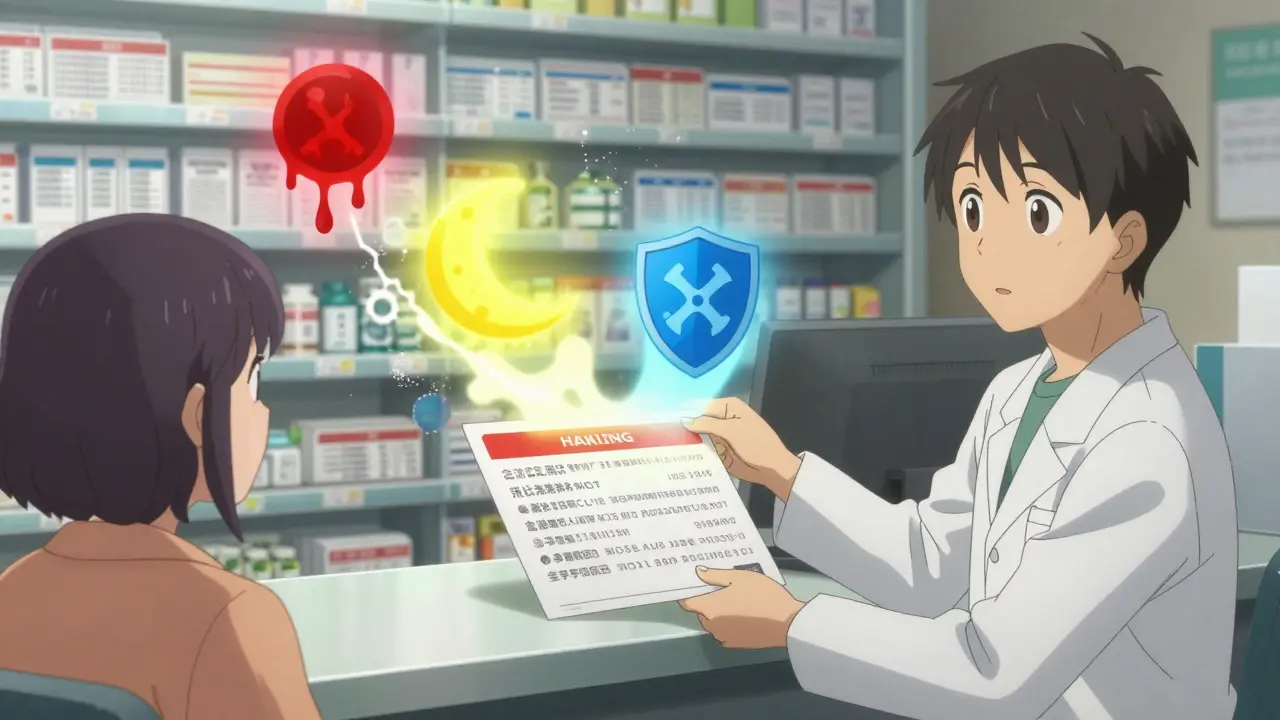
- QR codes on bottles: Some pharmacies now include scannable codes that link to short videos explaining the warning in simple terms. Walgreens piloted this with 12,000 patients-comprehension jumped from 63% to 92%.
- Warning log: Keep a notebook. Write down each drug, the warning, and what you need to do. Example: “Lisinopril: Watch for swelling in face/throat. Call 911 if it happens.” Review it every time you refill.
These aren’t luxuries. They’re safety nets. And they work.
What’s Changing in 2026
The FDA is pushing for better warning systems. By 2026, new drugs must include warning language tested on people with low literacy. You’ll start seeing pictograms-simple icons for risks like “bleeding,” “drowsiness,” or “allergy.”
Some pharmacies are testing color-coded systems: red for critical, yellow for important, blue for general. One CVS study showed patient recall improved by 22% after switching to this system.
But here’s the catch: tech won’t help if you don’t use it. If you’re not comfortable with apps or QR codes, ask for printed copies. You have the right to clear, readable information. Don’t let outdated labels or small print put you at risk.
Final Checklist: Before You Take Your Medication
- ✅ Did I read the boxed warning? (Look for the black border.)
- ✅ Did I check for interactions with my other meds, vitamins, or supplements?
- ✅ Did I understand the timing? (Before meals? After? At bedtime?)
- ✅ Did I ask my pharmacist to explain one thing I didn’t understand?
- ✅ Did I write down the warning in my own words?
If you can answer yes to all five, you’re doing better than most. Medication safety isn’t about being perfect. It’s about being aware. One small step-reading the label-can save your life.
12 Comments
January 12, 2026 Eileen Reilly
lol i just glance at the bottle and hope for the best. who has time to read all that? i took my blood pressure med with grapefruit juice last week and i’m still standing. 🤷♀️
January 12, 2026 Monica Puglia
I actually print out the full FDA label and tape it to my fridge next to my pill organizer. 🧠✨ It’s annoying at first, but now I catch things like ‘avoid with St. John’s Wort’ before I grab my supplements. Small effort, huge difference. You got this!
January 13, 2026 Cecelia Alta
Ugh. Another one of these ‘read your labels’ lectures. Like the FDA actually cares if you live or die. They just want to cover their asses so they don’t get sued. I’ve been on 7 different meds in the last 5 years and every single one had a ‘boxed warning’-and guess what? I’m still here. Meanwhile, my cousin died from a ‘safe’ over-the-counter sleep aid. Yeah, real scary, huh?
January 15, 2026 George Bridges
I used to ignore warnings too. Until my dad ended up in the ER because he took ibuprofen with his blood thinner. He didn’t even know they could interact. Now I ask my pharmacist to explain every new script in plain terms. No shame in asking. Seriously. It’s not your fault if the label’s confusing.
January 17, 2026 Rebekah Cobbson
I started using Medisafe after my mom missed her dose for 3 days and ended up with a stroke. The app sends me alerts, reminds me to check interactions, and even lets me share my list with my daughter. I wish I’d known about it sooner. You don’t have to be perfect-just consistent.
January 19, 2026 Audu ikhlas
This is why america is weak. People cant even read a label without crying for help. In my country we take medicine and dont ask questions. If you die its your fault. Simple.
January 19, 2026 Sonal Guha
The 400 boxed warnings statistic is misleading. Most are for drugs with very low usage. The real risk is polypharmacy in elderly patients. Also the QR code thing is a gimmick. Most seniors cant use smartphones. This whole post is performative safety culture.
January 19, 2026 Abner San Diego
I read the label once. Then I threw it out. If the doctor wanted me to follow every tiny warning they’d give me a 30-page pamphlet. I take my meds. I don’t die. That’s good enough.
January 21, 2026 steve ker
The real issue is not the label its the doctors who prescribe without explaining. I had a pill that said avoid alcohol. No one told me why. So I assumed it was just a legal cover. Turns out it caused liver failure in 1 in 500. That’s not a warning thats negligence
January 23, 2026 TiM Vince
I’ve been taking metformin for 8 years. I never knew about the lactic acidosis risk until I read this. I’m going to ask my pharmacist to print me a bigger label. I didn’t realize how much I was ignoring. Thanks for the nudge.
January 24, 2026 Jessica Bnouzalim
YES!!! I just started using the warning log and it’s changed my life!!! I write down every warning in my own words like ‘If my face swells → CALL 911’ and I keep it in my wallet. I even made a little emoji key: 🚨 = danger, 🟡 = be careful, 💙 = general tip. I’m so proud of myself for finally doing this!! 🙌💖
January 25, 2026 laura manning
The assertion that ‘400 medications carry boxed warnings’ is statistically misleading without context regarding prevalence of use, incidence rates of adverse events, and risk-benefit ratios. Furthermore, the reliance on patient self-reporting and anecdotal case studies undermines the evidentiary rigor required for clinical decision-making. The proposed pictographic system, while intuitively appealing, lacks validation through peer-reviewed cognitive load studies and may exacerbate disparities among non-literate populations. This piece, though well-intentioned, fundamentally conflates accessibility with scientific validity.
Write a comment