
Penicillin Allergy Risk Assessment Tool
Understanding Penicillin Allergy Testing
More than 10% of Americans report a penicillin allergy, but 90-95% of them are mislabeled. This tool helps determine if you might qualify for penicillin allergy testing based on your reaction history.
Your Results
Next Steps
More than 10% of Americans say they’re allergic to penicillin. But here’s the surprising truth: 90% to 95% of them aren’t. They’ve been mislabeled - often based on a childhood rash, a vague family history, or a reaction that happened decades ago. And that mislabeling is costing lives, money, and health.
When someone is labeled penicillin-allergic, doctors avoid the safest, cheapest, and most effective antibiotics. Instead, they turn to broader-spectrum drugs like clindamycin, vancomycin, or fluoroquinolones. These alternatives aren’t just more expensive - they’re riskier. Patients with a penicillin allergy label are 69% more likely to get a Clostridioides difficile infection. They’re 50% more likely to develop surgical site infections. And their treatment fails more often.
Penicillin allergy testing isn’t just about removing a label from a chart. It’s about fixing a broken system that’s been putting patients at risk for decades. And the science behind it is clear, safe, and ready to use.
How Penicillin Allergy Testing Works
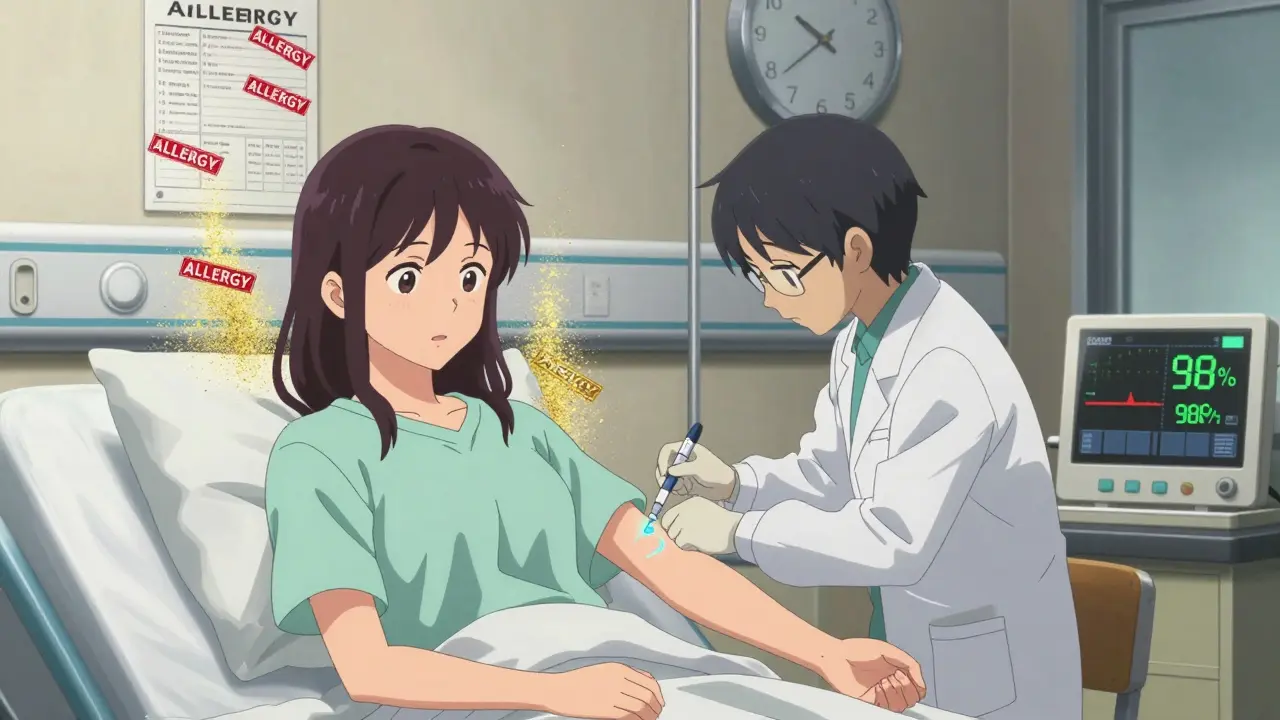
Penicillin allergy testing isn’t a single test. It’s a two-step process designed to find out if your body truly reacts to penicillin via IgE antibodies - the kind that cause hives, swelling, or anaphylaxis.
The first step is skin testing. A small amount of penicillin reagent is placed on the skin, then lightly pricked. If that’s negative, a deeper intradermal injection follows. The reagents used are specific: Pre-Pen (penicilloyl-polylysine) for the major determinant, and minor determinant mixtures like benzylpenicilloate. In the U.S., Pre-Pen is the only FDA-approved skin test reagent. Other countries may use different formulations, but this is the standard here.
After skin testing, if both results are negative, the next step is an oral challenge. You’re given a small dose of amoxicillin - usually 250 mg - and watched for an hour. If no reaction occurs, you’re cleared.
Why the oral challenge? Because skin testing, while highly specific, isn’t perfect. Studies show it misses about 30% of true IgE-mediated allergies. That’s why the oral challenge is required. Together, the two steps give you a 98%+ negative predictive value. That means if you pass both, your chance of having a future anaphylactic reaction to penicillin is as low as someone who never claimed to be allergic.
A new test kit is under FDA review that combines major and minor determinants with amoxicillin in one package. Early results show it can predict safety without needing the oral challenge - a game-changer for hospitals short on time or staff.
Who Should Get Tested?
Not everyone with a penicillin label needs testing. The key is risk stratification.
Low-risk patients include those who had:
- A rash that appeared more than 72 hours after taking the drug
- A family history of penicillin allergy
- Headache, nausea, or dizziness - not true allergic symptoms
- A reaction that happened more than 10 years ago
These patients can often skip skin testing and go straight to an oral challenge under supervision.
Moderate-risk patients had symptoms like hives, itching, or mild swelling within 1 to 6 hours of taking penicillin. They need skin testing first, then an oral challenge if the skin test is negative.
High-risk patients had anaphylaxis, low blood pressure, throat tightness, or respiratory distress. These patients should be referred to an allergist. But even here, testing is often safe - if done properly.
There’s one group that should NEVER be tested: those who had severe delayed reactions like Stevens-Johnson syndrome, toxic epidermal necrolysis, DRESS, or drug-induced liver or blood cell damage. These are T-cell mediated reactions, not IgE. Skin testing won’t help them - and they must avoid all penicillin-class drugs for life.

Why This Matters Beyond the Lab
Penicillin is cheap. Amoxicillin costs about $34.50 per course. Clindamycin? $95.20. Vancomycin? Over $200. When hospitals avoid penicillin because of a mislabeled allergy, they spend extra - and patients pay the price in side effects.
Studies show that after successful de-labeling, hospitals see:
- 30% to 50% more use of penicillin-class antibiotics
- 63% higher cost savings per patient
- 0.8 fewer days in the hospital
- Significant drop in C. difficile cases
One 2022 study of 121 U.S. hospitals found that 39% offered inpatient skin testing. That’s up from just 15% in 2016. But 61% still don’t have it. Why? Because testing requires training. And until recently, only allergists were seen as qualified.
That’s changing. Pharmacists, nurses, and infectious disease specialists are now being trained to perform assessments and oral challenges. In academic medical centers, pharmacists now handle 47% of penicillin allergy evaluations - up from 12% in 2017.
It’s not about replacing allergists. It’s about scaling access. Penicillin allergy testing doesn’t need a specialist’s office. It needs a protocol, a trained team, and a willingness to change.
What Happens After You Test Negative?
Passing the test isn’t the end. It’s the beginning.
The allergy label must be removed from your electronic medical record. Otherwise, the next doctor you see will still avoid penicillin. This step is critical - and often forgotten.
Hospitals that do this right have nurses or pharmacists document: “Patient tolerated amoxicillin challenge. Penicillin allergy removed from chart.” That note becomes part of your permanent record. It’s not just a formality. It’s a safety net.
Some patients worry: “What if I react next time?” But the data says otherwise. Once you’ve passed both skin testing and oral challenge, your risk is the same as someone who never claimed an allergy. You can safely take penicillin again - even for serious infections like syphilis or endocarditis.
The CDC now states that 97% of patients who report penicillin allergy can safely receive penicillin for syphilis treatment after testing. That’s huge. Syphilis used to be treated with doxycycline or ceftriaxone in penicillin-allergic patients. Now, penicillin G - the gold standard - can be used again.

The Future of Testing
Right now, testing takes 45 to 60 minutes. But new pilot programs at Mayo Clinic, Johns Hopkins, and UCSF are testing rapid protocols that cut that time to under 30 minutes. These use simplified steps and trained non-allergist staff. Early results show 96.5% accuracy compared to traditional methods.
The FDA is reviewing a new all-in-one test kit that includes major and minor determinants plus amoxicillin. If approved, it could eliminate the need for the oral challenge in most cases. That would make testing faster, cheaper, and easier to roll out in emergency rooms, urgent care centers, and even primary care offices.
By 2027, the CDC predicts 85% of U.S. hospitals will have formal penicillin allergy de-labeling programs. That could prevent 50,000 to 70,000 cases of C. difficile every year - and save billions in avoidable costs.
This isn’t science fiction. It’s happening now. Hospitals that adopt it see fewer infections, shorter stays, and better outcomes. Patients get better care. The system works better.
What You Can Do
If you’ve been told you’re allergic to penicillin:
- Ask your doctor: “Was my reaction confirmed by testing?”
- Ask: “Could I be tested now to see if I still have the allergy?”
- Bring up the CDC’s 2023 guidelines - they’re now standard of care.
- If you’re in a hospital, ask if they have a penicillin allergy de-labeling program.
Don’t assume your allergy is real just because it’s on your chart. Most aren’t. And if you’re not allergic, you deserve better antibiotics - safer ones, cheaper ones, more effective ones.
Penicillin isn’t dangerous because it’s powerful. It’s dangerous because we’ve been afraid of it - for the wrong reasons.
Can I outgrow a penicillin allergy?
Yes. Most people who report a penicillin allergy in childhood lose the sensitivity over time. Studies show that 80% of people who had a reaction more than 10 years ago will test negative. That’s why testing is recommended even if your allergy was diagnosed decades ago.
Is penicillin skin testing painful?
It’s similar to a skin prick test for pollen or peanuts. You’ll feel a small pinch during the intradermal injection, but it’s brief. Most people describe it as mild discomfort. There’s no lasting pain, and serious reactions during testing are extremely rare when done correctly.
Can I be tested if I’m pregnant?
Yes. Penicillin is the first-line treatment for syphilis in pregnancy, and avoiding it puts both mother and baby at risk. Skin testing and oral challenges are safe during pregnancy and recommended by the CDC when there’s a history of penicillin allergy. The benefits far outweigh any theoretical risks.
What if my test is positive?
If your skin test or oral challenge shows a reaction, you’re truly allergic. You’ll need to avoid all penicillin-class drugs. But even then, you may still be able to take other antibiotics safely. Your doctor can help you identify alternatives that don’t cross-react, like aztreonam or certain cephalosporins, depending on your specific reaction history.
Can pharmacists perform penicillin allergy testing?
Yes - in many hospitals, pharmacists are now trained to conduct risk assessments, administer oral challenges, and document results. They’re often the first point of contact for patients flagged with a penicillin allergy. This shift has helped expand access where allergists aren’t available.
Does insurance cover penicillin allergy testing?
Most insurance plans, including Medicare and Medicaid, cover penicillin allergy testing when ordered by a provider. Skin testing and oral challenges are considered medically necessary for patients with a history of penicillin allergy, especially if they’re being treated for an infection where penicillin is preferred.
14 Comments
January 8, 2026 Paul Mason
Man, I had a rash as a kid after penicillin and spent 20 years avoiding it. Turns out I was fine. Got tested last year, took amoxicillin like it was candy. My doctor was shocked I didn’t know this was a thing. Why isn’t this common knowledge? We’re all just guessing based on old charts.
January 9, 2026 Anastasia Novak
Oh please. Another ‘medical myth debunked’ clickbait article. You know what’s really dangerous? Giving people a false sense of security because some ‘test’ says they’re fine. Skin tests are not 100%. Oral challenges are still risky. And now we’re just going to hand out penicillin like candy? People die from anaphylaxis. Not every ‘label’ is wrong - some are just ignored because it’s easier.
January 11, 2026 Alex Danner
Real talk - this is one of the most important things in modern medicine nobody talks about. I work in ER. We have patients come in with pneumonia, and we’re forced to give them vancomycin because they ‘allergic to penicillin’ since age 6. No test. No history. Just a note. Then they get C. diff and spend 3 weeks in the hospital. We’ve started doing rapid de-labeling here. Nurses do the screening, pharmacists do the challenge. Cost per patient dropped 60%. Infection rates plummeted. It’s not magic. It’s just logic.
January 13, 2026 Elen Pihlap
Wait… so you’re saying I don’t have to avoid penicillin anymore? I’ve been scared my whole life because my mom said her sister died from it? I’m crying. I just want to know if I can take amoxicillin for my sinus infection. Can I just walk into a pharmacy and ask? I don’t have insurance. Will they still test me? Please tell me I’m not alone.
January 14, 2026 steve rumsford
so i had a rash after penicillin when i was 5. now im 34. got tested last month. turned out i was fine. my doc said ‘we’ve been doing this wrong for decades’ and i just sat there thinking… why did no one tell me this before? i wasted 30 years being extra careful about antibiotics. it’s wild.
January 16, 2026 Andrew N
Let’s not oversimplify. The 90% stat is misleading. It’s based on low-risk populations. High-risk patients? Those numbers drop fast. And many hospitals don’t have the resources to do proper testing. Just because a test is ‘safe’ doesn’t mean it’s practical. Also, some reactions aren’t IgE-mediated. You can’t test for everything. This article reads like a pharmaceutical ad.
January 16, 2026 Poppy Newman
This is so important!! 🙌 I’m a nurse and we just launched our de-labeling program last quarter. We’ve cleared 47 patients so far. 45 tested negative. One guy cried because he’d been avoiding penicillin since he was 4 and just had his first real infection treated right. I’m so proud of this. We need more of this. Please share this with your doctor! 🩺❤️
January 17, 2026 Anthony Capunong
Why are we trusting some test from some fancy hospital when our grandmas knew penicillin was dangerous? This is another example of American medicine trying to fix what ain’t broke. We’ve been doing fine with alternatives. Why mess with tradition? We don’t need some PhD telling us what our bodies feel.
January 18, 2026 Ayodeji Williams
lol this is why africa dont trust western medicine. you say penicillin safe then you say no then you say maybe then you say test then you say its fine. i had cousin who got rash then died after penicillin. now you say 95% are wrong? what about the 5%? who pays for their funeral? this is not science. this is gambling with lives.
January 19, 2026 Kamlesh Chauhan
so i got tested and turned out i was never allergic but now my doctor wont change my chart because ‘we dont have time’ and ‘someone else might see it’ so i still get clindamycin and i get diarrhea every time and now i have to pay more and i feel like a guinea pig
January 19, 2026 Sai Ganesh
In India, we’ve had this problem for years. People avoid penicillin because of old family stories or misdiagnosed rashes. But access to testing is almost nonexistent outside big cities. We need community health workers trained to do basic screening. Not everyone can go to a hospital. This isn’t just a US issue - it’s global. We need low-cost, scalable models.
January 20, 2026 Adam Gainski
I’m a pharmacist and I’ve done over 200 oral challenges. The scariest part? The patients are usually more nervous than we are. They’ve lived with this label for decades. Passing the test is life-changing. But the real win? When the EMR gets updated. That’s the part most hospitals forget. If the chart doesn’t change, the patient is still labeled. We’ve started printing a card for patients: ‘Penicillin allergy removed. Tested and cleared on [date].’ Simple. Effective.
January 20, 2026 Aparna karwande
This is pure American arrogance. You think your tests are better than centuries of traditional wisdom? You think you can just ‘test away’ a genetic predisposition? In my culture, we respect the body’s warnings. If your grandmother said no penicillin, you don’t just go ‘oh let’s try it’ because some study says 95%. You disrespect your ancestors. And now you want to force this on everyone? Shameful.
January 22, 2026 Jessie Ann Lambrecht
I’m so glad this is getting attention. I was one of those people who avoided penicillin for 15 years because of a rash I got as a kid. Got tested last year - passed with flying colors. My doctor said, ‘You’re now in the 5% who actually had it.’ I almost cried. I felt like I’d been lied to my whole life. But now? I take amoxicillin like it’s water. And my infections clear faster. I’m telling everyone. This is the quiet revolution in medicine. Let’s make it mainstream.
Write a comment