

Why You’re Losing Muscle When You Try to Lose Weight
Most people think weight loss means dropping pounds on the scale. But if you’re losing muscle along with fat, you’re actually making your body less efficient at burning calories long-term. That’s why so many people hit a plateau-or worse, regain all the weight they lost. The real problem isn’t too many carbs or too much sugar. It’s not enough protein.
When you cut calories to lose weight, your body doesn’t know the difference between starving and dieting. It starts breaking down muscle for energy. That’s bad news because muscle burns more calories at rest than fat. Lose muscle, and your metabolism slows down. Suddenly, eating the same amount as before makes you gain weight. It’s not your fault. It’s just biology.
But here’s the good part: you can stop this. There’s a proven way to lose fat while keeping your muscle intact. It’s called protein prioritization. And it’s not about eating chicken breast every meal or chugging protein shakes. It’s about getting the right amount, at the right times, from the right sources.
How Much Protein Do You Actually Need?
The old standard-0.8 grams of protein per kilogram of body weight-isn’t enough if you’re trying to lose weight. That number was set for sedentary people just to avoid deficiency, not to stay strong or feel full. If you’re cutting calories, you need more.
Research shows that 1.6 grams per kilogram of body weight is the sweet spot for most adults. For example, if you weigh 70 kg (about 154 lbs), aim for 112 grams of protein a day. That’s not crazy. It’s just more than most people eat.
For older adults over 65, the range is 1.2 to 1.6 g/kg. Muscle loss accelerates with age, and protein helps fight that. If you’re active, lifting weights, or doing any kind of resistance training, you might even benefit from going up to 2.2 g/kg. But beyond that, there’s no extra muscle gain-just extra cost and possible digestive discomfort.
Here’s a quick way to calculate your daily target: multiply your weight in pounds by 0.73. That gives you grams of protein per day. So 160 lbs × 0.73 = 117 grams. Simple.
When You Eat Protein Matters More Than You Think
It’s not just how much you eat-it’s when. Spreading protein evenly across your meals makes a huge difference. Eating 40 grams at dinner and 10 grams at breakfast won’t cut it. Your body can’t store protein like it stores fat or carbs. It needs a steady supply.
Studies show that consuming 25-30 grams of protein per meal, three to four times a day, keeps muscle protein synthesis turned on all day. That’s about the size of a palm-sized portion of chicken, fish, or tofu, or a scoop of whey with a cup of Greek yogurt.
One overlooked trick: don’t skip protein at breakfast. After a night of fasting, your muscles are hungry. Eating protein early helps reverse what’s called “anabolic resistance”-a slowdown in how well your muscles respond to protein as you age. A 2025 study from Purdue University found that older adults who ate 30g of protein at breakfast preserved significantly more muscle than those who saved it for dinner.
Also, if you work out, get protein within 45 minutes after. Doesn’t have to be a shake. A hard-boiled egg and a piece of whole grain toast works fine.
Not All Protein Is Created Equal
Whey, eggs, chicken, fish, and dairy have what’s called a high PDCAAS or DIAAS score. That means they contain all the essential amino acids your body can’t make on its own-and in the right amounts. Leucine, in particular, is the trigger that tells your muscles to grow. You need at least 2.5-3 grams of leucine per meal to activate this switch.
Here’s how much you need to eat to hit that threshold:
- 30g whey protein powder = 2.8g leucine
- 100g chicken breast = 2.5g leucine
- 1 cup cottage cheese = 2.6g leucine
- 1 large egg = 0.6g leucine (so you’d need 4-5 eggs)
Plant-based proteins like beans, lentils, and soy are great-but they’re lower in leucine. A cup of lentils has only about 1.2g. To match animal proteins, you need to combine them: rice + beans, hummus + whole grain pita, or add a pinch of leucine-fortified supplement if you’re vegan and serious about muscle retention.
And don’t trust protein bars labeled “high protein.” Many are full of sugar and fillers. Check the label: 20g protein with 15g sugar? That’s not a health food. It’s candy with protein.

Why Protein Keeps You Full Longer
Ever eat a big bowl of pasta and be hungry again two hours later? Now try a grilled chicken salad with eggs and Greek yogurt. You’ll feel satisfied for hours. That’s not magic. It’s science.
Protein boosts three key satiety hormones:
- Peptide YY (PYY) goes up by 25%
- GLP-1 increases by 20%
- Ghrelin-the hunger hormone-drops by 13%
Compare that to a carb-heavy meal like oatmeal with banana and honey. Your blood sugar spikes, then crashes. You feel tired. You crave sugar. Protein? No crash. Just steady energy and fewer cravings.
That’s why people who prioritize protein stick to their diets longer. The National Weight Control Registry found that 83% of people who kept off 30+ pounds for over a year intentionally ate more protein than average. Not because they were obsessed with fitness. Because they weren’t constantly hungry.
What Happens If You Don’t Get Enough?
Here’s what a low-protein diet looks like during weight loss:
- Loss of muscle mass-up to 1.3 kg more than with higher protein diets
- Slower metabolism-you burn fewer calories even at rest
- Increased hunger-more snacking, more cravings
- Weakness-stairs feel harder, carrying groceries feels exhausting
A 2023 study tracked 120 men over 65 losing weight. Those eating 0.8 g/kg lost 1.3 kg more muscle than those eating 1.6 g/kg. That’s like losing a full pound of muscle you’ll never get back without serious training.
And it’s not just older adults. Younger people who cut protein while dieting often feel “skinny fat”-thin but soft, lacking tone. That’s because they lost muscle, not just fat.
Cost, Convenience, and Real-Life Challenges
Yes, eating more protein costs more. Chicken, eggs, fish, and whey aren’t cheap. USDA data shows high-protein diets can raise food bills by 18%. But you don’t need to eat expensive stuff all the time.
Here’s how to keep costs down:
- Canned tuna: $0.12 per gram of protein
- Eggs: $0.15 per gram
- Cottage cheese: $0.18 per gram
- Whey isolate: $0.31 per gram
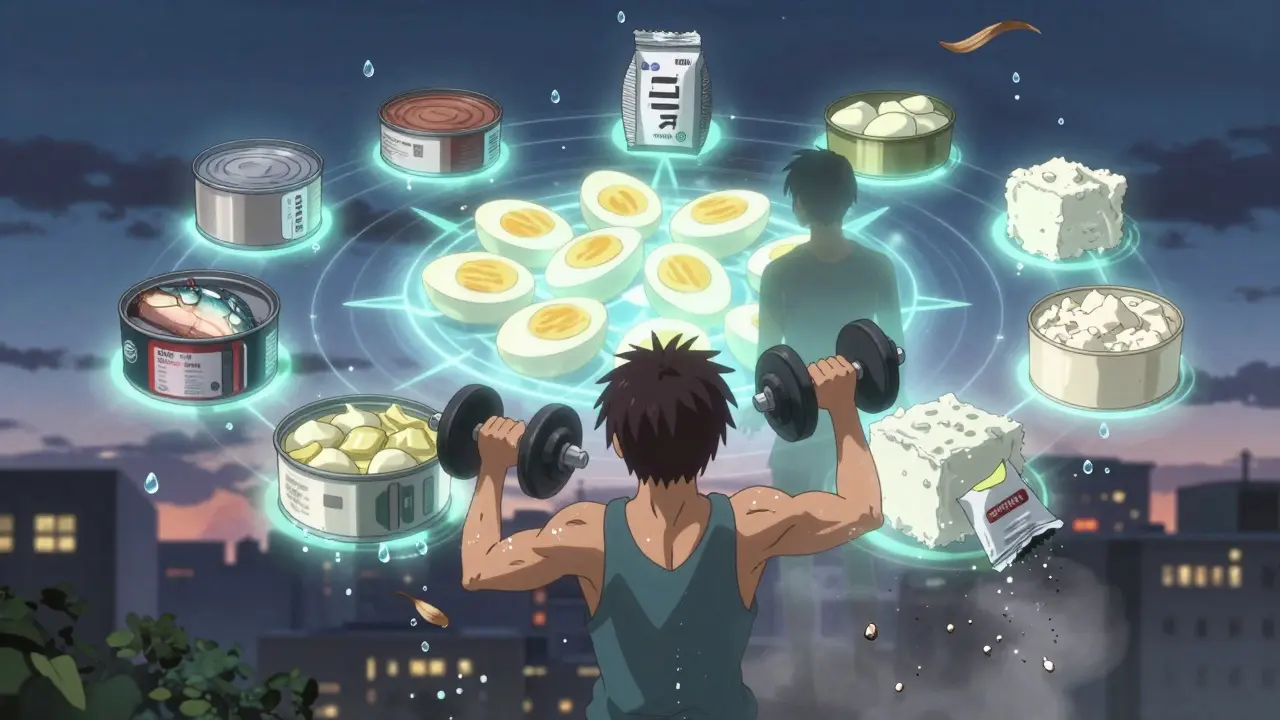
Batch cook on Sundays. Make a big pot of lentils, grill a whole chicken, hard-boil a dozen eggs. Portion them out. You’ll save time and money.
Also, don’t fall into the trap of thinking you need protein powder. Most people can get enough from whole foods. Powder is just a tool-not a requirement.
One common mistake? Ignoring fiber. Eating a lot of protein without enough veggies, beans, or whole grains leads to constipation. Drink more water too. Above 2.5 g/kg, you risk dehydration or kidney strain if you’re not hydrating well.
Who Should Skip This Approach?
Protein prioritization works for almost everyone trying to lose weight. But it’s not a magic bullet.
If you’re completely sedentary and not doing any strength training, the muscle-preserving benefits shrink. You’ll still feel fuller, but you won’t gain strength or tone. In that case, 1.2 g/kg is enough.
People with advanced kidney disease should avoid high protein diets unless cleared by a doctor. That’s rare-only about 1 in 700 adults have this condition.
And if you’re eating 2.5+ g/kg just because you saw a bodybuilder on Instagram? You’re probably wasting money. Your body can’t use it. You’ll just pee it out.
What the Experts Say
Dr. Stuart Phillips from McMaster University calls protein prioritization “the most evidence-based nutritional intervention for preserving lean mass during weight loss.” The American College of Sports Medicine and ESPEN both updated their guidelines in 2023-2024 to recommend 1.6 g/kg for active adults in energy deficit.
But not everyone is all-in. Dr. David Ludwig from Harvard warns that going too high on protein might mean cutting out fruits, veggies, and whole grains. Balance matters. You don’t want to trade one problem for another.
The consensus? Stick to 1.2-1.8 g/kg. Get most of it from whole foods. Spread it out. Don’t obsess. And don’t forget fiber and water.
Real People, Real Results
Reddit user ‘GainsByScience’ lost 42 pounds in six months while keeping 97% of his muscle mass. His secret? 1.8g/kg protein, 40g per meal, three times a day. No supplements-just chicken, eggs, and Greek yogurt.
On the flip side, ‘BudgetShredder’ on MyFitnessPal quit after three months because he was spending $97 a week on protein. He didn’t know canned tuna was cheaper than chicken breast.
Abbott Nutrition surveyed 1,200 dieters. Those on protein-prioritized plans had 78% adherence at 12 weeks. Those on standard diets? Only 56%. The main reasons people quit? Boredom with meals and stomach upset from too much protein too fast.
How to Start Today
- Calculate your protein target: weight in pounds × 0.73 = grams per day
- Divide that number by 4. That’s your target per meal (aim for 3-4 meals)
- Swap one carb-heavy meal for a protein-rich one (e.g., oatmeal → eggs + avocado)
- Buy one affordable protein source this week: eggs, canned tuna, cottage cheese
- Drink more water-aim for 2.5-3 liters daily
- Track for 2 weeks. Notice how full you feel. Notice how little you snack.
You don’t need to overhaul your life. Just shift one meal. Then another. In four weeks, you’ll feel stronger. You’ll crave less sugar. And you won’t be surprised when the scale drops but your clothes fit better.
Frequently Asked Questions
Is 1.6g of protein per kg too much for a normal person?
No. The recommended daily allowance (RDA) of 0.8g/kg is the bare minimum to prevent deficiency, not to stay healthy or lose fat. For anyone trying to lose weight, especially over 40, 1.6g/kg is the minimum recommended by leading health organizations. It’s safe, effective, and backed by dozens of clinical trials.
Can I get enough protein on a plant-based diet?
Yes, but it takes more planning. Plant proteins are lower in leucine, the amino acid that triggers muscle growth. To match animal proteins, combine sources like rice and beans, or add tofu, tempeh, and seitan. You may also need slightly larger portions-about 20-30% more-to get the same muscle-building effect. Leucine-fortified supplements can help if you’re serious about muscle retention.
Do I need protein powder?
No. Most people can meet their protein needs with whole foods like eggs, chicken, fish, Greek yogurt, cottage cheese, lentils, and tofu. Protein powder is convenient if you’re traveling, post-workout, or struggling to hit your target. But it’s not necessary-and many are loaded with sugar and artificial ingredients.
Will high protein hurt my kidneys?
No, not for healthy people. Studies show that even intakes up to 2.5g/kg don’t harm kidney function in individuals without pre-existing disease. The myth that protein damages kidneys comes from outdated studies on people with severe kidney disease. If you have kidney issues, consult your doctor. Otherwise, drink plenty of water and don’t overdo it.
Why am I constipated since I started eating more protein?
You’re probably eating less fiber. High-protein diets often replace whole grains, fruits, and vegetables. Add more beans, broccoli, chia seeds, apples, and oats. Aim for 25-30g of fiber daily. Also, drink more water-protein metabolism needs hydration. Constipation is a sign you need more plants, not less protein.
11 Comments
January 18, 2026 Jay Clarke
Bro, I lost 20 lbs last year and looked like a ghost with loose skin. Then I found out I was eating 60g of protein a day. SIXTY. I thought protein shakes were for bodybuilders. Turns out I was just dieting like a caveman. Started hitting 110g a day with eggs, tuna, and Greek yogurt. No more cravings. No more weakness. My jeans fit like they used to. This isn't rocket science-it's basic biology.
January 19, 2026 Praseetha Pn
You think this is about protein? Nah. Big Pharma and the USDA rigged the RDA so people stay sick and keep buying supplements. 0.8g/kg? That’s the amount they gave soldiers in WWII to keep them alive, not thriving. They don’t want you strong. They want you docile. And now they’re selling you ‘protein bars’ full of corn syrup and carrageenan. Wake up. Your body isn’t broken-you’re being gaslit by the food industry.
January 20, 2026 christian Espinola
The post incorrectly states that '1.6g/kg is the sweet spot.' That's misleading. The 2023 ESPEN guidelines recommend 1.6g/kg for those in energy deficit, but only if they're resistance training. For sedentary individuals, 1.2g/kg is sufficient. Also, 'palm-sized portion' is not a standardized unit. Please cite actual studies, not anecdotal Reddit lore.
January 21, 2026 Chuck Dickson
You got this. Seriously. I was skeptical too-thought protein was just for gym bros. Then I started eating 3 eggs and a cup of cottage cheese at breakfast. No more 10 a.m. snack attacks. No more 3 p.m. crash. I didn’t even change my workout. Just ate smarter. Now I’m 30 lbs lighter and actually feel like myself again. You don’t need fancy gear. Just consistency. One meal at a time. You’re already on the right path.
January 21, 2026 Andrew Qu
One thing people overlook: protein timing matters, but so does sleep. If you’re not sleeping 7+ hours, your body won’t use that protein efficiently. Muscle repair happens mostly during deep sleep. So yeah, hit your 110g target-but also put your phone down at 11. I did both. Lost 18 lbs in 8 weeks without touching a scale. Just noticed my shirts were looser.
January 22, 2026 kenneth pillet
I tried this. Got to 1.6g/kg. Felt fine. But then I got constipated. Turns out I stopped eating veggies. Added lentils and broccoli. Fixed it. Also, water. Drink more water. Seriously. This isn’t hard.
January 23, 2026 Stacey Marsengill
I used to be the girl who ate oatmeal for breakfast, then cried because I was starving by noon. Then I switched to scrambled eggs and smoked salmon. I didn’t lose weight at first. But I stopped hating food. Stopped binging. Stopped feeling guilty. It wasn’t about willpower. It was about not starving my body. Now I eat what I want and still fit in my old jeans. I’m not even trying anymore. And that’s the weirdest part.
January 25, 2026 Eric Gebeke
Let me guess-you’re one of those people who thinks protein is a magic bullet. You ignore the fact that processed meat is carcinogenic. You ignore the environmental cost. You ignore that 70% of the world eats less than 50g of protein a day and lives longer. You’re not optimizing health. You’re optimizing a fantasy. This isn’t biohacking. It’s ego.
January 27, 2026 Jake Moore
For real though-canned tuna is the MVP. $0.12 per gram of protein? That’s cheaper than instant ramen. I keep a stash in my desk drawer. Throw it on a salad, wrap it in a tortilla, eat it cold with hot sauce. No cooking. No stress. I hit my protein target without even thinking. If you’re struggling, start here.
January 28, 2026 Joni O
I’m 52 and started this 3 weeks ago. 2 eggs + 1/2 cup cottage cheese at breakfast. 4 oz chicken at lunch. Greek yogurt at snack. I didn’t even realize how hungry I was all day until I wasn’t. I used to snack on cookies. Now I just… don’t. It’s weird. I feel like my body finally trusts me. And I didn’t buy a single protein shake.
January 29, 2026 Ryan Otto
The entire premise is a capitalist construct. Protein prioritization is just a rebranding of the paleo diet with a lab coat. The real issue? Industrial agriculture has made whole foods inaccessible to 80% of the population. Meanwhile, corporations profit from protein powder marketing. The solution isn’t more chicken-it’s systemic food justice. But of course, you’d rather blame your metabolism.
Write a comment