
Getting the right amount of liquid medicine into a child’s mouth isn’t just about following a prescription-it’s about preventing real harm. Every year, thousands of kids end up in emergency rooms because someone gave them too much-or too little-liquid medication. The problem isn’t usually the doctor’s order. It’s the device used to measure it. A teaspoon from the kitchen. A plastic cup with too many lines. A dropper that’s hard to read. These aren’t minor mistakes. They’re dangerous ones.
Why Household Spoons Are a Dangerous Choice
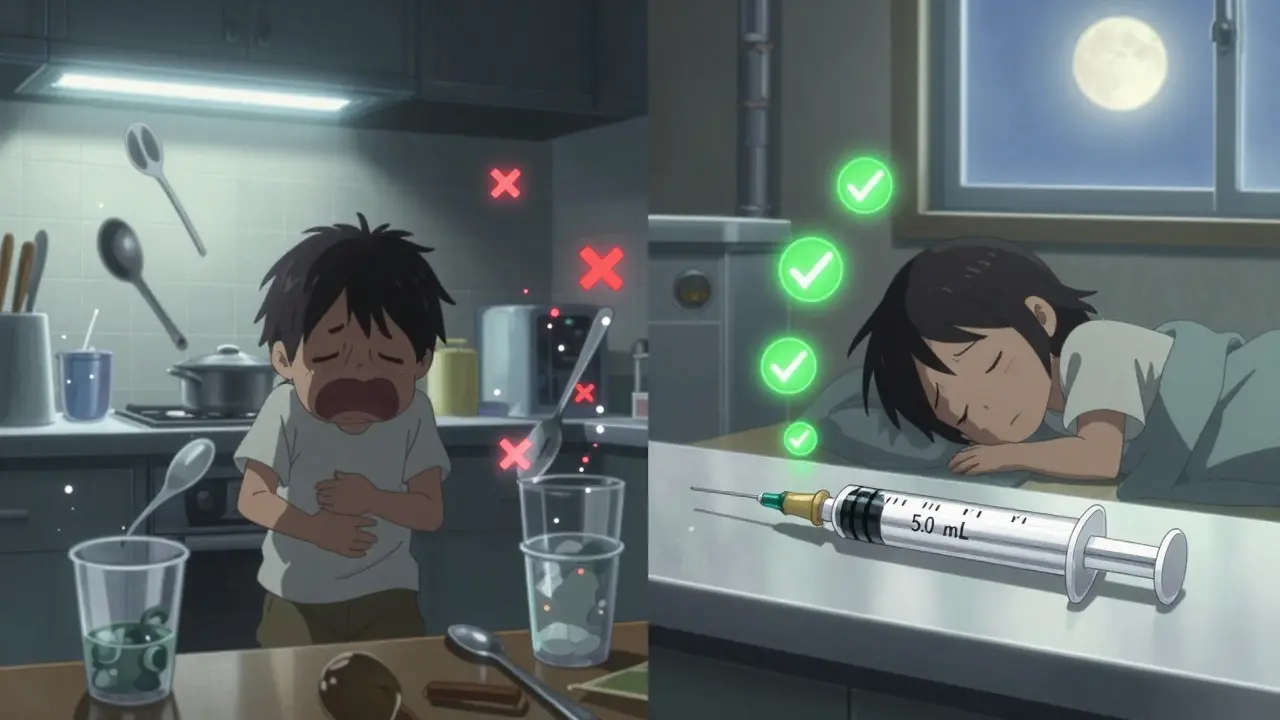
You’ve probably heard it before: "Give half a teaspoon." But here’s the truth: a household teaspoon holds anywhere from 2.5 to 7 milliliters. That’s a 180% difference. No two spoons are the same. And when you’re giving a baby a medicine that needs to be exact-like 1.6 mL for an antibiotic-guessing with a spoon isn’t just risky. It’s life-threatening. The Institute for Safe Medication Practices found that nearly 40% of liquid medication errors in children happen because caregivers use kitchen spoons. Even worse, many prescription labels still say "teaspoon" or "tablespoon," which tells families to reach for the silverware drawer. The FDA has been clear since 2011: labels must say "mL," not "tsp." And since 2022, they’ve required all new liquid medications to use milliliters only. Yet, a 2023 FDA audit found that 28% of liquid prescriptions still use non-metric units. That’s outdated, dangerous, and preventable.Oral Syringes Are the Gold Standard-Even If They Feel Unfamiliar
If you’ve ever tried to give a toddler medicine with a syringe, you know the hesitation. It looks clinical. It feels awkward. But here’s what the data says: oral syringes are the most accurate tool for measuring liquid medication. A 2023 study in PubMed found that when measuring a 2.5 mL dose, only 4% of users made a significant error with an oral syringe. With a dosing cup? That number jumps to 43%. For 5 mL doses, 67% of people got it right with a syringe. Only 15% did with a cup. The reason? Syringes eliminate parallax error-the mistake you make when you look at a liquid level from an angle. With a syringe, you read the line straight on. No guesswork. They also come with fine markings. A good syringe for pediatric use has 0.1 mL increments. That means if the prescription says 1.6 mL, you can hit it exactly. A typical dosing cup? It might only show 1 mL and 2 mL. That’s not enough precision. And if the cup is too big-say, 30 mL-you’re more likely to pour too much just because the liquid looks low in the container. The biggest barrier isn’t accuracy. It’s perception. Eighty-seven percent of caregivers say cups are easy to use. Only 63% say the same about syringes. But after using one, most change their minds. One parent on Amazon wrote: "The 1 mL syringe with 0.1 mL markings saved my infant from an overdose. The cup only had 1 and 2 mL lines. I couldn’t tell if it was 1.6 or 2.0." That’s the difference between safety and disaster.Why Dosing Cups Often Fail-Even When They Look Fine
Dosing cups aren’t all bad. But most of them are designed poorly. The JAMA Network study from 2013 found that 81.1% of dosing cups included too many markings. Too many lines create confusion. People start wondering which one to use. They might read the 4 mL line instead of the 3 mL line. Or they might misread the meniscus-the curved surface of the liquid-because they’re looking from above instead of eye level. Another problem? Size. Many cups hold 8 or 10 mL, even when the biggest dose is only 5 mL. That extra space makes it harder to judge small amounts. A 5 mL dose in a 10 mL cup looks like half. But in a 5 mL cup, it fills the whole thing. That visual cue helps prevent underdosing. And then there’s the unit mismatch. A 2022 study found that 89% of liquid medications had labels and dosing devices that didn’t match. The label says 5 mL. The cup says 1 teaspoon. The caregiver fills to the 1 tsp line, thinking it’s the same. But 1 tsp = 4.93 mL. Close enough? Not when you’re giving a medicine with a narrow safety window.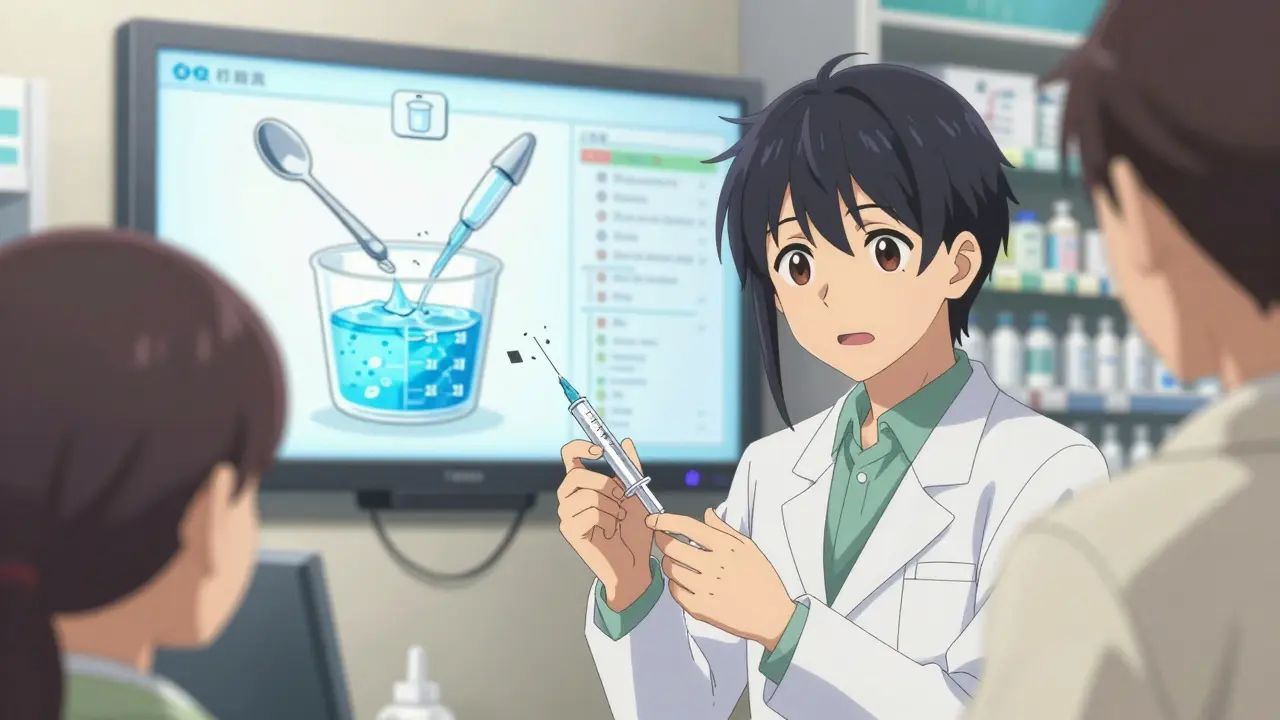
What Makes a Dosing Device Actually Accurate
The U.S. Pharmacopeia (USP) sets the standard: any device used to measure liquid medication must be accurate within 10% of the intended dose. That’s the minimum. Oral syringes regularly hit 2-3% accuracy. Cups? Around 10-15%. Spoons? Up to 15% off. Droppers vary wildly. Here’s what an accurate device should have:- Milliliters only-no teaspoons, tablespoons, or fluid ounces
- Leading zeros-0.5 mL, not .5 mL
- No trailing zeros-5 mL, not 5.0 mL
- Only necessary markings-if the dose is 2.5 mL, don’t show 1, 2, 3, 4, 5, 6, 7, 8, 9, 10. Just show 2 and 3, with a half-mark in between
- Size matched to dose-a 10 mL cup should never hold more than 15 mL total
- Clear, bold printing-no tiny fonts or faded ink
How to Teach Caregivers to Use Syringes Correctly
It’s not enough to hand someone a syringe. You have to show them how to use it. The teach-back method works. Ask the caregiver to demonstrate the steps before they leave the pharmacy or clinic. Here’s the right way to use an oral syringe:- Draw up a little extra air-about 0.5 mL more than the dose. This helps push all the liquid out.
- Insert the tip below the liquid surface. Don’t let it touch the sides of the bottle.
- Slowly pull back the plunger until the top of the plunger lines up with the correct mark.
- Tap the side of the syringe gently to bring any bubbles to the top. Push the plunger slightly to expel them.
- Hold the syringe at eye level. Read the line where the top of the liquid sits-not the bottom.
- Administer slowly, aiming toward the inside of the cheek, not the back of the throat.
What Pharmacies and Providers Should Do Now
Pharmacists have the power to fix this. The American Pharmacists Association recommends giving an oral syringe with every liquid prescription under 10 mL. That’s not a suggestion. It’s a safety standard. In hospitals, 87% already use metric-only protocols. But in community pharmacies? Only 63% do. That gap is dangerous. Here’s what needs to change:- Always include a syringe with pediatric doses under 10 mL
- Remove cups unless the dose is over 10 mL and the cup is exactly sized
- Print labels with milliliters only-no "tsp" or "tbsp"
- Attach a QR code that links to a 60-second video showing proper syringe use
- Train staff to demonstrate technique, not just hand out devices
12 Comments
January 26, 2026 fiona vaz
I used to use kitchen spoons until my nephew had a bad reaction to a wrong dose. Now I only use oral syringes-no exceptions. The first time I used one, I thought it was overkill. Now I can’t imagine doing it any other way. It’s not about being paranoid; it’s about being precise.
Pharmacies should hand these out like bandages. Free. Every time.
January 27, 2026 Sue Latham
Oh honey, if you’re still using a teaspoon, you’re basically playing Russian roulette with your kid’s liver. I mean, really? You’re trusting your child’s life to a spoon you used for cereal this morning? 🙄
At this point, if your pharmacist doesn’t hand you a syringe, walk out. Demand one. It’s not a favor-it’s a damn standard.
January 28, 2026 John Rose
This is one of those issues where science, policy, and public behavior are wildly out of sync. The data is overwhelming-oral syringes reduce errors by over 80%. Yet we still treat this like a suggestion rather than a mandate.
It’s not just about education. It’s about systemic accountability. If a pharmacy hands out a dosing cup with a 1.6 mL prescription, they’re not just being lazy-they’re enabling harm. That needs to be a liability issue, not just a ‘please do better’ plea.
January 29, 2026 Mark Alan
THE GOVERNMENT IS HIDING THE TRUTH!! 🚨
Why do you think they don’t force every pharmacy to give syringes? BIG PHARMA doesn’t want you to know how easy it is to get it right! They profit off ER visits! They’re selling you cups so your kid gets sick and you buy MORE MEDS!! 😡
My cousin’s baby nearly died because of a cup. Now I’m on a mission. #DoseRightOrDoseDead
January 30, 2026 Ambrose Curtis
Look, I get it-syringes feel weird at first. I thought the same. But after I used one with my daughter’s antibiotics, I was shocked how easy it was. No more guessing. No more spilled medicine on the floor.
Also, side note: if your cup says "tsp" next to a number, throw it out. That’s not a mistake-that’s a red flag. And yeah, the leading zero thing? Totally matters. .5 mL looks like 5 mL if you’re half-asleep at 3 AM.
Also, tap the bubbles out. I didn’t know that until last year. Game changer.
January 31, 2026 Linda O'neil
Stop making this harder than it is. You don’t need a PhD to use a syringe. You just need to care enough to try.
Practice with water. Use a digital scale if you’re paranoid. Watch the 60-second video. Do it once, and you’ll never look back. Your kid deserves that kind of attention.
And if your pharmacist gives you a cup? Say, "I need a syringe." No apology needed. You’re not being difficult-you’re being responsible.
February 1, 2026 James Dwyer
I’ve been a nurse for 22 years. I’ve seen kids come in with overdoses from kitchen spoons. I’ve seen parents cry because they thought "half a teaspoon" meant the same everywhere.
This isn’t about blame. It’s about changing the system. And honestly? The syringe is the easiest fix we’ve got.
February 1, 2026 Phil Davis
So let me get this straight. We have a medical system that can send rockets to Mars but can’t make a dosing cup that doesn’t look like a Rorschach test?
81% of cups have too many lines. That’s not a design flaw. That’s a corporate decision. Someone thought, "Let’s make this confusing so people don’t notice we’re cutting corners."
Classic.
February 2, 2026 Mel MJPS
My sister-in-law is a single mom who works two jobs. She didn’t know about syringes until her pediatrician showed her. She cried because she felt so guilty for using a spoon before.
This isn’t about being perfect. It’s about giving people the tools to be safe. We need to stop shaming and start equipping.
February 4, 2026 Rhiannon Bosse
Okay but… what if the syringe is contaminated? 🤔
Have you ever seen how they’re packaged? Sometimes they’re just… sitting in a bin next to the cough syrup. Are we supposed to trust that? What if someone else used it first? What if it’s been touched by 20 other parents?
And what about the QR code? Do they track who watches it? Are they selling our data? I’m not saying it’s a conspiracy… but I’m also not not saying it.
February 5, 2026 Bryan Fracchia
There’s something deeply human about how we resist tools that feel clinical-even when they’re safer. We want to feel like we’re doing it the "natural" way. But medicine isn’t about aesthetics. It’s about survival.
A syringe doesn’t make you a bad parent. Not using one when you know better? That’s the real disconnect.
Maybe the problem isn’t the device. It’s our cultural fear of anything that feels like "hospital." We’ve forgotten that hospitals save lives. Not just treat them.
February 7, 2026 Lance Long
Let me tell you something. I used to think I was doing fine with the cup. Then one night, my daughter spiked a fever. I was half-asleep. I poured the medicine. Thought I got 2.5 mL. Turned out I gave her 4.5.
I panicked. Called 911. Sat in the ER for six hours.
That was the worst night of my life.
Now? I have a syringe next to my toothbrush. I check the dose with a scale. I show my friends. I tell strangers in the pharmacy aisle.
You think this is just about medicine?
No.
This is about not losing your child because you didn’t ask for the right tool.
Don’t wait for your ER story to wake you up.
Write a comment