

Risk-Benefit Calculator for Drug Labels
Your Results
Your absolute risk reduction is 0%
Actual risk with drug: 0%
Actual risk with placebo: 0%
Why this matters: A 25% relative risk reduction might sound impressive, but if your baseline risk was only 4%, the actual risk reduction is 1% (4% × 25%). That means 4% of patients on placebo had the event, while only 3% on the drug did.
Looking at absolute numbers gives you the real picture of how much the drug helps you personally.
Have you ever looked at the label of a new prescription drug and felt like you were reading a legal contract written in another language? You’re not alone. The U.S. Food and Drug Administration (FDA) requires drugmakers to include detailed risk-benefit statements in medication labels-but for most patients, these statements are confusing, overwhelming, or even misleading. The FDA has been trying to fix this, but progress is slow. Here’s what’s really in those labels, why it matters, and how you can actually understand what it means for you.
What’s Really in an FDA Drug Label?
Every prescription drug approved by the FDA comes with a label that includes sections on benefits, risks, side effects, and how it compares to other treatments. But the way this information is presented isn’t designed for patients. It’s built for doctors and regulators. The FDA’s official guidance, updated in December 2021, says the label must include an integrated summary of benefits and risks-but that summary often hides in dense paragraphs buried in Section 14 (Clinical Studies) or Section 6 (Adverse Reactions). The label doesn’t just list side effects. It tries to answer: Do the good outweigh the bad? For example, a cancer drug might show a 30% reduction in tumor size but also cause severe nausea in 70% of patients. The FDA’s job is to decide if that trade-off makes sense for the average patient. But your personal experience might be very different. Maybe nausea is something you can manage. Maybe you’ve tried everything else. That’s where the system falls short.Why Most Patients Don’t Understand Their Drug Labels
A 2022 survey by the National Health Council found that only 22% of patients felt very confident in understanding the risk-benefit information on their drug labels. For those with lower health literacy, that number dropped to 9%. Why? Three big reasons:- Too much jargon: Terms like “relative risk reduction” or “adverse event frequency” sound technical, not helpful.
- No context: A label might say a drug reduces heart attack risk by “25%.” But 25% of what? If the baseline risk was 4%, that’s a drop to 3%. That’s not life-changing-it’s modest. Yet many patients think 25% means they’re now much safer.
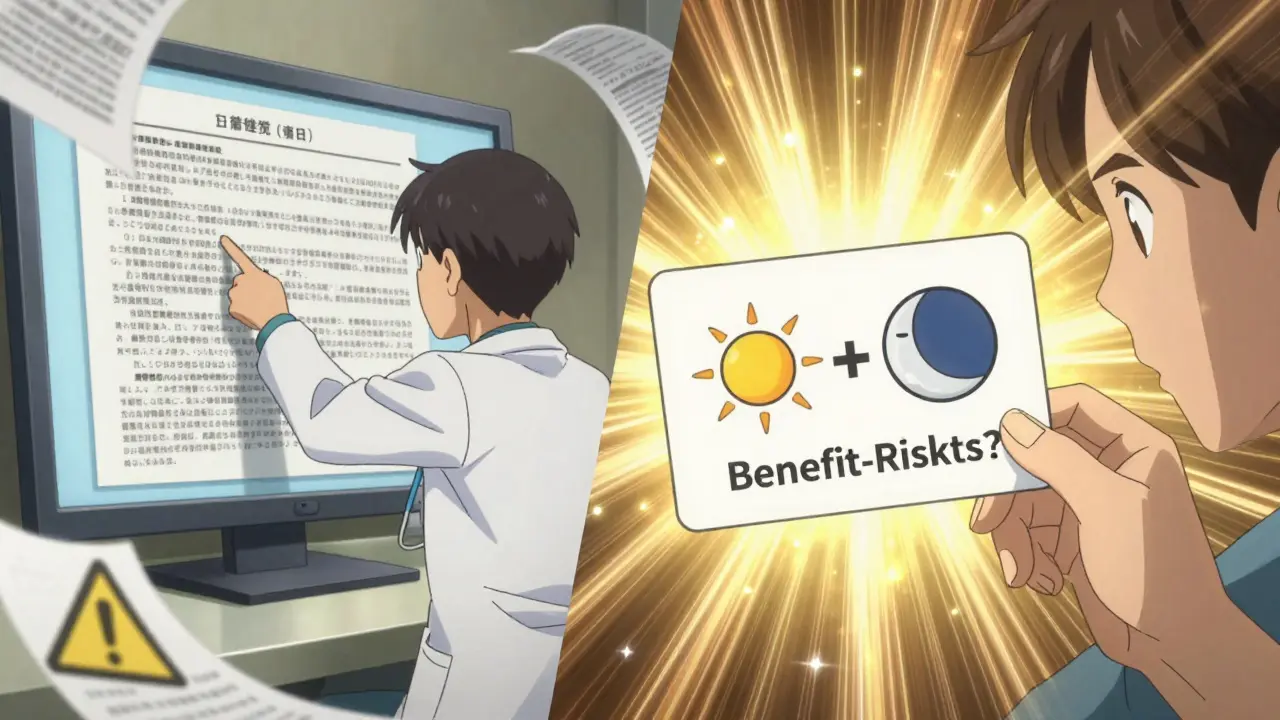
- No visuals: Almost no labels include charts, icons, or graphs to show how big the benefit is compared to the risk. You’re left guessing.
Take the example of Jardiance, a diabetes drug. Its label says: “In adults with type 2 diabetes and cardiovascular disease, JARDIANCE reduced the risk of cardiovascular death by 38% (10.5% with placebo vs. 6.5% with JARDIANCE).” That’s clear. It uses absolute numbers. It gives you a baseline. That’s why it’s one of the few labels patients actually understand.
How the FDA Tries (and Often Fails) to Make It Clearer
The FDA knows the problem. In 2023, they launched a pilot program requiring six new cancer drugs to include a Patient Benefit-Risk Summary-written at a 6th-grade reading level, with simple icons showing benefit vs. risk. One icon might show a large green arrow for benefit and a small red dot for risk. Another might show two scales: one for survival, one for side effects. But here’s the catch: only 17% of new drugs approved in 2022 included any kind of visual summary. And the pilot is still small. Most labels still rely on text alone. Even when the FDA asks for clearer language, drugmakers often push back, saying their legal teams won’t approve simplified wording. The FDA’s own Benefit-Risk Framework uses a matrix with five dimensions: the condition being treated, current treatment options, benefits, risks, and how risks are managed. Sounds logical, right? But when it gets turned into a label, it becomes a wall of small print. Patients don’t get the matrix. They get a paragraph.How Other Countries Do It Better
The European Medicines Agency (EMA) uses a more structured method called PrOACT-URL, which stands for Pros, Cons, Alternatives, Context, Uncertainty, Risk Tolerance, and Likelihood. It forces companies to answer specific questions in order. During the COVID-19 vaccine rollout, the EMA’s clear, consistent messaging helped the public understand that rare blood clots were far less likely than the risk of dying from COVID-19. The UK’s MHRA goes even further. They regularly run patient preference studies-asking real people: Would you take this drug if it reduced your chance of hospitalization by 15% but gave you headaches 3 days a week? That kind of input shapes their labeling. The FDA doesn’t do this as systematically. Their framework is flexible, which sounds good-but it means every drug label looks different. One might say “moderate risk of liver damage.” Another might say “1 in 500 patients experienced severe liver injury.” Which one is clearer? The second. But only a few labels use numbers like that.
What You Can Do Right Now
You don’t have to wait for the FDA to fix this. Here’s how to read your own drug label and get real answers:- Look for absolute numbers: If the label says “reduced risk by 50%,” ask: “50% of what?” Find the baseline. If it’s not there, ask your doctor.
- Check the placebo group: In clinical studies, some patients get a sugar pill. Compare the number of bad outcomes in that group to the drug group. That’s your real risk difference.
- Ask: “How does this compare to other options?”: Many labels don’t say. But your doctor should. If they can’t answer, ask for a comparison sheet.
- Request a visual: Tell your doctor you’d like a chart or diagram. Some clinics now have printed benefit-risk cards for common drugs.
- Use trusted sources: The FDA’s website has public drug labels. Search “FDA drug label [drug name]” and read the full document. Skip the marketing fluff-go straight to the data.
For example, if you’re considering a cholesterol drug that says “lowers risk of heart attack,” find out: How many people in the study had heart attacks? How many on placebo did? How many on the drug? That’s the real story.
The Bigger Picture: Why This Matters
This isn’t just about reading labels. It’s about trust. When patients can’t understand their own treatment, they’re more likely to skip doses, stop taking medication, or refuse it altogether. A 2023 study found that patients who understood their drug’s benefit-risk profile were 40% more likely to stick with it long-term. The FDA’s goal is to make decisions based on science-but they also need to make those decisions understandable. Right now, they’re stuck in the middle: too technical for patients, too vague for doctors, too inconsistent for regulators. The solution isn’t more rules. It’s simpler language, real data, and visuals that speak to people, not just experts.By 2026, experts predict nearly half of new drug labels will include visual summaries. That’s progress. But until then, you have to be your own advocate. Don’t just accept the label. Ask questions. Demand clarity. Your health depends on it.
Why do FDA drug labels use such complicated language?
FDA labels are written to meet strict regulatory standards that prioritize legal accuracy over patient understanding. The language is designed to cover every possible scenario for legal protection, not to help patients make decisions. While the FDA encourages clearer communication, drugmakers often resist simplifying wording because of liability concerns and regulatory review delays.
Can I trust the benefit numbers on drug labels?
Yes-but only if you look at absolute numbers, not percentages. A 50% reduction in risk sounds impressive, but if the original risk was 2%, that’s just a drop to 1%. Always ask for the actual event rates: “How many people had a heart attack in the study? How many on the drug? How many on placebo?” That’s the real measure.
Do all drugs have the same kind of risk-benefit info?
No. Cancer drugs often include clear survival data, like “38% longer life expectancy.” Psychiatric drugs, on the other hand, usually describe symptoms like “improved mood” or “reduced anxiety” without numbers. Oncology labels are more quantitative because benefits are easier to measure. Mental health and chronic pain drugs often rely on vague language because the benefits are harder to quantify.
Are there any drugs with truly patient-friendly labels?
Yes. Jardiance (empagliflozin) for type 2 diabetes is one of the best examples. It clearly states: “Reduced risk of cardiovascular death by 38% (10.5% with placebo vs. 6.5% with JARDIANCE).” It uses real numbers, compares to placebo, and avoids jargon. A few other drugs, like some new heart failure medications, are starting to follow this model-but they’re still rare.
What’s the FDA doing to fix this?
The FDA launched a pilot in 2023 requiring six new cancer drugs to include a Patient Benefit-Risk Summary with simple language and icons. They’re also testing standardized benefit-risk pictograms with the National Institutes of Health. By 2025, they plan to require these summaries for all breakthrough therapies. But full rollout across all drug classes will take years. For now, only a small fraction of labels are truly patient-friendly.
9 Comments
February 24, 2026 Nerina Devi
As someone who’s had to explain drug labels to elderly patients in rural India, I can tell you this isn’t just an FDA problem-it’s a global one. We don’t have access to visual aids or digital tools, so we rely on word-of-mouth and handwritten notes. I’ve drawn little suns and clouds on paper to show ‘good’ vs ‘bad’ side effects. It’s crude, but it works. The system needs to stop assuming everyone has a smartphone and a college degree just to understand their own medicine.
Simple language isn’t dumbing down-it’s dignity.
February 25, 2026 Dinesh Dawn
Yeah, I read the label for my blood pressure med last week and just gave up. It felt like reading a contract I didn’t sign. The numbers didn’t mean anything until my cousin, who’s a nurse, sat me down and said, ‘Look-out of 100 people like you, 4 had heart attacks without this pill. With it? 2. That’s it.’ Suddenly it made sense. Why can’t the label just say that?
February 26, 2026 Vanessa Drummond
Let’s be real-the FDA doesn’t care if you understand your meds. They care that the drug company doesn’t get sued. Every word in that label is a lawyer’s insurance policy. And guess who pays? Us. We’re the ones skipping doses because we’re scared of ‘rare but serious’ side effects that sound like horror movie plot points. If you want patient-friendly labels, stop letting Big Pharma write them.
It’s not rocket science. It’s basic human decency.
February 28, 2026 Nick Hamby
The core issue here is epistemic asymmetry: the knowledge gap between those who produce medical information and those who consume it. The FDA’s framework is logically sound, but its implementation fails because it does not account for cognitive load, literacy variance, or affective decision-making. Patients do not make choices based on statistical models-they make them based on narrative, trust, and emotional resonance.
What if, instead of forcing patients to decode legal prose, we designed labels as stories? A journey from ‘before’ to ‘after,’ with clear thresholds for risk and reward? This isn’t about simplification-it’s about human-centered design. We’ve done it for airplanes, for smartphones, for banking apps. Why not for life-saving medication?
March 2, 2026 kirti juneja
OMG yes!! I was on that diabetes med that made my stomach feel like a stormtrooper was doing backflips inside it. The label said ‘gastrointestinal discomfort’-like that’s some fancy spa treatment. I looked it up and found out it meant ‘you’re gonna be best friends with the toilet for a week.’ Why not say that??
Also, I love how Jardiance just says it like it is. No fluff. No ‘may’ or ‘possibly.’ Just numbers. That’s the gold standard. All other labels should be forced to wear a dunce cap until they match that clarity.
Also-can we please get emojis? 🟢 Benefit 🟥 Risk? I’d read that in a heartbeat.
March 3, 2026 Haley Gumm
Let’s not pretend this is about patient safety. This is about liability. The moment a label says ‘this helps 70% of people,’ someone sues because their cousin’s dog got sick from it. So they bury the truth under 500 words of legalese. The FDA’s ‘pilot programs’? PR stunts. Real change would require drug companies to accept responsibility for honest communication. Which they won’t. So we’re stuck with this mess.
And don’t get me started on psychiatric meds-‘improved mood’? That’s like saying ‘your aura got brighter.’ Use numbers. Or shut up.
March 5, 2026 Gabrielle Conroy
I love that Jardiance example!!! 🎉 So refreshing to see real data! And yes, visuals?? PLEASE!! 📊📈📉 I’d 100% read a label with a bar chart showing ‘before vs after’-it’s way easier than parsing paragraphs! Also, I’ve started asking my pharmacist for printed benefit-risk cards-they have them for statins and blood thinners now!! 🙌 Can we make this standard?? I’m telling all my friends to demand this!!
Also, if the label says ‘38% reduction,’ always ask for the baseline!! 🤓 It changes everything. I did this last month and realized my ‘high risk’ was actually 2%-so the benefit was tiny. Mind blown. 🤯
March 7, 2026 Spenser Bickett
lol so the FDA wants ‘simple language’? cool. next they’ll ask for a ‘how to breathe’ pamphlet. you think people are dumb? no. they’re lazy. they want the answer handed to them on a silver platter while they scroll tiktok. the real problem? no one wants to think anymore. just give me the pill and tell me it’s magic.
btw, ‘patient-friendly’? more like ‘lawyer-proof.’ if you want clarity, go to a doctor. don’t expect a 10-page legal doc to be rewritten for your attention span.
March 7, 2026 Christopher Wiedenhaupt
While I appreciate the sentiment behind improving patient communication, we must not overlook the structural constraints imposed by regulatory compliance. The FDA’s current approach balances efficacy, safety, and liability-a triad that cannot be compromised without exposing the system to litigation risk. Simplification, while desirable, must not occur at the expense of precision. The challenge lies not in language, but in education: we need better health literacy infrastructure, not simplified labels. The solution is not to dumb down the text, but to empower the reader.
Write a comment