

Imagine waking up with an eye that feels like there is a piece of glass stuck in it. Your vision is hazy, your eye is bloodshot, and even a little bit of light feels like a punch to the face. If you wear contact lenses, this isn't just a "bad eye day"-it could be a medical emergency. A corneal ulcer is an open sore on the cornea, the clear front dome of the eye. Unlike a simple scratch, this is actual tissue loss often driven by infection. If you don't get it treated immediately, you aren't just looking at a few days of discomfort; you're risking permanent scarring and blindness.
Quick Facts for Contact Lens Wearers
- Contact lens wearers are roughly 10 times more likely to develop an ulcer than non-wearers.
- Sleeping in lenses increases your risk by nearly 100 times.
- An ulcer is an open sore, not a superficial scratch (abrasion).
- Treatment must start immediately to prevent permanent vision loss.
Why Contact Lenses Increase Your Risk
It might seem strange that a thin piece of plastic could cause an open sore, but the mechanics are pretty straightforward. When you wear lenses for too long, you essentially block oxygen from reaching the cornea. This creates a stressed environment where the eye's natural defenses drop. But the oxygen issue is only half the battle. Your lenses can act as a trap. Bacteria from your fingers or non-sterile cleaning solutions get caught under the lens, clinging to the surface of your eye. This is why soft contact lenses, especially those designed for overnight wear, carry a higher risk profile. They tend to hug the eye more tightly, trapping pathogens against the corneal tissue.
It's not just about the lenses themselves, but how we treat them. Using old solutions or "topping off" a bottle of cleaner instead of replacing it creates a breeding ground for germs. Some people even try to rinse their lenses with tap water-a dangerous move that can introduce rare parasites like Acanthamoeba, which cause incredibly aggressive and difficult-to-treat infections.
Spotting the Difference: Ulcers vs. Abrasions
People often confuse a corneal ulcer with a corneal abrasion. While both hurt, they are very different animals. An abrasion is a superficial scratch-think of it like a skinned knee on your eye. Most abrasions heal on their own within a few days. An ulcer, however, is a deep hole. It involves the loss of the corneal endothelium and often involves an active infection.
Before an ulcer even forms, you might experience keratitis, which is general inflammation of the cornea. If you notice your eye getting red and irritated but no "sore" has appeared yet, you're already in the danger zone. If you see a small white or grey spot on the colored part of your eye, that is a massive red flag-it's likely the ulcer itself.
| Feature | Corneal Abrasion | Corneal Ulcer |
|---|---|---|
| Depth | Superficial/Surface level | Deep tissue loss (open sore) |
| Cause | Scratches, dust, nail | Infection, hypoxia, severe trauma |
| Appearance | Redness, slight clouding | White/Grey patch on cornea |
| Urgency | Needs check-up | Immediate Urgent Care |
| Risk | Usually heals quickly | Permanent scarring/Blindness |

When to Panic (and When to Call the Doctor)
You don't need to panic, but you do need to act. If you experience any of the following, take your lenses out immediately and call an ophthalmologist or visit urgent care:
- Severe Pain: Not just a "gritty" feeling, but actual pain that makes it hard to keep your eye open.
- Photophobia: An extreme sensitivity to light where you feel the need to squint or close your eyes in a bright room.
- Blurred Vision: A hazy or foggy quality to your sight that doesn't clear up with blinking.
- Discharge: Unusual mucus or pus coming from the eye.
- The "White Spot": Any visible white or yellowish opaque spot on the cornea.
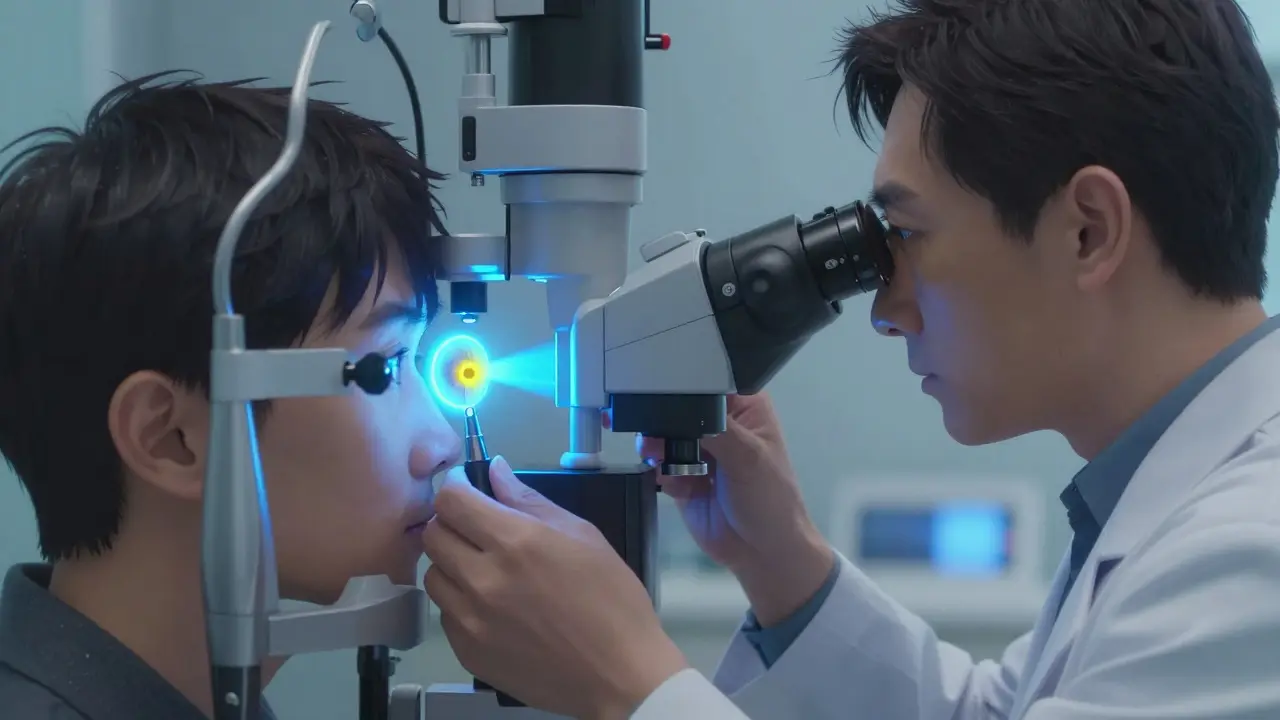
When you get to the clinic, expect more than just a quick glance. The doctor will likely use fluorescein staining, where they put a yellow dye in your eye. Under a blue light, the dye pools in the "hole" of the ulcer, making it glow and revealing the exact size of the damage. They'll also use a slit-lamp to get a magnified, cross-sectional view of your cornea.
How Doctors Treat an Ulcer
Treatment is a race against time. The goal is to kill the pathogen and stop the tissue from melting further. For most bacterial ulcers, doctors start with fluoroquinolones, which are potent broad-spectrum antibiotic drops. These are often applied every hour at first to overwhelm the infection.
If the ulcer is considered "sight-threatening"-meaning it's larger than 2mm or very close to the center of your vision-the doctor will perform a corneal scraping. They literally take a tiny sample of the ulcer to send to a lab. This ensures they aren't using a bacterial drug on a fungal infection, as the wrong medication can actually make a fungal ulcer worse.
Depending on the cause, the medicine changes:
- Bacterial: Fluoroquinolone antibiotics.
- Viral: Antiviral medications like acyclovir.
- Fungal: Specialized antifungal agents.
In the worst-case scenario, where the infection causes a massive scar in the center of the eye, a corneal transplant may be the only way to restore vision. This is why starting treatment in the first 24-48 hours is non-negotiable.
The Golden Rules of Prevention
You can enjoy your contact lenses without living in fear of ulcers if you follow a few strict rules. The most important one? Stop sleeping in your lenses. Even if they are labeled "extended wear," the risk of infection skyrockets when the eye is closed and oxygen levels drop.
Next, watch your water. Never swim, shower, or bathe while wearing soft lenses. Water is not sterile, and it can harbor bacteria and amoebas that glide right under the lens and attach to your cornea. If you're going for a dip in the pool or the ocean, pop the lenses out first.
Lastly, treat your replacement schedule like a law. If your lenses are "two-week" lenses, throw them away on day 14, even if they feel comfortable. Biofilms-invisible layers of bacteria-build up on the lens surface over time. No amount of rubbing or soaking can completely remove a mature biofilm; the only cure is a fresh lens.
Can a corneal ulcer go away on its own?
No. Unlike a corneal abrasion, which can heal naturally, an ulcer is an open sore usually caused by infection. Without professional medical treatment and targeted antibiotics or antifungals, an ulcer will likely worsen, leading to permanent scarring, vision loss, or in severe cases, the need for a corneal transplant.
Is it safe to use steroid drops for an eye infection?
Never use steroid drops without a doctor's direct supervision. While steroids can reduce inflammation, they suppress the immune system's ability to fight infection. If you apply steroids to an active bacterial or fungal ulcer, you could effectively "feed" the infection, causing the ulcer to expand and the cornea to perforate much faster.
How long does it take for a corneal ulcer to heal?
Healing time varies based on the cause. Bacterial ulcers often respond quickly to antibiotics and may begin to heal within a week. Fungal ulcers are much slower and can take weeks or months of intensive medication. The key is early intervention; the sooner treatment starts, the less likely you are to end up with a permanent scar.
Do I have to stop wearing contacts forever if I get an ulcer?
Not necessarily, but you must stop immediately during the infection. Your doctor will decide when it's safe to return to lenses. In some cases, they may recommend switching to daily disposables to reduce the risk of biofilm buildup or suggest a period of "lens-free" time to let the corneal surface fully recover.
What is the most dangerous mistake contact lens wearers make?
Sleeping in lenses and using tap water for cleaning are the top culprits. Sleeping in lenses increases the risk of ulcers by 100 times compared to daily wear, and tap water can introduce Acanthamoeba, a parasite that is notoriously resistant to standard antibiotics and can lead to blindness.
Next Steps for Your Eye Health
If you are currently experiencing symptoms, remove your lenses now and head to an eye clinic. Do not wait until tomorrow to see if it "clears up." If you're feeling fine but realized you've been sleeping in your lenses or using old solution, today is the day to change your habits. Schedule a routine check-up to ensure your current lens fit is correct and that your corneas are healthy.
14 Comments
April 21, 2026 Valorie Darling
imagine actually thinking you can just sleep in these and not go blind lol some people really love living on the edge
April 23, 2026 julya tassi
That part about the tap water is actually terrifying! I didn't know about the parasites. Definitely sticking to sterile saline from now on :O
April 24, 2026 Tokunbo Elegbe
It is absolutely critical... that we educate... our peers... on these dangers!!! Safety first... always!!!
April 25, 2026 Rob Schlautman
funny how people just ignore the instructions on the box and then act shocked when their eye starts melting because they thought two weeks meant two months and basically just played roulette with their vision which is just typical human laziness at its finest honestly
April 26, 2026 Lesley Wimbush
I mean, obviously, anyone with a modicum of self-care knows this, but it's cute that we need a guide to tell us not to put tap water in our eyes. Some of us just naturally prioritize our health, but I guess not everyone is on that level.
April 26, 2026 Ms. Sara
Listen, if you are reading this and you're currently wearing lenses that are past their expiration date, take them out right now. Your vision is irreplaceable and no amount of convenience is worth a permanent scar on your cornea.
April 27, 2026 Aman Tomar
Oh my god, this is so terrifying!! I once used a bit of water to rinse mine and now i am shaking thinking about those parasites... truly a nightmare!!
April 28, 2026 Akshata Kembhavi
totally agree, the daily ones are the way to go if you can afford them. way less stress about whether the case is actually clean or not
April 28, 2026 caesar simpkins
The imagery of the yellow dye glowing under blue light is just wild. Like, we're literally using neon markers to find holes in our eyes. Absolute madness!
April 30, 2026 Don Drapper
The sheer negligence exhibited by those who utilize non-sterile aqueous solutions for ocular hygiene is a testament to the catastrophic failure of modern health literacy. It is a tragedy of epic proportions that such preventable blindness occurs in an era of instant information.
April 30, 2026 Truman Media
We must all be kind to our bodies for they are the only homes we have. It is a blessing to have such clear guides to help us stay safe. 😊
May 1, 2026 William Young
Good advice. Just stay safe everyone.
May 3, 2026 Wendy Ajurín
The distinction between an abrasion and an ulcer is a vital point of clarification. Many individuals mistakenly assume any corneal irregularity is a simple scratch, which delays necessary pharmaceutical intervention and compromises the long-term prognosis of the ocular surface.
May 5, 2026 aman motamedi
I concur with the necessity of strict adherence to the prescribed lens replacement schedules to ensure ocular health.
Write a comment