
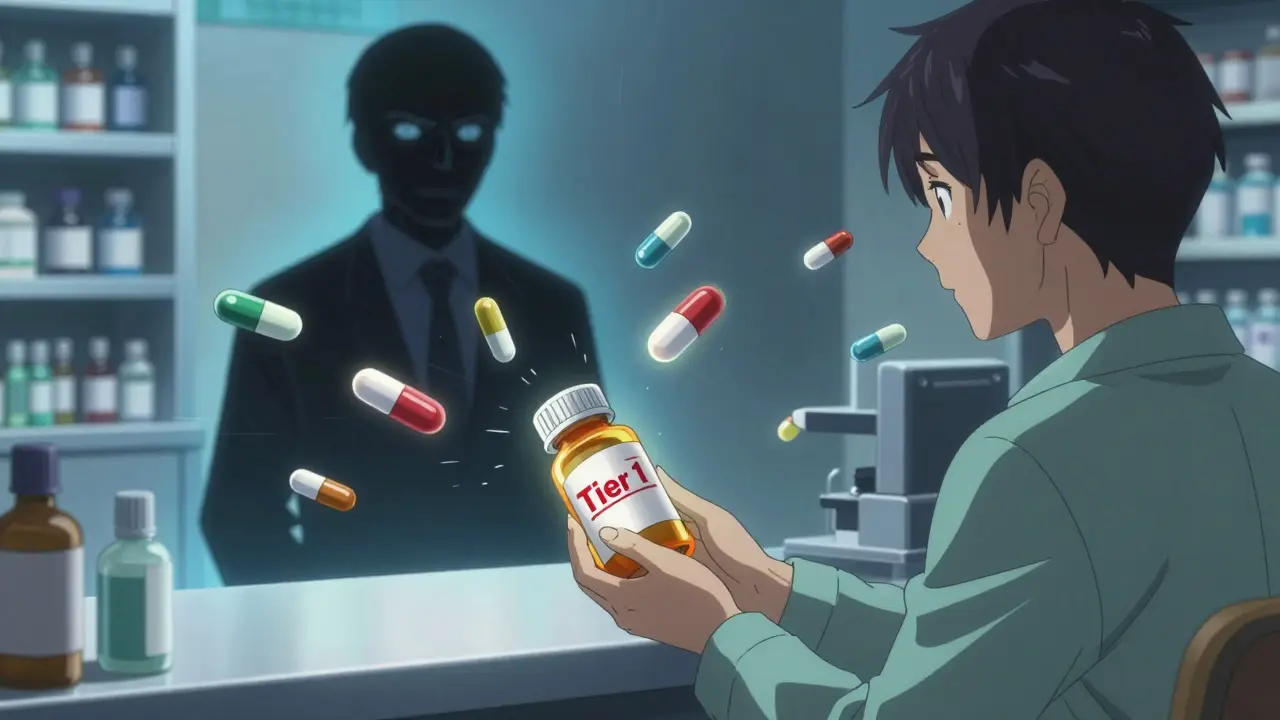
When you pick up a prescription, you might not realize you’re stepping into a complex system designed to save money - but sometimes at the cost of clarity. The difference between a generic drug and its brand-name version isn’t just in the price tag. It’s in how your insurance treats them, what you pay out of pocket, and even whether you can get the one your doctor originally prescribed.
Why Insurance Treats Generics and Brands Like Different Things
Generic drugs aren’t knockoffs. They’re exact copies of brand-name medications in terms of active ingredients, dosage, strength, and how they work in your body. The FDA requires them to be just as safe and effective. So why does your insurance charge you $5 for a generic and $85 for the brand version? It’s simple economics. Brand-name drugs carry the cost of research, clinical trials, and marketing. Generics don’t. Once a patent expires, other manufacturers can make the same drug for a fraction of the cost. Insurance companies know this. So they use tiered formularies to steer you toward generics - not because they’re inferior, but because they’re cheaper. Most commercial insurance plans have four tiers:- Tier 1: Preferred generics - usually $5-$15 for a 30-day supply
- Tier 2: Non-preferred generics or preferred brands - $40-$60
- Tier 3: Non-preferred brand-name drugs - $70-$100
- Tier 4: Specialty drugs - often coinsurance (25-33% of cost)
How Substitution Rules Work - And When They Don’t
In all 50 states, pharmacists can swap a brand-name drug for a generic unless your doctor writes “dispense as written” or “do not substitute” on the prescription. This is called automatic substitution. It’s built into the law to cut costs. But here’s the catch: substitution isn’t always harmless. For drugs with a narrow therapeutic index - like warfarin, levothyroxine, or phenytoin - even tiny differences in inactive ingredients can affect how your body absorbs the drug. That’s why 27 states have special rules allowing brand-name coverage for these drugs without extra paperwork. For most other medications, the system assumes generics are interchangeable. But patient experiences tell a different story. On forums like Drugs.com, thousands of people report side effects, reduced effectiveness, or new symptoms after switching to a generic. Some mention trouble with Concerta, Wellbutrin XL, or Lamictal - drugs where the release mechanism or fillers matter more than people think. The FDA says generics must perform the same. But 68% of physicians report patients having different reactions to generics, even when the active ingredient is identical. That’s not a flaw in the science. It’s a reminder that bodies are complex. What works for one person might not work for another.Medicare, Medicaid, and the Hidden Rules
Medicare Part D plans are even stricter. By law, pharmacists must substitute generics unless the doctor says no. In 2022, 91% of all Medicare Part D prescriptions were for generics. That’s a huge savings - but it also means many seniors are forced to switch. And switching isn’t always smooth. A 2022 CMS survey found that only 63% of Medicare beneficiaries were satisfied when their plan changed their drug from brand to generic. Many didn’t realize the change was coming until they got the pill bottle. Medicaid works differently. Because of federal “best price” rules, states pay the lowest price any private insurer pays for a drug. That means generics get reimbursed at rates 87% lower than brand-name versions. It’s the most aggressive cost-control system in the country. But here’s the irony: while Medicaid pushes generics hard, it also covers brand-name drugs for patients who can’t tolerate generics - without requiring prior authorization in most cases. That’s because Medicaid is designed to be a safety net, not a cost-saver.
What Happens When You Need the Brand
If your doctor says you need the brand-name drug - maybe because you had side effects, or the generic didn’t work - you’re not out of luck. But you’ll have to fight for it. Most insurers require a step therapy process: you must try the generic first. If it fails, you file a prior authorization. That process takes an average of 3.2 business days. In 41% of cases, your doctor has to call back to explain why the generic didn’t work. For specialty drugs like those for MS or rheumatoid arthritis, step therapy is even more common. About 35.6% of these drugs require you to fail a generic before you can get the brand. That can mean weeks of uncontrolled symptoms. Some states have passed laws to protect patients. California’s SB 1055 (2022) says insurers must cover the brand if a generic causes an adverse reaction. Texas, on the other hand, only allows brand coverage if no generic equivalent exists. And then there’s the paperwork. Insurance companies use codes like “YN1” to flag brand prescriptions that require special approval. If your doctor doesn’t use the right code, your claim gets denied - even if you have a medical reason.Why Some People Still Pay Full Price for Brands
You might wonder: if generics are cheaper, why do people still pay for brands? One reason: copay cards. Brand-name drug makers offer coupons that reduce your out-of-pocket cost to $0-$10. These are powerful. For people with commercial insurance, they can make a $300 brand drug feel like a $10 generic. But here’s the catch: copay cards are illegal for Medicare and Medicaid patients. That’s because federal law bans drug manufacturers from subsidizing government programs. So if you’re on Medicare and your brand drug costs $120, you pay $120 - no discounts, no help. Another reason: confusion. A 2022 AARP study found that 44% of Medicare beneficiaries thought generics were less effective. That’s not true - but it’s widespread. And when people don’t understand their coverage, they avoid filling prescriptions altogether. One in five commercially insured patients reported skipping meds because they didn’t know they’d be charged extra for a brand.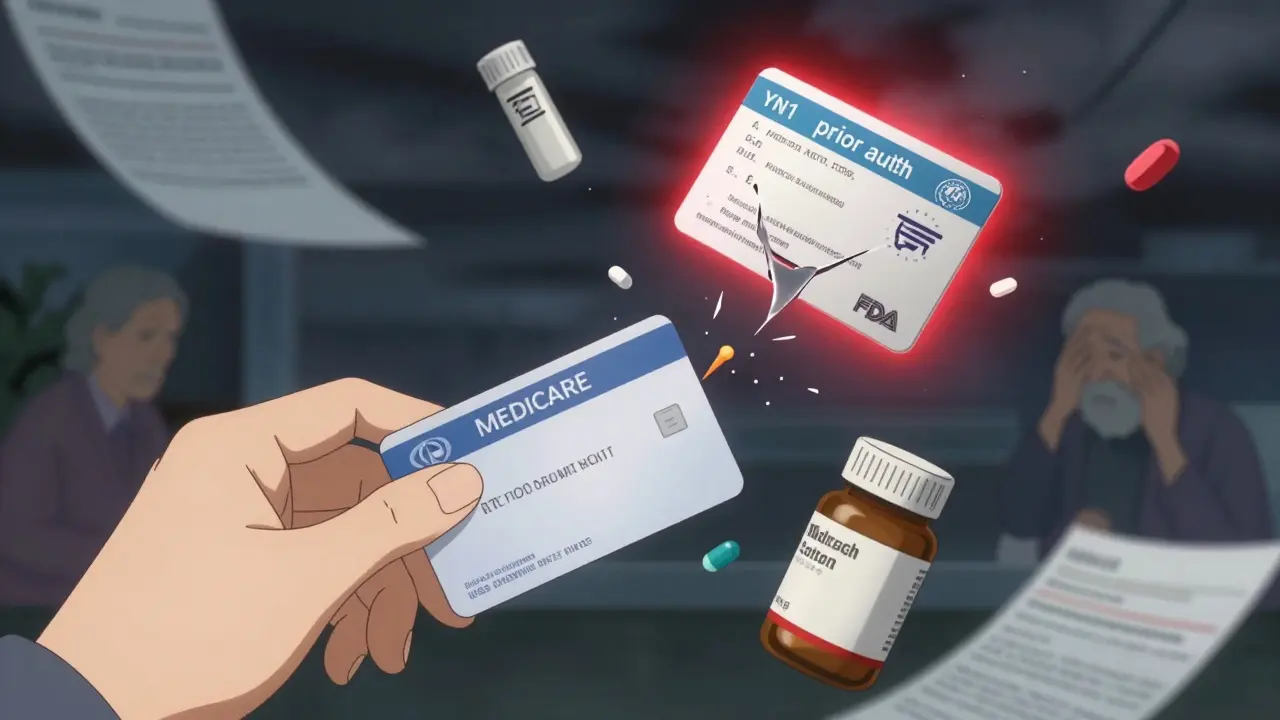
The Bigger Picture: Savings vs. Safety
The system works - if you’re healthy and your drugs respond the same every time. Since 2012, generic drugs have saved the U.S. healthcare system over $2.2 trillion. In 2022 alone, they saved $370 billion. But savings aren’t the whole story. The Congressional Budget Office estimates that forcing more generic substitution could cut national health spending by $15.2 billion a year - but might also reduce pharmaceutical innovation by 4.7%. That’s a trade-off lawmakers are still debating. And for patients? The data is mixed. A 2022 JAMA Neurology study found that switching from brand to generic antiepileptic drugs led to a 12.3% increase in seizure rates. That’s not a small number. For someone with epilepsy, it could mean the difference between safety and hospitalization. Meanwhile, the FDA is updating labeling rules for therapeutic equivalence ratings, starting in 2025. That will help insurers make smarter decisions - but it won’t fix the fact that some people just don’t tolerate generics.What You Can Do
If you’re on a plan with strict generic rules:- Ask your pharmacist: “Is there a generic available for this?”
- Ask your doctor: “Can you write ‘dispense as written’ if the generic doesn’t work?”
- Check your plan’s formulary online - most insurers have a searchable drug list.
- If you’re on Medicare, use the Plan Finder tool to see which drugs are covered and at what tier.
- If you have side effects, document them. Bring the list to your doctor. That’s your best shot at getting an exception.
Can I be forced to take a generic drug even if my doctor prescribes the brand?
Yes, in most cases. Pharmacists are legally allowed to substitute a generic for a brand-name drug unless your doctor writes "dispense as written" or "do not substitute" on the prescription. This is standard practice in all 50 states. However, for certain drugs - like warfarin or levothyroxine - state laws may require the brand to be dispensed unless a medical exception is documented.
Why is my generic drug so much cheaper than the brand?
Generic drugs cost less because they don’t include the expenses of research, development, and marketing that brand-name manufacturers pay. Once a brand’s patent expires, other companies can produce the same active ingredient. Since they don’t need to repeat clinical trials, their production costs are far lower. Insurance companies pass those savings on to you through lower copays.
What’s the difference between a generic and an authorized generic?
An authorized generic is made by the original brand-name company but sold under a generic label. It’s identical to the brand in every way - same ingredients, same factory, same packaging. The only difference is the label. These often get better coverage than third-party generics because insurers see them as more reliable. About 46% of all generic prescriptions in the U.S. are authorized generics.
Can I use a copay card to lower the cost of a brand-name drug?
Yes - but only if you have commercial insurance. Drug manufacturers offer copay cards that can reduce your out-of-pocket cost to $0-$10. However, these are illegal for Medicare and Medicaid beneficiaries under federal law. If you’re on Medicare, you won’t be able to use them, even if the brand is the only option that works for you.
What should I do if a generic drug isn’t working for me?
First, document any side effects, changes in symptoms, or lack of effectiveness. Then ask your doctor to write a letter of medical necessity and submit a prior authorization request to your insurer. Many plans require you to try and fail two or three generics before approving the brand. Keep records of all communication - this helps if you need to appeal a denial.
Do all states have the same rules for generic substitution?
No. While all states allow pharmacists to substitute generics by default, rules vary for exceptions. For example, California requires insurers to cover brand-name drugs if a generic causes an adverse reaction. Texas only allows brand coverage if no generic equivalent exists. Some states also have special rules for narrow therapeutic index drugs. Always check your state’s pharmacy laws or ask your pharmacist for details.
13 Comments
January 15, 2026 evelyn wellding
I switched to a generic for my thyroid med and felt like a zombie for two weeks 😅 My doctor didn't even know it could happen. Don't let anyone tell you generics are always 'the same'-bodies aren't Lego blocks!
January 17, 2026 Chelsea Harton
genrics are fine... unless they aint
January 17, 2026 Corey Chrisinger
It’s funny how we treat medicine like a commodity. We want it cheap, fast, and perfect-but our bodies don’t care about quarterly earnings. The FDA says ‘bioequivalent,’ but ‘equivalent’ doesn’t mean ‘identical.’ We’re all just guessing at the edges of biology.
January 19, 2026 Bianca Leonhardt
People who say generics are just as good haven't had their anxiety meds switch and then panic attack for no reason. This isn't 'economics'-it's medical negligence dressed up as savings. Stop pretending this is fair.
January 20, 2026 Travis Craw
I get why insurance does it... but when your kid’s seizure meds change and they start having mini episodes? That’s not a cost-saving-it’s a gamble with someone’s life. Maybe we need better labels on generics.
January 21, 2026 vivek kumar
In India, generics are the only option-and we have some of the best pharmaceutical manufacturing in the world. But I’ve seen people suffer because pharmacists substitute without checking if the patient has a history of sensitivity. It’s not the generic’s fault-it’s the system’s failure to personalize.
January 23, 2026 Riya Katyal
Oh wow, so now we're supposed to be grateful that corporations are saving us money by making us sick? 🙃 I’m sure the CEO of Pfizer is sleeping peacefully knowing grandma’s blood thinner was swapped for a cheaper version.
January 23, 2026 waneta rozwan
I had to fight my insurer for 6 months to get my brand-name Lamictal back after the generic gave me a rash that looked like I’d been burned by acid. They finally approved it… after I sent them photos. Do you know how many people don’t have the energy to fight? This isn’t healthcare. It’s a horror show with a formulary.
January 24, 2026 Nicholas Gabriel
I’ve been a pharmacist for 22 years. I’ve seen generics work perfectly, and I’ve seen them cause people to crash-literally. The FDA’s equivalence standards are based on averages, not individuals. If your body reacts differently? You’re not broken. The system is. Always ask for the authorized generic-it’s the brand in disguise, and insurers often cover it better.
January 25, 2026 swarnima singh
i just wish people would stop acting like generics are evil... its just capitalism... and yes i know i sound like a robot but its true... we all want cheap stuff... but then cry when it hurts us... hypocrites
January 27, 2026 Isabella Reid
I’m Indian-American and my mom takes generics for everything-no issues. But my dad? He had a bad reaction to a generic statin and we had to go through the whole prior auth nightmare. Culture matters too. In some families, you don’t question doctors. In others, you fight the system. Both are valid.
January 27, 2026 Jody Fahrenkrug
I just check my plan’s formulary before my doc writes anything. Saves me so much stress. Also, if you’re on Medicare, use the Plan Finder. It’s clunky but it tells you what’s covered. No drama, just info.
January 28, 2026 Rob Deneke
You’re not alone. If you’ve had a bad experience with a generic, document it. Bring it to your doctor. Then go to your insurer’s appeals page. Most people give up after the first no. But if you push, you can win. I helped my sister get her brand back-after three tries. You’ve got this.
Write a comment