
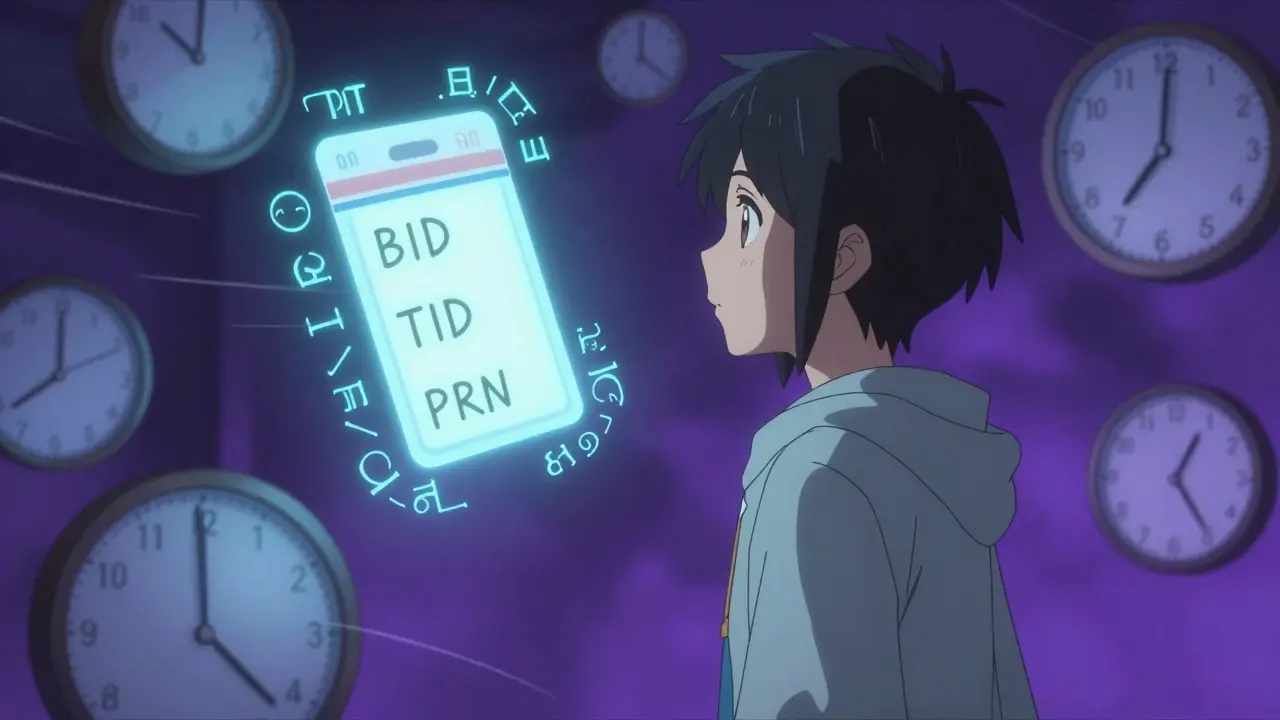
Ever stared at your prescription label like it’s written in another language? You’re not alone. Those little abbreviations-BID, TID, PRN-look like secret codes, but they’re not. They’re Latin shorthand that’s been stuck in medical practice for over a century. And while pharmacies are slowly moving toward plain English, you still see them everywhere. If you don’t know what they mean, you could be taking your meds wrong-and that’s risky.
What BID, TID, and PRN Really Mean
BID stands for bis in die, which means twice a day. That doesn’t mean morning and night, though. It means roughly every 12 hours. So if you take your first dose at 8 a.m., the next should be around 8 p.m. Skipping the evening dose because you’re tired or forgot? That lowers how well the medicine works. A 2021 Johns Hopkins study showed antibiotics taken at uneven intervals lost nearly 30% of their effectiveness.
TID means ter in die-three times a day. Again, not breakfast, lunch, and dinner. It means every 8 hours. So 6 a.m., 2 p.m., and 10 p.m. That timing keeps the drug level steady in your blood. If you stretch it out-say, only taking it in the morning and at bedtime-you’re not getting the full benefit. Mayo Clinic data from 2020 found that when TID doses were spaced more than 2 hours off schedule, drug effectiveness dropped by 38%.
PRN is short for pro re nata, Latin for “as needed.” This one trips up the most people. It doesn’t mean “take whenever you feel like it.” It means take only when you have a specific symptom, and only up to a set limit. For example: “Ibuprofen 400mg PRN for pain, max 3 doses in 24 hours.” That means you can take it up to three times, but not more. Taking four doses because your headache won’t go away? That’s dangerous. PRN medications caused 31% of all dosing errors in 2021, according to the FDA, mostly because patients misunderstood the limits.
Other Common Abbreviations You’ll See
BID, TID, and PRN aren’t the only ones. Here’s what else you might find on your label:
- QD (quaque die) = once daily. Best taken at the same time every day, like 8 a.m.
- QID (quater in die) = four times daily. That’s every 6 hours: 6 a.m., 12 p.m., 6 p.m., 12 a.m.
- AC (ante cibum) = before meals. Take it 30-60 minutes before eating. This matters for drugs like antibiotics or thyroid meds that don’t absorb well with food.
- PC (post cibum) = after meals. Take within 30 minutes. This helps reduce stomach upset for NSAIDs like ibuprofen.
- HS (hora somni) = at bedtime. This is for sleep aids, blood pressure meds that work better overnight, or some diabetes drugs.
- PO (per os) = by mouth. This just means it’s an oral pill or liquid-not a shot or cream.
The U.S. Pharmacopeia lists 47 approved abbreviations. But here’s the problem: not everyone uses them correctly. A 2022 AMA survey found that 22% of doctors still write “BID” without periods, or use lowercase “bid.” Some even mix in old shorthand like “q4h” (every 4 hours). That’s confusing, especially if you’re used to seeing it one way.

Why These Abbreviations Still Exist
You’d think by 2026, we’d have ditched Latin terms. But we haven’t. Why? Tradition. Many doctors learned them in medical school decades ago. Handwritten prescriptions still make up 17% of all U.S. prescriptions, according to the American Pharmacists Association. And in those, space is tight. Latin saves room.
But it’s not just habit. A 2022 survey showed 34% of physicians believe Latin abbreviations are more precise. They think “TID” is clearer than “three times daily.” But the data says otherwise. The Institute for Safe Medication Practices found that 29% of all medication errors tied to misreading frequency instructions involved these abbreviations. One case? A patient took a TID antibiotic only twice a day because they thought “TID” meant “three days.” The infection came back.
Even worse, some abbreviations are outright dangerous. The Joint Commission banned “U” for units in 2006 because it looked like a zero-and led to 10-fold insulin overdoses. They also banned “Q.O.D.” (every other day) because it was mistaken for “Q.D.” (daily). These aren’t theoretical risks. Between 2015 and 2019, over 1,200 medication errors were directly caused by misreading abbreviations.
What’s Changing-and What’s Not
Things are shifting. In the UK, Latin abbreviations were banned in 2015. All prescriptions now say “twice daily,” “three times daily,” “as needed.” That’s why a U.S. tourist in London once took her “BD” (British for twice daily) medication at bedtime, thinking it meant “bedtime.” She ended up in the ER.
In the U.S., big pharmacy chains are catching up. CVS and Walmart now include plain-English instructions on 74% and 78% of labels, respectively. Kaiser Permanente cut prescription clarification calls by 29% after switching to plain language in 2022. The U.S. Pharmacopeia’s new standard, <17>, requires all Latin abbreviations to disappear by the end of 2025. By 2027, experts predict less than 5% of prescriptions will still use them.
But here’s the catch: many independent pharmacies still lag behind. Only 41% give plain-English translations. And doctors? Half of new residents are still trained on Latin terms. So even if your pharmacy switches, your doctor might not.

How to Stay Safe
You can’t control what your doctor writes. But you can control what you do next.
- Ask the pharmacist. Seriously. They’re trained for this. A 2022 Pharmacy Times survey found 89% of patients felt more confident after asking. Don’t feel silly. One TikTok pharmacist, @PharmacistAnna, got 2.4 million views showing how to explain BID and PRN in under a minute.
- Use the teach-back method. When the pharmacist explains your meds, repeat it back in your own words. “So you’re saying I take this pill at 8 a.m. and 8 p.m., even if I feel fine?” That cuts misunderstanding rates from 38% down to 9%, according to FDA trials.
- Use a pill organizer. Buy one with time labels-morning, noon, night, bedtime. Studies show it improves adherence by 52%. Apps like Medisafe (used by 18.7 million people) convert BID to “8 a.m. and 8 p.m.” and send you reminders.
- Do a brown bag review. Once a year, bring all your pills-bottles, boxes, even old ones-to your doctor. They’ll spot mismatches, duplicates, or confusing labels.
- Know the window. You don’t need to be exact to the minute. For TID, 6-10 hours between doses is fine. For BID, 10-14 hours is acceptable. It’s about keeping levels steady, not clock-watching.
What to Do If You’re Still Confused
If the label says “PRN for pain” but your doctor told you to take it every day? Call the pharmacy. If it says “TID” but your schedule doesn’t allow three doses? Ask if it can be changed to “twice daily.” Many meds can be adjusted.
Don’t guess. Don’t assume. Don’t look it up on Google and hope you got it right. A 2023 Kaiser Family Foundation survey found 68% of patients felt unsure about their prescription instructions. You’re not the only one. But you can fix it.
Medication errors aren’t rare. They’re common. And most of them are preventable. You’re not just reading a label-you’re protecting your health. Take the extra two minutes. Ask the question. Write it down. Use an app. Do whatever it takes.
Because your health isn’t a guessing game. It’s a science. And you deserve to understand the instructions.
What does BID mean on a prescription?
BID means twice a day, from the Latin phrase "bis in die." It does not mean morning and night unless your pharmacist or doctor specifies it. For best results, space doses about 12 hours apart-for example, 8 a.m. and 8 p.m. Taking it only at breakfast and dinner may reduce the medicine’s effectiveness.
Is TID the same as three times a day?
Yes, TID means three times a day, from "ter in die." But it’s not just breakfast, lunch, and dinner. It means evenly spaced doses-every 8 hours. For example: 6 a.m., 2 p.m., and 10 p.m. If you take them too close together or too far apart, your blood levels of the drug can drop, making it less effective. A Mayo Clinic study found a 38% drop in efficacy when intervals varied by more than 2 hours.
Can I take PRN medication whenever I want?
No. PRN means "as needed," but it always comes with limits. For example, "ibuprofen 400mg PRN for pain, max 3 doses in 24 hours" means you can take it up to three times, only when you have pain-not every hour. Taking more than the limit can cause serious side effects like stomach bleeding or liver damage. Always check the maximum daily dose on the label.
Why do prescriptions still use Latin abbreviations?
They’re outdated, but still used because many doctors learned them in medical school decades ago and continue using them out of habit. Handwritten prescriptions also save space. But safety groups like The Joint Commission and the FDA have pushed to eliminate them since 2006. By 2025, U.S. standards will require all prescriptions to use plain English. Big pharmacy chains like CVS and Walmart are already ahead-many now include both abbreviations and plain-language instructions.
What should I do if I don’t understand my prescription?
Ask your pharmacist. They’re required to explain your medication. If they don’t offer, ask directly: "Can you explain what BID or PRN means on this label?" You can also request a written plain-language version. If you’re still unsure, call your doctor’s office. Never guess-taking medication wrong can be dangerous. You’re not bothering them. They expect these questions.
15 Comments
January 14, 2026 Crystel Ann
Finally, someone explains this in a way that doesn’t make me feel like I’m back in med school. I used to take my antibiotics at breakfast and dinner, thinking that was ‘twice a day’-turns out I was sabotaging my own recovery. This post saved me from a relapse.
January 16, 2026 Nat Young
Let’s be real-this whole ‘plain English’ movement is just bureaucratic overreach. Latin abbreviations have been used for centuries because they’re precise, compact, and carry historical weight. If you can’t decode ‘TID,’ maybe you shouldn’t be managing your own meds. The real problem isn’t the language-it’s the patient’s willingness to learn.
January 17, 2026 Niki Van den Bossche
Ah, the tragic poetry of Latin in modern pharmacology-a relic of Enlightenment rationality, now weaponized by institutional inertia. We’ve reduced the sacred act of healing to a bureaucratic cipher, where ‘PRN’ becomes not a physician’s discretion, but a consumer’s guilt trip. The body doesn’t speak in bullet points; it speaks in rhythms. And yet, we force it into a spreadsheet. How profoundly alienating.
January 19, 2026 Frank Geurts
It is imperative to underscore the significance of standardized nomenclature in clinical practice. The persistence of Latin abbreviations, while historically entrenched, constitutes a measurable threat to patient safety. The U.S. Pharmacopeia’s forthcoming mandate, effective 2025, represents not merely an administrative adjustment, but a moral imperative in the evolution of healthcare communication.
January 20, 2026 Ayush Pareek
This is so helpful. I’ve been taking my blood pressure meds ‘when I remember’-now I know I need to space them out. I’m going to set phone alarms. Thank you for making this clear without making me feel dumb.
January 21, 2026 Nilesh Khedekar
Oh, so now we’re blaming doctors for not switching to ‘plain English’? Funny-when I was in India, our pharmacists used to write ‘2x/day’ in Hindi script. No Latin, no confusion. But here? We’re still clinging to dead languages while people die from misreading ‘U’ for units. Wake up, America.
January 22, 2026 Amy Ehinger
I used to think ‘QID’ meant ‘quicker is better’-like, if I took my pills faster, they’d work faster. Spoiler: it didn’t. I ended up in the ER with a stomachache and a very confused pharmacist. Now I use Medisafe. It tells me when to take stuff, even translates ‘HS’ to ‘bedtime’ in bold letters. Best $0 I ever spent.
Also, I keep all my pills in a little plastic organizer with AM/PM/PM/HS labeled. It looks like a tiny science lab, but I haven’t missed a dose in six months. You’re welcome, future me.
January 23, 2026 RUTH DE OLIVEIRA ALVES
The assertion that Latin abbreviations are inherently dangerous is not empirically supported in all contexts. While the Joint Commission has issued guidelines, these are recommendations, not universal mandates. Moreover, the efficacy of plain-language instructions has not been conclusively demonstrated in longitudinal studies across diverse literacy populations. One must consider cultural and educational heterogeneity before enforcing linguistic standardization.
January 23, 2026 Iona Jane
They’re hiding something. Why do you think they still use Latin? It’s not tradition-it’s control. If you can’t read your own prescription, you can’t question it. The pharmaceutical industry loves confusion. It keeps you dependent. PRN? That’s not ‘as needed.’ That’s ‘as long as you don’t ask questions.’
January 24, 2026 Jaspreet Kaur Chana
Bro, I’m from Delhi and we use ‘twice daily’ in our scripts-but my cousin in Texas got a script with ‘BID’ and thought it meant ‘before insulin dose.’ He took it before his coffee. Nearly passed out. This post? Lifesaver. I’m forwarding it to everyone I know. Even my uncle who still uses paper prescriptions. He’s 72. He gets it now.
January 26, 2026 Haley Graves
If you’re still using ‘TID’ on your prescriptions in 2026, you’re not just outdated-you’re negligent. Patients aren’t medical students. We don’t have time to Google Latin. If your handwriting can’t be read, type it. If your knowledge can’t be understood, update it. Your laziness isn’t my risk.
January 26, 2026 Diane Hendriks
Let’s not pretend this is about patient safety. It’s about erasing history. Latin was the language of science for 1,500 years. Now we’re scrubbing it because millennials can’t read a dictionary? Next they’ll ban Greek letters in math. We’re becoming a nation of people who demand everything be spoon-fed, even if it means dumbing down centuries of medical wisdom.
January 28, 2026 ellen adamina
I always thought ‘PRN’ meant ‘if you feel like it’ until I read this. Now I check the max dose every time. I used to take extra ibuprofen because ‘it couldn’t hurt.’ Turns out it could. And did. Stomach bleed. Now I don’t guess. I read. And I ask. Small things matter.
January 29, 2026 Jami Reynolds
It’s not just Latin abbreviations-it’s the entire pharmaceutical-industrial complex. The FDA approves these terms knowing they’re ambiguous because ambiguity creates liability loopholes. If you misread ‘BID’ and overdose, it’s your fault. Not theirs. The system is designed to protect corporations, not patients. This ‘plain language’ initiative? A PR stunt. They’ll still bury the real dangers in footnotes.
January 30, 2026 Gloria Montero Puertas
Of course you’re confused. You’re using a pharmacy that outsources its labeling to a third-world call center. If your label says ‘TID’ without a plain-English translation, you’re not getting care-you’re getting a discount. Go to a premium pharmacy. Pay the extra $3. Your life is worth it.
Write a comment